

Between nostalgia and amnesia: the legacy of Julia Gillard as PM, 10 years after her ousting
- Written by: Joshua Black, PhD Candidate, School of History, National Centre of Biography, Australian National University
On June 26 2013, as she fronted the press gallery in Canberra after her removal as leader of the Labor Party, Julia Gillard was determined not to cry. In her prime ministerial resignation speech, she asked not for pity, but rather for a meaningful national conversation about gender and politics, specifically the politics of her demise.
It doesn’t explain everything; it doesn’t explain nothing. It explains some things. And it is for the nation to think in a sophisticated way about those shades of grey.
Ten years after the fact, that conversation is ongoing. At times, it has been a progressive and sophisticated one. The events of recent weeks, including the puerile debate about Katy Gallagher’s prior knowledge of Brittany Higgins’ sexual assault allegations, and the allegations against Senator David Van, remind us there is still a long way to go.
However, it is worth pausing to reflect on what has happened to Gillard’s reputation over the decade. Why has it thrived? Is it all about gender? And if we have forgotten key aspects of the Gillard years, what does that partial amnesia say about us?
From ‘Juliar’ to feminist icon
For much of her premiership, Gillard was singularly unpopular among Australian voters. Her efforts to put a price on carbon (damned by critics as a broken promise not to introduce a carbon tax) proved electorally damaging, as did her failure to end the deadlock over asylum-seeker policy. Controversies surrounding Labor MP Craig Thompson and Speaker Peter Slipper (selected for the role by Gillard) further undermined her standing.
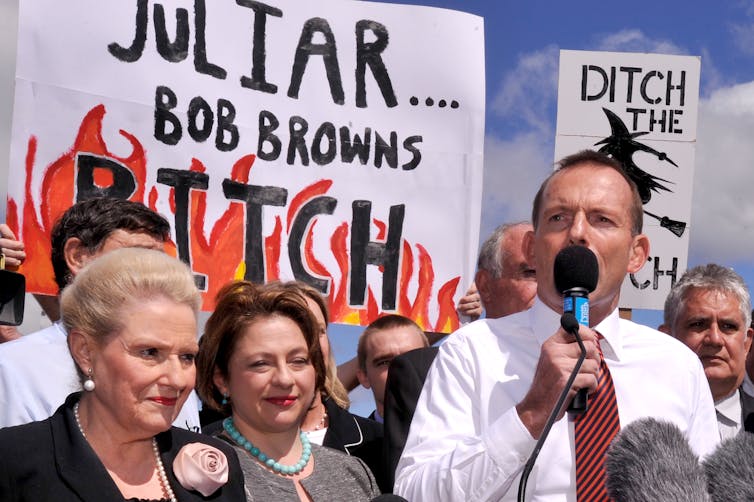
There was much sexism at play. Her critics incessantly argued this was a woman not to be trusted. Critics of carbon pricing infamously dubbed her “Juliar” on their angry placards. Her body was objectified in the public domain, and the shock jocks of commercial radio questioned the sexuality of her then partner.
One commentator, the irascible Alan Jones, even suggested the prime minister ought to be “put in a chaff bag” and drowned at sea. The shocking thing is not that these things were said, but rather that they were accepted as legitimate contributions to public debate by the community at large.
Stories about Gillard’s alleged corruption as a lawyer in Perth in the early 1990s also proved a distraction from the government’s agenda. Not until 2014 – in the witness box of a royal commission, no less – was Gillard finally able to clear her name.
The misogyny speech
The passage of time can make things seem as if they always were as they are now. But Gillard’s renowned misogyny speech was not an instant sensation in Australia. The context – a censure motion on the disgraced speaker Peter Slipper – was unpropitious, and when Gillard made her speech, the conservative press called her a hypocrite who now played the “gender card” for political expediency.
The speech’s global impact was immediate, but only after Gillard’s removal from power did it capture the hearts and minds of some Australians. New developments – the sexist attacks on US presidential candidate Hillary Clinton in 2016, the #MeToo movement beginning in 2017, and latterly the backlash against gendered discrimination and abuse in parliament house – gave it further acuity in the following years.
A decade after its muted reception in Canberra, the speech is circulated on TikTok, featured in stage productions, and in 2020 it was even voted Australia’s most “unforgettable” television moment.
Though not always enamoured with the way it dominated her political legacy, Gillard ultimately leaned in to it, as the saying goes. She started a podcast called A Podcast of One’s Own (a clear nod to Virginia Woolf), published two books about women and leadership, and established the Global Institute for Women’s Leadership at King’s College London, and latterly the Australian National University.
Star status
As prime minister, Gillard was regularly criticised for her “wooden” media appearances and her cautious approach to public engagement. It is ironic, then, that her transformation from untrustworthy politician to venerable feminist advocate depended on the media and celebrity industries.
It began with a series of ticketed public talks in venues such as the Sydney Opera House with longstanding feminist advocate, author and historian Anne Summers. Gillard’s memoir, My Story, and a high-profile book tour followed in 2014.
In her advocacy work as chair of the Global Partnership for Education she also rubbed shoulders with celebrities such as Rihanna.
The policy legacy
Several of the Rudd-Gillard government’s policy initiatives were unravelled by their successors. The $23-per-tonne carbon price was repealed by Tony Abbott’s government, as was the (clearly deficient) Minerals Resource Rent Tax. The National Broadband Network, the rollout of which began under Gillard, was dramatically reimagined by Malcolm Turnbull as communications minister and then as prime minister.
Some of the less-savoury aspects of Gillard policy legacy have been forgotten for more convenient reasons. Gillard herself has not often discussed her government’s revival of mandatory offshore processing for asylum seekers in Australia. The cutting of the single parents’ benefit, on the very same day as Gillard’s misogyny speech, has earned perhaps not enough discussion. It is her failure to support same-sex marriage as prime minister that now draws the most condemnation from pundits.
But policy legacies have also played a huge part in the revival of Gillard’s public standing. The Royal Commission into Child Sexual Abuse in Institutional Settings was a hugely important initiative. It earned Gillard significant credit across the political spectrum when its findings proved so damning.
The NDIS, largely overlooked in media coverage in favour of “carbon tax” and “deficit”, has become a sacred element in Australian social and welfare policy. The subsequent policy debate has not hinged on the design of the scheme, but rather how best to fund it.
Read more: How Julia Gillard forever changed Australian politics - especially for women
Between nostalgia and amnesia
There is a dissonance in the way Australians talk about Gillard today. Her magnanimity is respected, her embrace of a life after politics admired. Above all else, Gillard’s status as Australia’s first woman prime minister and now a global women’s ambassador prevails. As a rule, she does not parade her views on contemporary politics before the public, except at a conceptual level. (Her memoir was perhaps the exception.)
But when commentators refer to the decade of egos, ambitions and failed leaders, they are increasingly likely to elide her name entirely. It is a disservice to the historical record, and to Gillard herself. She was a fierce combatant in parliament, and endured a period of intense conflict within the Labor Party. Her victory over Kevin Rudd in February 2012 – one of their many spills and shadow contests – was larger than any ballot that Rudd, Abbott or Turnbull ever contested.
People have been quick to wipe their hands clean of yesterday’s sexism in order to make Gillard yesterday’s heroine. But they ought to be careful that, in the process, they do not erase her from other political histories.
To segregate her story as one of women’s leadership while neglecting it in wider histories of Australian politics and policy would, in its own way, be an act of sexism.
Read more: Who were Australia's best prime ministers? We asked the experts
Authors: Joshua Black, PhD Candidate, School of History, National Centre of Biography, Australian National University


 Daily Bulletin


