

The FDA finally approved Elon Musk's Neuralink chip for human trials. Have all the concerns been addressed?
- Written by: David Tuffley, Senior Lecturer in Applied Ethics & CyberSecurity, Griffith University
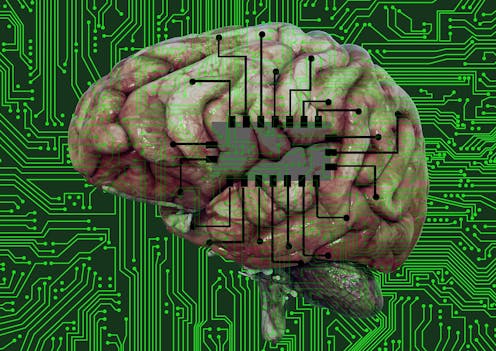
Since its founding in 2016, Elon Musk’s neurotechnology company Neuralink has had the ambitious mission to build a next-generation brain implant with at least 100 times more brain connections than devices currently approved by the US Food and Drug Administration (FDA).
The company has now reached a significant milestone, having received FDA approval to begin human trials. So what were the issues keeping the technology in the pre-clinical trial phase for as long as it was? And have these concerns been addressed?
What is Neuralink?
Neuralink is making a Class III medical device known as a brain-computer interface (BCI). The device connects the brain to an external computer via a Bluetooth signal, enabling continuous communication back and forth.
The device itself is a coin-sized unit called a Link. It’s implanted within a small disk-shaped cutout in the skull using a precision surgical robot. The robot splices a thousand tiny threads from the Link to certain neurons in the brain. Each thread is about a quarter the diameter of a human hair.
Potential benefits
If Neuralink’s BCI can be made to work safely on humans, I believe the potential benefits would make the effort worthwhile.
The company says the device could enable precise control of prosthetic limbs, giving amputees natural motor skills. It could revolutionise treatment for conditions such as Parkinson’s disease, epilepsy and spinal cord injuries. It also shows some promise for potential treatment of obesity, autism, depression, schizophrenia and tinnitus.
Several other neurotechnology companies and researchers have already developed BCI technologies that have helped people with limited mobility regain movement and complete daily tasks.
BCIs have also been used to help older people train their motor and cognitive abilities to moderate the worst effects of ageing.
The long road to FDA approval for human trials
In February 2021, Musk said Neuralink was working with the FDA to secure permission to start initial human trials later that year. But human trials didn’t commence in 2021.
Then, in March 2022, Neuralink made a further application to the FDA to establish its readiness to begin humans trials.
One year and three months later, on May 25 2023, Neuralink finally received FDA approval for its first human clinical trial. Given how hard Neuralink has pushed for permission to begin, we can assume it will begin very soon.
The approval has come less than six months after the US Office of the Inspector General launched an investigation into Neuralink over potential animal welfare violations.
What were the FDA’s concerns?
The FDA had quite a list of issues that needed to be resolved before human trials could commence, as was reported in a Reuters investigation, which claimed to have spoken to several Neuralink sources.
Most of these concerns called for Neuralink to perform thorough and repeated testing and data collection over an extended period. This was likely a deciding factor in why the approval process to begin human testing took as long as it did.
It can’t be said with certainty that all of the issues have been fully resolved. But considering the rigour of the FDA’s approval process, we might conclude they have at least been resolved to a point of satisfaction for the FDA.
A precision robot known as Implant/r1 performs the surgical procedure to implant the Neuralink BCI. This robot surgeon had to be put through its paces to gather evidence that it could reliably and safely implant and remove the Neuralink BCI without damaging surrounding brain tissue, or creating the risk of infection, bleeding, inflammation or scarring.
Once implanted, the Neuralink BCI must function as intended. It must not unintentionally influence other brain functions, or cause any unwanted side effects such as seizures, headaches, mood changes, or cognitive impairment.
In particular, overheating lithium-ion batteries can pose great risk to BCI users. When defective, such batteries have historically been known to overheat. They can even explode if the insulation between the cathode and anode (the metal electrode components) breaks down, resulting in a short circuit.
The longevity of the battery was also taken into account, as well as how easy it would be to safely replace from its position under the skin behind the ear. Since the FDA’s previous rejection, extensive tests have been conducted on the specially designed Neuralink battery to evaluate its performance, durability and bio-compatibility.
Then there is the risk of wire migration. The Link consists of a disk-shaped chip with very thin wire electrodes that connect to neurons in the brain.
Connecting these wires by means of a surgical robot is a major challenge in itself. But there is also the possibility the electrodes could move elsewhere in the brain over time due to natural movement, inflammation, or scar tissue formation. This would likely affect the proper functioning of the device, and could cause infection or damage to the brain tissue.
Neuralink had to conduct extensive animal studies and provide evidence its wires did not migrate significantly over time, or cause any adverse effects on the brain. The company also had to show it had a method for tracking and adjusting the position of the wires if this became necessary.
Another challenge Neuralink faced was that of safe implant removal. The FDA wanted to know how easy or difficult it would be to remove the device from the brain if this became necessary.
Strong safeguards are required to prevent data collected by the Link from being hacked, manipulated or otherwise misused. Neuralink would have had to assure the FDA it could avoid nightmare scenarios of hackers rendering its Link users vulnerable to interference, as well as guaranteeing the privacy of brain-wave data generated by the device.
The way ahead
Critics acknowledge the potential benefits of Neuralink, but caution the company to hasten slowly. Adequately addressing these issues will take time – and corners must not be cut when arriving at a solution.
Beyond the Link’s potential medical uses, Musk has made many radical claims regarding his future vision for the technology. He has claimed Neuralink could augment human intelligence by creating an on-demand connection with artificial intelligence systems – allowing, for example, improved cognition through enhanced memory, and improved learning and problem-solving skills.
He has even gone as far as to say the Link could allow high-bandwidth telepathic communication between two or more people connected via a mediating computer. Common sense would suggest these claims be put in the “I’ll believe it when I see it” category.
The situation with Neuralink has clear parallels with current advancements in AI (and the growing need to regulate it). As exciting as these technologies are, they must not be released to the public until proven to be safe. This can only be achieved by exhaustive testing.
Read more: Futurists predict a point where humans and machines become one. But will we see it coming?
Authors: David Tuffley, Senior Lecturer in Applied Ethics & CyberSecurity, Griffith University


 Daily Bulletin


