

Beware red flags and fakes: how to buy authentic First Nations designs that benefit creators and communities
- Written by: Nicola St John, Lecturer, Communication Design, RMIT University
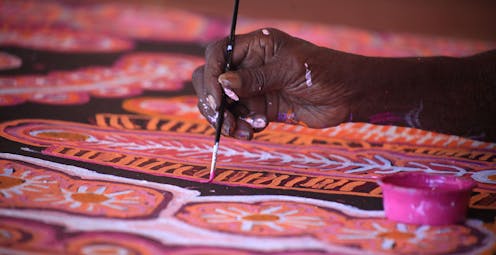
From souvenir shops to art galleries, First Nations designs are big business. Australia’s Productivity Commission estimates about $250 million of Indigenous-style art and consumer products are sold annually. But just 16% of that ends up in the hands of Aboriginal and Torres Strait Islander artists.
When it comes Indigenous-style souvenirs, the commission says about 75% aren’t authentic. The art market is a little better, but fakes are prevalent enough for one to have appeared in comedian Ricky Gervais’ sit-com Afterlife.
To support First Nations artists and communities, here’s what you need to know, and need to ask, before buying.
Home is where the art is
Aboriginal and Torres Strait Islander art is more than aesthetically pleasing shapes and colours. It is a cultural expression, a means of passing information from one generation to the next, of telling stories.
These stories may be about sacred knowledge and dreamings specific to an individual, a family or a community – stories not culturally permissible for others to tell. Those stories share commonalities but also differ according to place – plants, animals, customs and laws.
Each of Australia’s more than 200 Indigenous nation groups – comprised of clans that share a common language and kinship systems – will use designs, colours and materials related to place.
Dot painting, for example, is specific to the desert interior of Western Australia, Northern Territory and South Australia.
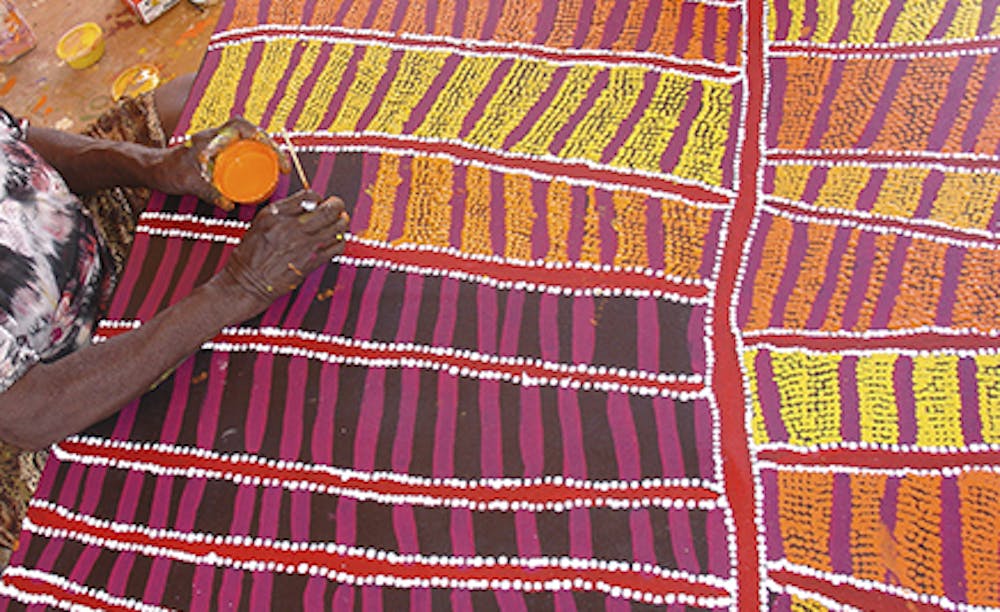
Cross-hatching and “x-ray” paintings come from Arnhem Land in north-east Northern Territory.
 Arnhem Land artist Glen Namundja at work in 2014.
Mark Roy/Wikimedia Commons, CC BY
Arnhem Land artist Glen Namundja at work in 2014.
Mark Roy/Wikimedia Commons, CC BY
Depictions of “Wandjina” spirits come from the Kimberley coast in northern Western Australia. The Wandjina are the most powerful creation spirits, symbolising rain. They are often depicted with bodies of dots, representing rainfall.
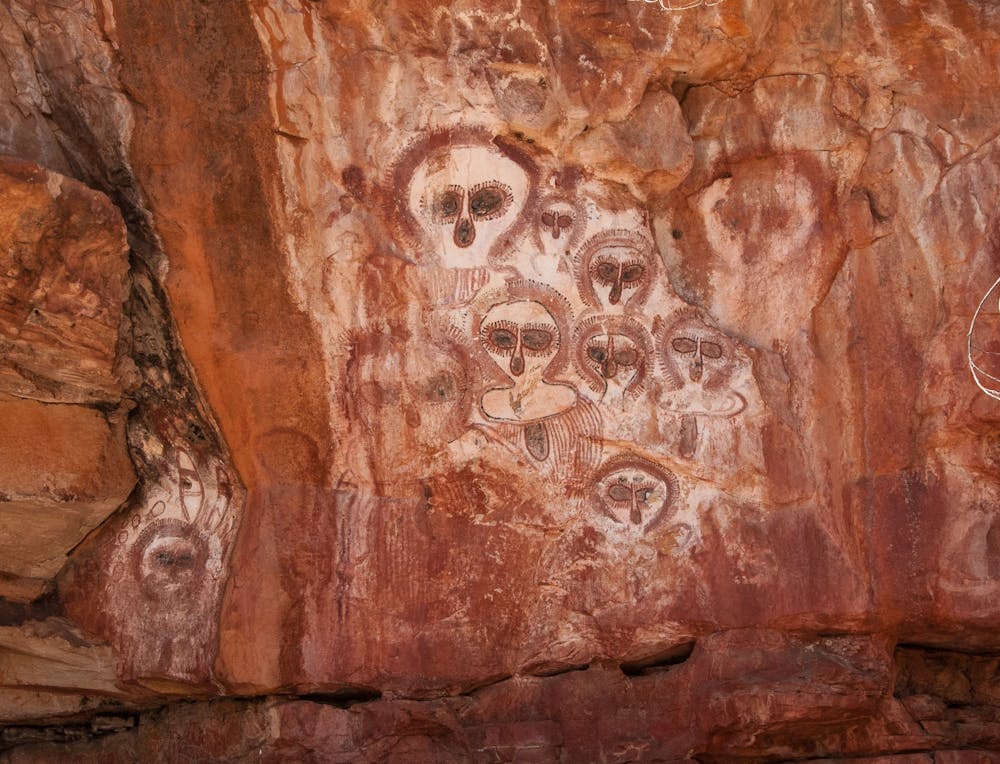 Wandjina rock art near the Barnett River, in the Kimberley, north Western Australia.
Graeme Churchard/Wikimedia Commons, CC BY
Wandjina rock art near the Barnett River, in the Kimberley, north Western Australia.
Graeme Churchard/Wikimedia Commons, CC BY
Ochre pigments, derived from soil, are used across the east Kimberley, Arnhem Land and central Northern Territory.
 Art for sale at the Warmun Art Centre in the east Kimberley.
Bo Wong/West Australian Museum, CC BY
Art for sale at the Warmun Art Centre in the east Kimberley.
Bo Wong/West Australian Museum, CC BY
Any authentic piece of Indigenous art tells a story. Before you buy, get to know that story.
What’s the story?
There’s one simple rule when buying First Nations art or crafts: the more information the better.
Artists have two main ways to sell their art. For original art, it’s through a gallery, which takes a hefty commission. If it’s a design on a product, licensing is more common: the artist gives permission for the reproduction of their work in exchange for a one-off payment or an ongoing commission, usually linked to sales.
In either case, a legitimate gallery or licensee has a vested interest in assuring you of the authenticity of what they are selling, and that the artist is benefiting from your purchase.
They should be able to provide you with:
- the artist’s name and biography, including their language or nations group
- evidence of the work’s authenticity, such as photographs of the artist at work
- how they pay the artist, and how much
- evidence of commitment to efforts to improve the industry, such as the Indigenous Art Code.
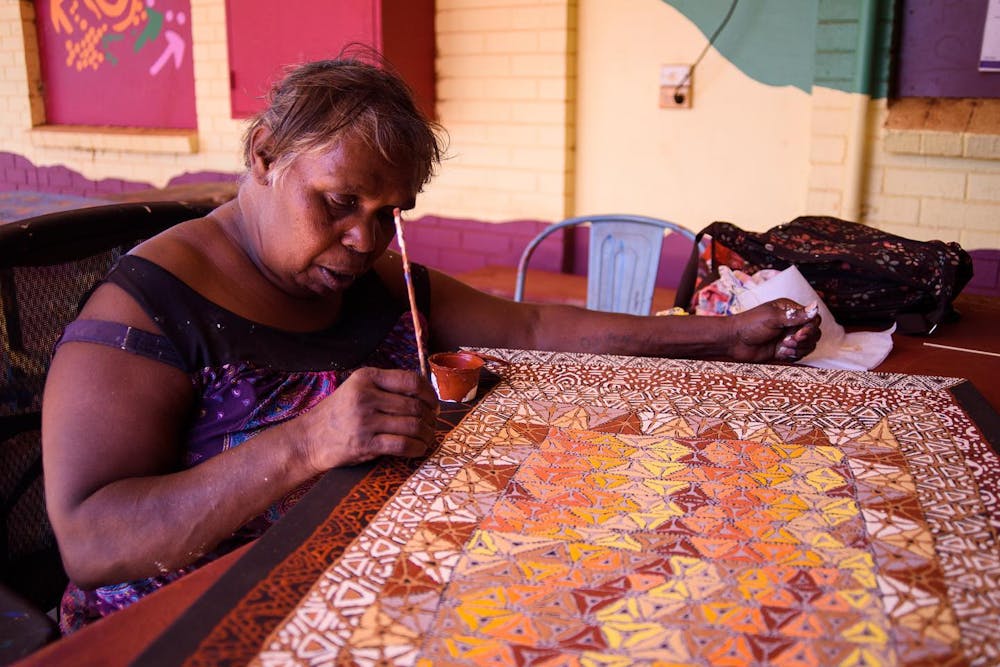 Hilda Nakamarra Rogers, a member of the Warlukurlangu Artists Aboriginal Corporation.
Warlukurlangu Artists, CC BY-NC-ND
Hilda Nakamarra Rogers, a member of the Warlukurlangu Artists Aboriginal Corporation.
Warlukurlangu Artists, CC BY-NC-ND
If there’s no information on who created an artwork and where they’re from, it is most likely fake.
In short: buy from sellers with transparent policies. On their website and in person they should provide clear information on all off the above. Reluctance to share this information is a red flag.
Look for community connections
Galleries and other intermediaries may be Indigenous or non-Indigenous-owned. They may be private for-profit businesses or community-owned.
Private businesses can be highly ethical and reinvest in their community, but there is greater assurance of this happening with collectively owned businesses established specifically for the benefit of local artists, to employ local people and fund community projects.
An example is the Warlukurlangu Artists Aboriginal Corporation, a not-for-profit company owned by artists from the Yuendumu community in the Northern Territory, about 300 kilometres northwest of Alice Springs. Founded in 1985, the company uses its surpluses to fund community projects such as a health program and a dog program, which cares for the local dog population.
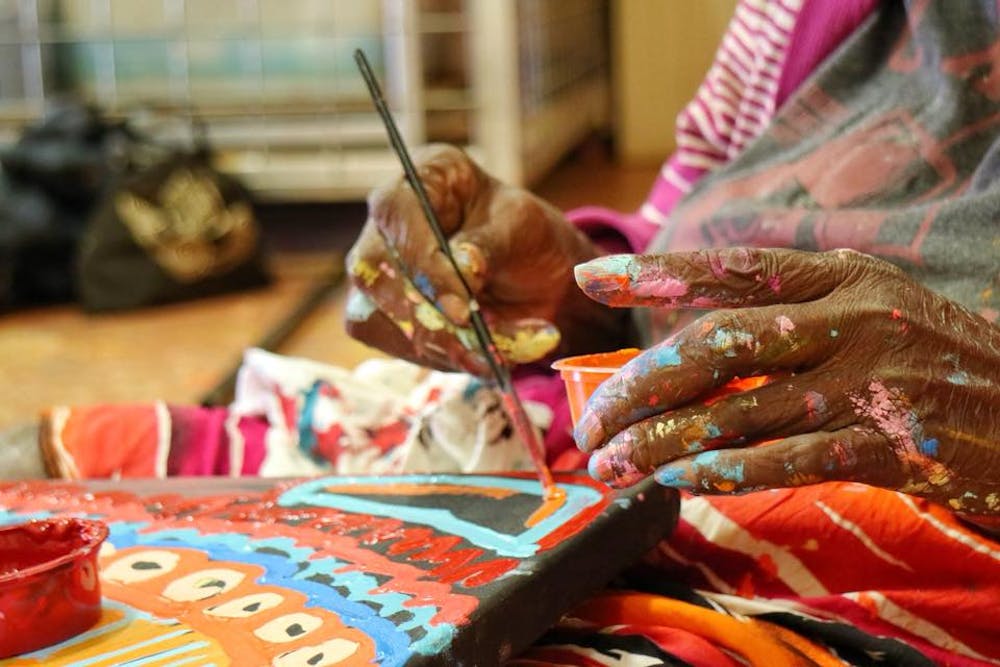 At work at the Warlukurlangu Artists art centre.
Warlukurlangu Artists, Author provided
At work at the Warlukurlangu Artists art centre.
Warlukurlangu Artists, Author provided
There are more than 100 such independently governed First Nations art and craft centres in Australia, including umbrella organisations in the following areas:
Art centres sell online. They may have arrangements to sell artwork through commercial galleries nearer population hotspots. They may also license art for use on homeware and souvenirs.
In the wider market for First Nations designs and products, look for evidence of Indigenous ownership, commitment to compensate artists, and other evidence of community engagement. Most First Nations-run businesses are proud to acknowledge their heritage.
There is a federal scheme, called Supply Nation database, that verify Aboriginal and Torres Strait Islander businesses. But because this is focused on government and commercial procurement, it has few listings for arts, craft, and design business.
So use your best judgement. Ask the right questions, expect full answers.
What about product certification?
What about certifying products? This is done for Australian Made goods. Why not for First Nations-made products?
The problem, according to the Productivity Commission, is that certification schemes need high producer take-up and high consumer recognition to succeed. That would require resources the artists don’t have.
The commission has recommended an alternative approach, mandatory labelling of inauthentic products, through amending the Australian Consumer Law.
It has also recommended new “cultural rights” legislation, giving traditional owners control over cultural assets such as stories, symbols and motifs, with power to take legal action when the infringement of their rights.
So far, however, the federal government has given no indication of if and when it will act on these recommendations.
Until it does, and there are more legal protections and clear labelling – of fake or authentic good – take the time to ask the right questions and get the right answers.
Authors: Nicola St John, Lecturer, Communication Design, RMIT University


 Daily Bulletin


