

Doctors may soon get official 'endorsements' to practise cosmetic surgery – but will that protect patients?
- Written by: Christopher Rudge, Law lecturer, University of Sydney
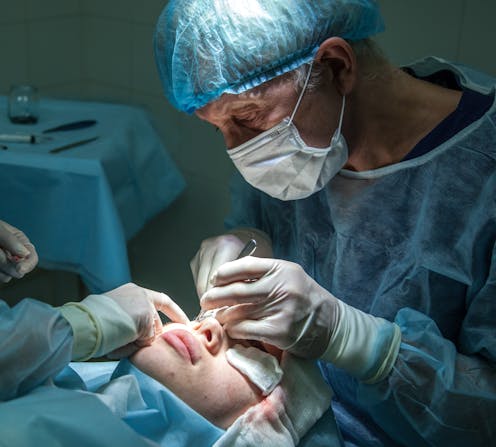
Disturbing reports about botched cosmetic surgeries and injuries in Australia – from breast augmentations causing chronic pain to liposuction leaving patients with lifelong injuries – have sparked concerns in recent years. Several high-profile cosmetic surgeons alleged to have fallen short of expected professional standards have been disciplined.
Last year, a class action was commenced against one clinic in the Victorian Supreme Court.
People who are interested in exploring whether cosmetic surgery is appropriate for them are right to feel wary and confused. Now, the introduction of a scheme to officially endorse doctors who practise in the area of cosmetic surgery promises to allay patients’ doubts. But the idea remains contentious for those in the field.
Read more: Thinking about cosmetic surgery? At last, some clarity on who can call themselves a surgeon
The story so far
In the wake of cosmetic surgery controversies, two significant but separate responses have been adopted by medical regulators. First, the country’s health ministers began a consultation to decide whether to stop doctors promoting themselves as “surgeons”.
The consultation acknowledged a gap or “loophole” that allows any registered medical practitioner to call themselves a surgeon in Australia, even with no specialist training beyond their medical degree.
The second response was initiated in December 2021, by AHPRA, which accredits and registers doctors, and the Medical Board of Australia, which regulates the practices of registered medical practitioners. Together, they commissioned an independent review into the regulation of medical practitioners who perform cosmetic surgery in Australia.
Although informed by each other, these separate initiatives wrought distinct solutions. While one has been embraced, the other remains controversial.
Ministerial reforms
After nearly two years of consultation, the health ministers decided last December to restrict the use of the title “surgeon”. Soon, only medical practitioners holding a specialist registration, such as ophthalmology, will be permitted to use the title.
In a meeting late last month, health ministers approved a draft bill to give effect to this decision. While the draft remains unpublished, no stakeholders in the health sector appear to have criticised the change.
But the health ministers approved another, more controversial, reform as well. They welcomed a new model of accrediting cosmetic surgery practitioners known as an “endorsement of registration”. This proposal came from the AHPRA and Medical Board review.
AHPRA and the Medical Board’s ‘endorsement model’
Among its 16 recommendations (all of them accepted by AHPRA and the Medical Board), the independent review’s first and most significant reform proposal was to establish an “area of practice endorsement” for cosmetic surgery.
The technical language of “endorsement” comes from consistent national laws enacted, with minor variations, in each state and territory.
In a nutshell, “area of practice endorsement” would introduce new minimum standards for the education, training and qualification of Australian medical practitioners seeking to practise as cosmetic surgeons.
Currently, the Medical Board uses codes of conduct and guidelines to regulate most doctors’ practices.
But these “soft law” instruments permit doctors to decide for themselves whether they are competent enough to perform procedures like brow lifts or tummy tucks.
The new endorsement model would require doctors to apply to the Medical Board to qualify to practice in the area of cosmetic surgery. To be approved, the doctor-applicant would need to furnish evidence of their qualifications. Such an endorsement arrangement already exists for acupuncture.
Together with restricting the title “surgeon” and some other reforms (such as improved information campaigns), it is now hoped the endorsement model would manage risky cosmetic surgeries by requiring practitioners to be endorsed by the Medical Board. But not everyone thinks it’s the way to go.
Read more: Who's the best doctor for a tummy tuck or eyelid surgery? The latest review doesn't actually say
What’s the problem with endorsement?
Fresh forms of old tensions have arisen, based on how endorsement will be designed. At the core of these tensions is a debate about how the Australian Medical Council, which is responsible for setting the accreditation, training and education standards for the medical profession, will determine the curriculum and assessment regimes for cosmetic surgery study programs.
What was once a debate about an unregulated area of practice is now about what kind of training cosmetic surgeons should have before wielding their instruments.
Some experts suggest defining cosmetic surgery could help regulation and safety discussions. Meanwhile, the Royal Australasian College of Surgeons says it will oppose any study program of a lesser standard than that required of specialist surgeons.
Although the Australian Medical Council has not yet published its education standards for cosmetic surgery, it has proposed six draft qualification standards and is consulting with the profession.
What this could mean for patient safety
On the one hand, the proposed changes are a continuation of a long-running turf war. On one side are the surgeons with special accreditation, approved by the Royal Australasian College of Surgeons and typically engaged in reconstructive plastic surgeries. On the other, stand the so-called “non-surgeons” or “wannabees”.
The debate is also about protecting patients and legislative reform.
It is too early to determine whether the Australian Medical Council’s endorsement standards will improve patient safety. But the slow process of reforming the cosmetic surgery “industry” – in the face of explosive increases in demand, fuelled in part by seductive social media claims – illustrates how complex medical regulation is in Australia. With so many regulatory actors involved in our polycentric system, feuds over governance are unsurprising.
Today, the cosmetic surgery industry is estimated to be worth more than one billion dollars a year. It is crucial regulators ensure the public is protected from unscrupulous – or unqualified – operators.
Authors: Christopher Rudge, Law lecturer, University of Sydney


 Daily Bulletin


