

Read The Times Australia

Daily Bulletin

'I can only do so much': we asked fast-fashion shoppers how ethical concerns shape their choices

  • Written by: Tara Stringer, PhD Candidate, Queensland University of Technology
'I can only do so much': we asked fast-fashion shoppers how ethical concerns shape their choices

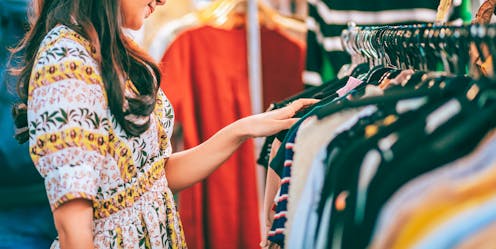
You’ve found the perfect dress. You’ve tried it on before and you know it looks great. Now it’s on sale, a discount so large the store is practically giving it away. Should you buy it?

For some of us it’s a no-brainer. For others it’s an ethical dilemma whenever we shop for clothes. What matters more? How the item was made or how much it costs? Is the most important information on the label or the price tag?

Of the world’s industries that profit from worker exploitation, the fashion industry is notorious, in part because of the sharp contrast between how fashion is made and how it is marketed.

There are more people working in exploitative conditions than ever before. Globally, the garment industry employs millions of people, with 65 million garment sector workers in Asia alone. The Clean Clothes Campaign estimates less than 1% of what you pay for a typical garment goes to the workers who made it.

Clean Clothes Campaign/The Conversation, CC BY-ND Some work in conditions so exploitative they meet the definition of being modern slaves – trapped in situations they can’t leave due to coercion and threats. But their plight is hidden by the distance between the worker and the buyer. Global supply chains have helped such exploitation to hide and thrive. Do we really care, and what can we do? We conducted in-depth interviews with 21 women who buy “fast fashion” – “on-trend” clothing made and sold at very low cost – to find out how much they think about the conditions of the workers who make their clothes, and and what effort they take to avoid slave-free clothing. Well-known fast-fashion brands include H&M, Zara and Uniqlo. Read more: Four Corners’ forced labour exposé shows why you might be wearing slave-made clothes What they told us highlights the inadequacy of seeking to eradicate exploitation in the fashion industry by relying on consumers to do the heavy lifting. Struggling to seek reliable information on ethical practices, consumers are overwhelmed when trying to navigate ethical consumerism. Out of sight, out of mind The 21 participants in our research were women aged 18 to 55, from diverse backgrounds across Australia. We selected participants who were aware of exploitation in the fashion industry but had still bought fast fashion in the previous six months. This was not a survey but qualitative research involving in-depth interviews to understand the disconnect between awareness and action. Our key finding is that clothing consumers’ physical and cultural distance from those who make the clothes makes it difficult to relate to their experience. Even if we’ve seen images of sweatshops, it’s still hard to comprehend what the working conditions are truly like. Garment workers sew clothes at a factory in Huaibei, Anhui province, China.
Garment workers sew clothes at a factory in Huaibei, Anhui province, China. Xie Zhengyi/AP

As Fiona*, a woman in her late 30s, put it: “I don’t think people care [but] it’s not in a nasty way. It’s like an out of sight, out of mind situation.”

This problem of geographic and cultural distance between garment workers and fashion shoppers highlights the paucity of solutions premised on driving change in the industry through consumer activism.

Who is responsible?

Australia’s Modern Slavery Act, for example, tackles the problem only by requiring large companies to report to a public register on their efforts to identify risks of modern slavery in their supply chains and what they are doing to eliminate these risks.

While greater transparency is certainly a big step forward for the industry, the legislation still presumes that the threat of reputational damage is enough to get industry players to change their ways.

The success of the legislation falls largely on the ability of activist organisations to sift through and publicise the performance of companies in an effort to encourage consumers to hold companies accountable.

Read more: Modern Slavery Bill a step in the right direction – now businesses must comply

All our interviewees told us they felt unfairly burdened with the responsibility to seek information on working conditions and ethical practices to hold retailers to account or to feel empowered to make the “correct” ethical choice.

“It’s too hard sometimes to actually track down the line of whether something’s made ethically,” said Zoe*, a woman in her early 20s.

Given that many retailers are themselves ignorant about their own supply chains, it is asking a lot to expect the average consumer to unravel the truth and make ethical shopping choices.

Confusion + overwhelm = inaction

“We have to shop according to what we care about, what is in line with our values, family values, budget,” said Sarah*, who is in her early 40s.

She said she copes with feeling overwhelmed by ignoring some issues and focus on the ethical actions she knew would make a difference. “I’m doing so many other good things,” she said. “We can’t be perfect, and I can only do so much.”

Other participants also talked about juggling considerations about environmental and social impacts.

“It’s made in Bangladesh, but it’s 100% cotton, so, I don’t know, is it ethical?” is how Lauren*, a woman in her early 20s, put it. “It depends on what qualifies as ethical […] and what is just marketing.”

Comparatively, participants felt their actions to mitigate environmental harm made a tangible difference. They could see the impact and felt rewarded and empowered to continue making positive change. This was not the case for modern slavery and worker rights more generally.

Fast fashion is a lucrative market, with billions in profits made thanks to the work of the lowest paid workers in the world.

Read more: Fashion production is modern slavery: 5 things you can do to help now

There is no denying consumers wield a lot of power, and we shouldn’t absolve consumers of their part in creating demand for the cheapest clothes humanly – or inhumanly – possible.

But consumer choice alone is insufficient. We need a system where all our clothing choices are ethical, where we don’t need to make a choice between what is right and what is cheap.

The names of study participants have been changed to protect their anonymity.

Authors: Tara Stringer, PhD Candidate, Queensland University of Technology

Read more https://theconversation.com/i-can-only-do-so-much-we-asked-fast-fashion-shoppers-how-ethical-concerns-shape-their-choices-172978

Business News

Inside the Icon: The BridgeMuseum Officially Opens at the Sydney Harbour Bridge

A bold new way to experience one of Australia’s most recognisable landmarks has arrived, with BridgeClimb Sydney officially opening the all-new BridgeMuseum.  Located inside the Sydney Harbour Brid...

Daily Bulletin - avatar Daily Bulletin

Is Your Brand Showing Up in AI Search? Most Melbourne Brands Aren't.

The New Front Door Nobody Told You About Something changed. Quietly. Without a press release. The way buyers find businesses in Australia has been rewired. Not replaced, rewired. Google isn't dead...

Daily Bulletin - avatar Daily Bulletin

How Australian Businesses Can Measure SEO ROI

SEO can feel vague when you are staring at a dashboard full of numbers that do not clearly connect to revenue. The key is to measure the right signals in the right order, then tie them back to outcome...

Daily Bulletin - avatar Daily Bulletin

How Commercial Roller Shutters Improve Site Security Without Slowing Operations

Security upgrades can be frustrating when they make everyday work harder. A door that takes too long to open, creates bottlenecks at shift change, or fails at the worst time can turn “better protectio...

Daily Bulletin - avatar Daily Bulletin

Why a Document Destruction Service Still Matters for Modern Businesses

Businesses generate large volumes of information every day, from staff records and contracts to invoices, reports and customer files. While attention often focuses on how documents are stored, the way...

Daily Bulletin - avatar Daily Bulletin

Bicycle Rack Safety and Space-Smart Storage

Bike storage problems usually show up as small annoyances first: tangled handlebars, scratched frames, and bikes that topple when you pull one out. Over time, those issues become safety risks, especia...

Daily Bulletin - avatar Daily Bulletin

How to Tell if a Childcare Centre Is a Good Fit for Your Child

Choosing childcare can feel like you’re making a huge decision with limited information. Tours are short, centres are often on their best behaviour, and your child might act differently in a new space...

Daily Bulletin - avatar Daily Bulletin

Car Import Timeline: What Usually Happens at Each Stage

Importing a car into Australia can feel confusing because multiple agencies and checkpoints are involved, and the timeline is shaped as much by paperwork quality as it is by shipping speed. The most u...

Daily Bulletin - avatar Daily Bulletin

Portable Toilet Hygiene Standards Explained: Clean vs Sanitised vs Disinfected

In portable toilet servicing, the words clean, sanitised, and disinfected often get used as if they mean the same thing. They don’t. And that difference matters because a unit can look tidy and still ...

Daily Bulletin - avatar Daily Bulletin

The Daily Magazine

What Actually Makes a Good Criminal Lawyer in Melbourne

Most people only think about this question once. That is usually too late. Most people charged wi...

Why Working With A Chatswood Tutor Can Improve Academic Performance

Academic expectations continue increasing for students across primary school, high school, and senio...

Is It Worth Getting Solar Panels in Melbourne?

The real question is not whether solar works in Melbourne. It works. The question is what it is co...

How A Diploma Of Project Management Builds Practical Skills For Modern Work Environments

Developing the ability to plan, execute, and deliver outcomes efficiently is a key requirement in to...

How to Choose the Right Football for Every Level

Choosing a football may seem straightforward, but the right option depends on who will be using it a...

What to Ask a Wedding Photographer Before You Book

Booking a wedding photographer can feel deceptively simple: you like the photos, you like the vibe...

Why Stress Relief For Dogs Is Essential For Emotional Balance And Long-Term Wellbeing

Managing emotional health is just as important as physical care when it comes to pets, which is why ...

Australia’s Best Walking Trails and the Shoes You Need to Tackle Them

Australia is not short on spectacular walks. You can follow ocean cliffs in Victoria, cross ancien...

Why Pre-Purchase Building Inspections Are Essential Before Buying a Home in Australia

source Have you ever walked through an open home and started picturing your furniture, family d...