

5 unmissable films from the Sydney Film Festival
- Written by: Ari Mattes, Lecturer in Communications and Media, University of Notre Dame Australia

In his announcement as spokesperson for the jury of the Sydney Film Festival, film director David Michôd pointed out that judging films at film festivals is like comparing apples and oranges.
And he’s right – there’s such an assortment of films from a variety of genres, that it becomes difficult to lay out clear judgements. The best we can hope to do is articulate the strengths and weaknesses of particular films on their own terms, and then hold these evaluations in relation to one another.
With this caveat in mind, my pick for the top five films of the Sydney Film Festival follows, in no particular order.
The Hand of God
Paolo Sorrentino’s latest film is his best to date, and I wouldn’t hesitate to suggest that this will endure as a masterpiece of cinema. In some respects, it’s a simple coming of age film, following adolescent Fabietto (Filippo Scotti) and his family as they live their lives in Naples in the 1980s, anchored around the event of Maradona coming to play soccer for Napoli.
But it’s a far more complex film than its simple narrative would suggest, and where other films of this type chart the course of the main character’s life purely through narrative, with events marking their education about the reality of the world, The Hand of God embodies this transformation at a formal cinematic level in the film’s transition from kitschy Italian comedy in the first part to devastating urban drama in the second.
It begins like a tourist advertisement for Italy. We are presented with a colourful, sun-drenched Naples bound by the usual cliches: buxom women, sexist men, yearning boys, bad driving, and bounteous food. It’s good natured and funny, and so beautifully shot that we are sucked into the world despite all the silliness.
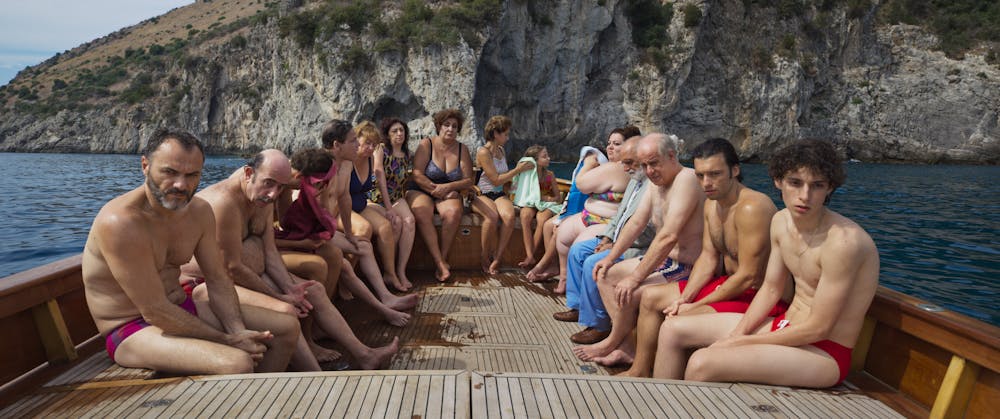
However, midway through a completely random tragic event befalls Fabietto, and the film’s whole tenor is transformed in a way that forces us to re-imagine what we have just been watching. All of the clichés are suddenly redrawn as the product of Fabietto’s (and the cinematic viewer’s) fantasies about Italy and the world at large, as realised with the simplicity of caricature.
The second half moves more clearly into the “true” consciousness of Fabietto as he finds himself deracinated, bereft, wandering around Naples without a clue what to do. His formerly adored Naples soccer team no longer holds any interest for him, and the hand of God, rather than referring to his idol Maradona, now seems to suggest, merely, the cruelty and arbitrariness of the world.
The Hand of God is a haunting, miraculous film about the power – and lack thereof - of our illusions to comfort us. Despite its appearance, it is hard edged and unsentimental, forcing us to think about our positions as subjects in the cinema.
Pleasure
Like many of the best films about America, Pleasure is made by a European, Swedish writer-director Ninja Thyberg. It is a thoroughly formulaic film, following an ingenue’s rise to stardom in an American tradition stretching from Paul Verhoven’s Showgirls back to Theodore Dreiser’s novel Sister Carrie. But this makes Pleasure no less pleasurable.
The narrative is centred on Bella Cherry (Sofia Kappel) as she arrives in LA to try to become, as she puts it early in the film, the best porn star in the world. We follow her from shoot to shoot, on her way to becoming a “Spiegler girl” (played by real-life talent agent Mark Spiegler, with all of the cast of the film, except Kappel, coming from the porn industry).
Much of the action is comical, and one of the key comedic tropes of the film is the contrast between the fantasy when the cameras are rolling and the reality when the cameras stop. Brutal, tattooed men become attentive and sensitive coworkers.
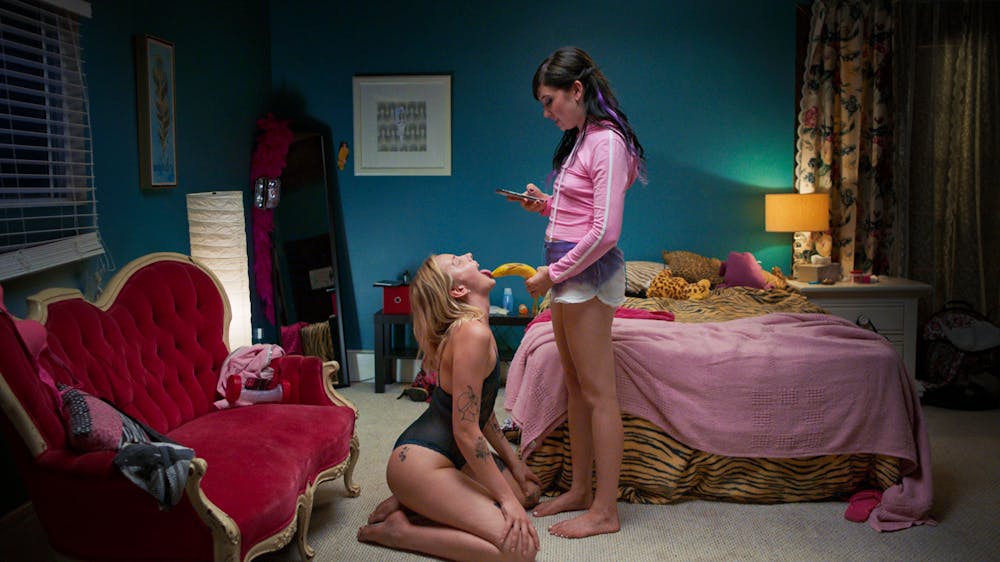 Pleasure follows Bella Cherry (Sofia Kappel) as she arrives in LA to try to become, as she puts it early in the film, ‘the best porn star in the world’.
Sydney Film Festival
Pleasure follows Bella Cherry (Sofia Kappel) as she arrives in LA to try to become, as she puts it early in the film, ‘the best porn star in the world’.
Sydney Film Festival
But it’s not all hugs and jokes. In a particularly disturbing sequence, the boundaries between reality and fantasy are blurred during a “rough sex” shoot. Bella finds herself harassed and abused by two men on camera, demands they stop, and when she tries to get out of it the director and actors pressure her to continue. When she later confronts her agent, claiming that she was “raped,” he replies “Don’t throw that word around just because you had a bad day at work.”
The inconsistency of Bella’s experience across different “rough sex” sets – rather than the morality of the acts themselves – is critically scrutinised by the film as a reflection of a general lack of regulation in the industry.
Kappel is absolutely mesmerising as Bella, star-struck ingenue-come-Machiavellian player, and she performs the part with confident understatement, surprising for an actress in her first film. The supporting cast are equally brilliant, including newcomer Revika Anne Reustle as Joy, and porn actors Chris Cock and Kendra Spade in non-porn roles as Bella’s friends Bear and Kimberly.
Pleasure is an intense experience, raucous, but terrifying at times too. It is beautifully shot by Sophie Winqvist, capturing the neon lights of party LA with electric intensity, while visually connecting this to the other LA – the LA of the sprawling, post-industrial wasteland. This is a film that truly revels in its own pleasure, amoral and sublime.
Television Event
Television Event is an extremely well-made documentary that follows the difficulties of the (American) ABC network producing and then exhibiting the nuclear apocalypse telemovie, The Day After, which aired in 1983 and became the most-watched TV movie to this day.
Director Jeff Daniels skilfully assembles a plethora of archival material, interspersing this with talking head interviews with the main figures behind the television event. This includes director of The Day After, Nicholas Meyer, and his nemesis at ABC, executive Stu Samuels, who still mostly have only negative stuff to say about each other.
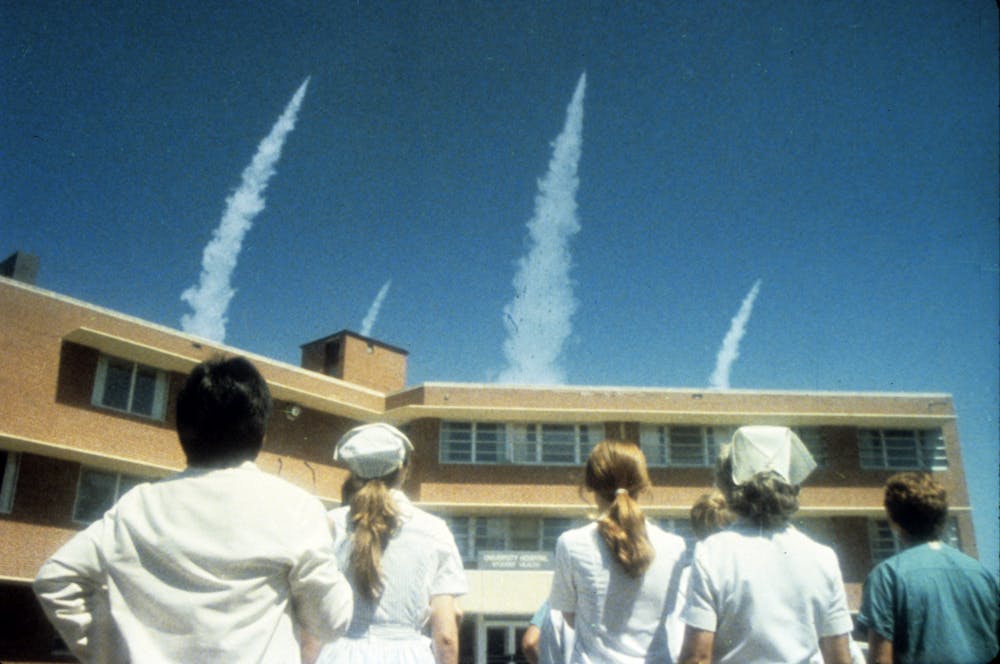 Television event is a documentary about the Cold War nuclear apocalypse telemovie, The Day After, which aired in 1983 and became the most-watched TV movie to this day.
Sydney Film Festival
Television event is a documentary about the Cold War nuclear apocalypse telemovie, The Day After, which aired in 1983 and became the most-watched TV movie to this day.
Sydney Film Festival
While it taps into a certain nostalgia for the period, evident in the hilariously outdated network promos and talk shows featured in the film, the story of the conception, filming and screening of the movie is carefully contextualised by Daniels in terms of the Reagan-era Cold War, with the anti-nuke message of the film changing, the film suggests, America’s nuclear policy.
And this is the ultimate claim of the film – that mass media does have the potential to positively effect the world for most of the population, not just the powerful who control the networks – even if one’s cynicism regarding the military-media-industrial complex is usually warranted.
The Story of My Wife
In a seemingly inconsequential piece of dialogue in Ildikó Enyedi’s The Story of My Wife, protagonist Jakob (Gijs Naber) challenges the astrological obsession of his landlord Herr Blume (Josef Hader). Why not a carrot?, he asks him – the miracle of the world is in a carrot, not in the stars, in the simplicity of being-as-it-is, not in the attempt to decipher some underlying mystery.
In this moment, the film articulates its vision of the world – the mystery is in the play of light across surfaces, not in the attempt to render depth where there is none. And the film performs this truth: it is an epic-scale production, a period film featuring meticulous design in every aspect – and yet the whole thing seems effortless, breezing along for nearly 3 hours with the lightest of touches propelled by two amazing actors in the lead roles.
After sea captain Jakob is advised to get a wife by his vessel’s cook, he promises his colleague that he will marry the next woman who enters the café in Paris where they are drinking. It happens to be Lizzy (Léa Seydoux), and, charmed by his combination of bravado and frankness, she agrees to his proposal.
 The Story of My Wife is epic in length, a massive-scale production shot in multiple languages.
Sydney Film Festival.
The Story of My Wife is epic in length, a massive-scale production shot in multiple languages.
Sydney Film Festival.
Once they are married, suspicions regarding his wife’s motives immediately begin to emerge. He cannot believe she has married him – she is a social butterfly type, he is a stodgy sea captain. He is unable to follow his own advice, to find beauty in the present, in the simple appearance, in the being of the carrot.
It sounds tragic and dramatic, but it’s not really, with the film adopting the easygoing attitude of Lizzy, at the same time romantic, whimsical and profoundly melancholic. Its three hours passes like a flash of light on a Parisian street, and it is rare to see such a light touch in a film today.
Pompo the Cinéphile
Pompo: The Cinéphile, an animated work from writer-director Hirao Takayuki, is an incredibly joyful film. The title character is a hotshot producer in “Nyallywood”, renowned for her exciting but trashy blockbusters, the kind of stuff involving bikini-clad beauties fighting giant octopi with machine guns. Pompo, despite her status, acts and looks like a kid, with her temper tantrums, one suspects, poking fun at some of the more eccentric Hollywood producers.
 Pompo the Cinéphile is set in ‘Nyallywood’, a fictional Hollywood analogue.
Sydney Film Festival
Pompo the Cinéphile is set in ‘Nyallywood’, a fictional Hollywood analogue.
Sydney Film Festival
When Pompo develops an idea for a more serious dramatic film – a corny but completely believable Oscar-bid type film about an ageing conductor’s path to redemption – she enlists her assistant, film nerd Gene, to direct it. We follow Gene as he flourishes into a star director, with his rise paralleling the rise to stardom of the leading actress in the film, Nathalie.
The whole thing plays like a weird and delightful fantasy. It’s of the funny and sweet rather than violent and mean school of anime, but this does not make its barbs about the film industry any less incisive. This film will not be for everyone – maybe not even for most – but it makes my top five as an exercise in pure cinematic joy, full of stunningly drawn images and a pleasurably escapist narrative.
Other hits
Many other brilliant films screened, like Eddie Martin’s stunning documentary The Kids, which looks at the aftermath of career and life of those who participated in Larry Clarke/Harmony Korine’s famous 1990s film Kids, and received virtually nothing for their efforts. Or Paul Schrader’s brooding exercise in minimalistic noir, The Card Counter, about an ex-torture specialist soldier who now spends his life travelling from casino to casino.
Then there were the standouts from the Freak Me Out section of the festival, The Spine of God, a fantasy film made by rotoscope animation that played like an R-rated, ultraviolent version of the Masters of the Universe cartoon, and Censor, a grim, beautifully made horror film set in the UK video nasties era, about a censor who finds herself swept into her own horror story.
The two strongest films not in the above five are A Hero, an Iranian film from Asghar Farhadi that skilfully dissects the effects of social media when a prisoner’s return of a bag of gold becomes a local media event, and Compartment Number 6, a beautifully shot film from director Juho Kuosmanen that follows the budding friendship between pretentious Irina (Dinara Drukarova) and macho Vadim (Yuriy Borisov) as they share a compartment while travelling across Russia by train.
A frequent refrain during this film festival was that “Sydney needs the festival now more than ever.” It sounds corny, but having sat in the dark with masses of potentially germ-bearing strangers over the past twelve days, collectively participating in an absolute feast of cinema, I can at least confirm this for myself.
Authors: Ari Mattes, Lecturer in Communications and Media, University of Notre Dame Australia
Read more https://theconversation.com/5-unmissable-films-from-the-sydney-film-festival-171814


 Daily Bulletin


