

Using military language and presence might not be the best approach to COVID and public health
- Written by: Stuart Ralph, Associate Professor and malaria researcher, The University of Melbourne
Governments around the world have enacted unprecedented responses to minimise the spread of COVID to preserve both individual health and health systems.
In enacting these responses, governments have repeatedly used rhetoric invoking notions of war. Often they’ve painted the virus as an “invader” and a “wicked enemy”.
Read more: Stop calling coronavirus pandemic a 'war'
Such language was arguably useful to help mobilise resources and underscore the seriousness of the situation to the community.
However, ongoing use of military rhetoric, war metaphors and, in some cases, the direct involvement of military personnel in public health communication and local responses may undermine efforts to control the virus — especially among communities most vulnerable to COVID.
The language of war
Among the most tangible examples of militarisation of Australia’s COVID response was the appointment of Lieutenant General John Frewen as commander of the national COVID vaccine taskforce.
Another is the launch by Frewen of a military themed vaccination campaign “arm yourself”.
These approaches to getting the vaccine rollout back on track are perhaps unsurprising given the warlike language invoked by leaders in Australia and elsewhere. Two weeks ago, Scott Morrison said “this has been a long war against this virus, and there have been many, many battles”.
Framing health strategies as a war against disease is a long-standing approach for garnering support and attracting funding for disease control and eradication programs.
This method was central to the conception of post-WWII “campaigns” against infectious diseases like malaria and tuberculosis.
Such metaphors may be useful for simplifying complex biomedical concepts or encouraging public vigilance.
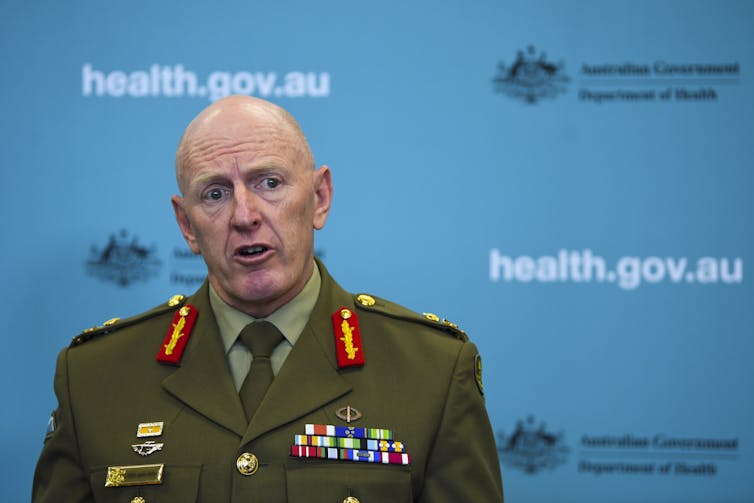 A Lieutenant General is in charge of the COVID vaccine rollout.
Lukas Coch/AAP
A Lieutenant General is in charge of the COVID vaccine rollout.
Lukas Coch/AAP
But health communicators increasingly urge us to reduce the use of military metaphors in describing our responses to disease.
In the context of cancer, perceiving the illness as an active enemy can lead people to be more fatalistic and more likely to perceive preventative behaviours as futile.
Using militaristic language inevitably defines those who succumb to disease as losers of a battle. Writer and activist Susan Sontag suggested wrapping disease in metaphors risks inappropriate inferences that people who contract, die or suffer from disease didn’t try hard enough. This may result in discouragement and shame among people affected.
Read more: Queensland's coronavirus controversy: past pandemics show us public shaming could harm public health
Deploying soldiers in Sydney is inappropriate
Another example of the inappropriate use of the military has come in Sydney’s current outbreak, where uniformed soldiers are now being deployed to enforce lockdown.
This presence is clearly causing some distress and resentment among local community leaders as it did in suburbs of Melbourne last year.
It’s incongruous that this same military is simultaneously being used to deliver public health messages that rely on engagement, trust and transparency.
South Western Sydney is rich in culturally and linguistically diverse communities where Arabic and Vietnamese are widely spoken as first languages, and is home to many refugees and First Nations people.
Many of these people have good reason to regard armed forces as unreliable sources of public assistance. In these communities the use of the army in enforcing lockdowns will inevitably undermine its dual role as a source for trusted health-care messages.
This may also resonate poorly with migrants from countries where authoritarian governments use the military and police to control and intimidate communities.
This month’s vaccine coverage data show South Western Sydney has some of the lowest uptake of COVID vaccines in the country. A non-military approach will be required to address this.
In public health messaging, the use of militaristic or violent language also risks alienating other parts of the intended audience. Some Australians, for example LGBTQI+ people and people with disability, have been historically excluded from the military or militaristic narratives.
For many Australian women too, the use of aggressive and warlike language amid the pandemic has been particularly ill-fitting. Social inclusion policy strategist Amy Haddad has pointed out the military language employed around COVID in Australia has been particularly gendered.
Masculine and martial calls from the prime minister to “summon the ANZAC spirit” disregard many groups, and particularly many women who are central to the primary health-care roles in responding to COVID.
Authors: Stuart Ralph, Associate Professor and malaria researcher, The University of Melbourne


 Daily Bulletin


