

Use it or rapidly lose it: how to keep up strength training in lockdown
- Written by: David Scott, Associate Professor (Research) and NHMRC Emerging Leadership Fellow, Deakin University
If you’re among the millions in lockdown, ask yourself: when was the last time you did some strength training?
Many of us are regularly going for walks or runs during lockdown but, with gyms closed in a lot of places it’s more difficult to lift weights, and we may neglect bodyweight exercises like push-ups.
Unfortunately, when it comes to muscle mass, it’s a case of use it or rapidly lose it.
Short- and long-term consequences
Research shows periods of muscle disuse can lead to staggeringly rapid and significant loss of muscle mass, even in young people.
Beyond the obvious decline in strength and function, loss of lean muscle mass can affect metabolism, increase type 2 diabetes and obesity risk and weaken your bones. In older people, it’s associated with cardiovascular disease, osteoarthritis, cognitive impairment, depression, falls and fractures.
That’s why it’s so crucial to keep up your strength training and maintain muscle mass, even in lockdown. The good news is there is plenty of strength training exercises you can do at home, even without special equipment.
Try as best you can to match your usual strength training routine during this time or, if you don’t have one, begin building it into your day.
 Reductions in muscle mass have serious short- and long-term consequences, so keep up the strength training during lockdown.
Shutterstock
Reductions in muscle mass have serious short- and long-term consequences, so keep up the strength training during lockdown.
Shutterstock
Young people are not immune to muscle mass loss
Many think of muscle mass loss as a problem that mostly affects older people, but even people in their early 20s can experience rapid muscle loss under certain conditions.
One study of men in their early 20s found just one week of strict bed rest resulted in an average loss of around 1.4kg in whole-body lean mass.
Another study, involving young people who had one leg immobilised by knee brace, observed muscle size decreased in the immobilised legs by approximately 5% over two weeks. Strength decreased by 10-20%.
Clearly, lockdowns do not enforce the same degree of muscle disuse as bed rest or immobilisation.
Nonetheless, in studies where people decreased their usual physical activity levels, it took just two weeks or so for worrying changes in lean mass, insulin sensitivity and function to show up.
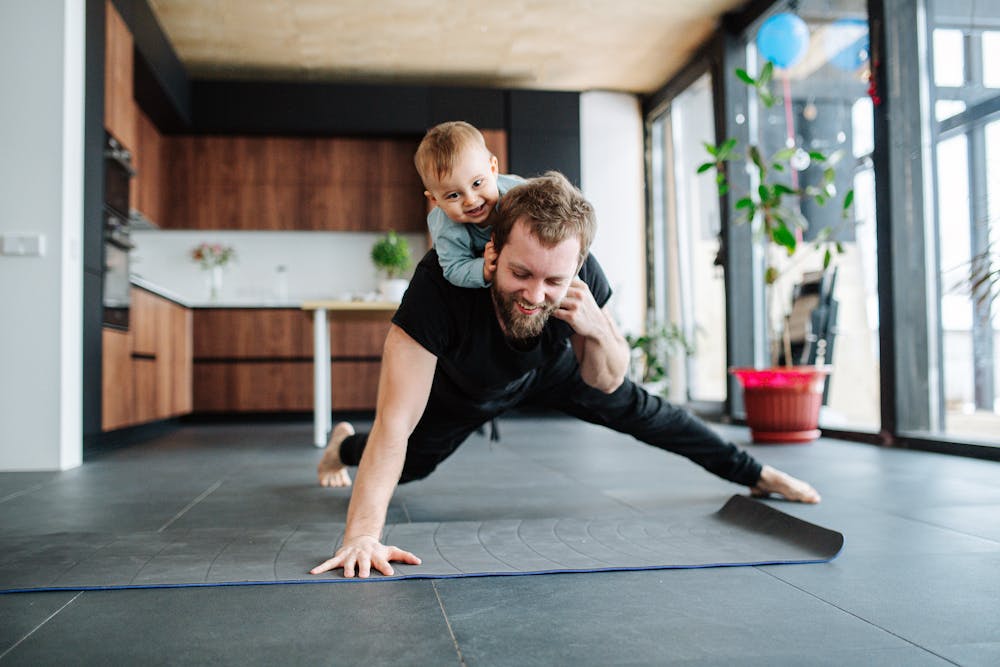 Anything you can do to find ways to maintain activity and reduce sedentary time during lockdowns is likely to limit or prevent significant muscle loss.
Shutterstock
Anything you can do to find ways to maintain activity and reduce sedentary time during lockdowns is likely to limit or prevent significant muscle loss.
Shutterstock
Decline can happen in fits and starts
People in my field of research talk a lot about “sarcopenia”: the age-related loss of muscle mass and function that begins in your 30s and can accelerate as you age.
Traditionally, we’ve thought of sarcopenia as occurring in a largely linear fashion.
However, a newer idea suggests this decline may not be so linear after all. Perhaps it happens in fits and starts, where acute episodes of sedentary behaviour (often due to illness or hospitalisation) result in repeated short but severe declines in muscle mass. Researchers call this a “catabolic crisis model”.
According to this idea, muscle mass recovers at the end of each acute episode, but never quite returns to its initial quantity. Over time, an accumulation of episodes results in substantial muscle loss and severely compromised physical function.
Of course, some people may be exercising more than usual during lockdown. That’s great! But sedentary behaviour can easily creep in. One study of people under lockdown found increases in walking and moderate physical activity were only around 10 minutes per day, whereas sedentary behaviour increased by around 75 minutes per day.
And of 64 studies exploring changes in activity related to COVID-19 lockdowns, most observed decreases in physical activity and increases in sedentary behaviour.
Anything you can do to find ways to maintain activity and reduce sedentary time during lockdowns is likely to limit or prevent significant muscle loss.
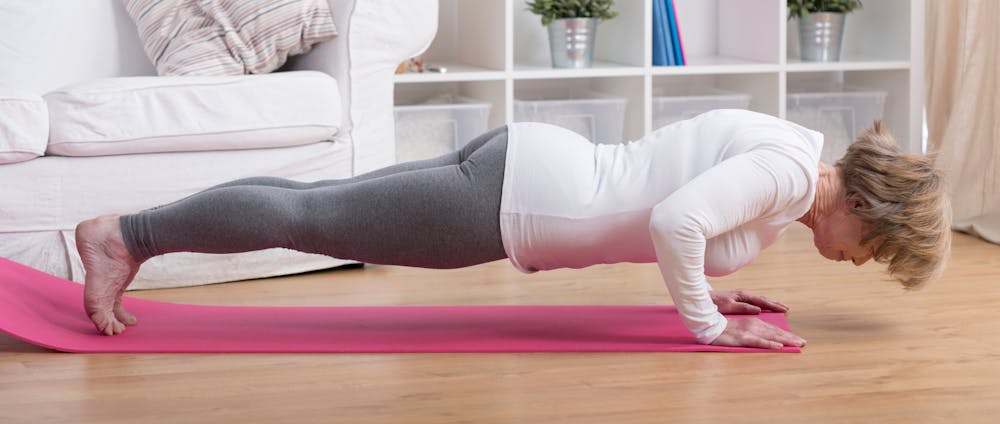 Anything you can do to find ways to maintain activity and reduce sedentary time during lockdowns is likely to limit or prevent significant muscle loss.
Shutterstock
Anything you can do to find ways to maintain activity and reduce sedentary time during lockdowns is likely to limit or prevent significant muscle loss.
Shutterstock
How to build and maintain muscle at home
Resistance training is unequivocally the best way to build and strengthen muscle. This is any type of exercise that causes your muscles to contract against an external resistance.
The classic example of resistance training is using a weights machine but there are plenty of resistance exercises you can do at home with little or no equipment, including:
“equipment-free” strengthening exercises such as push-ups, planks, triceps dips, lunges, squats, calf raises and sit-ups
exercises using dumbbells or resistance bands if you’ve got them. If you don’t, try lifting bricks, full milk bottles, or any heavy household item
functional “power” exercises like climbing a flight of stairs as quickly (and safely) as you can or seeing how many times you can get up and sit down in a chair in 30 seconds. Try deadlifts with a heavy item, or pushing a loaded wheelbarrow outside.
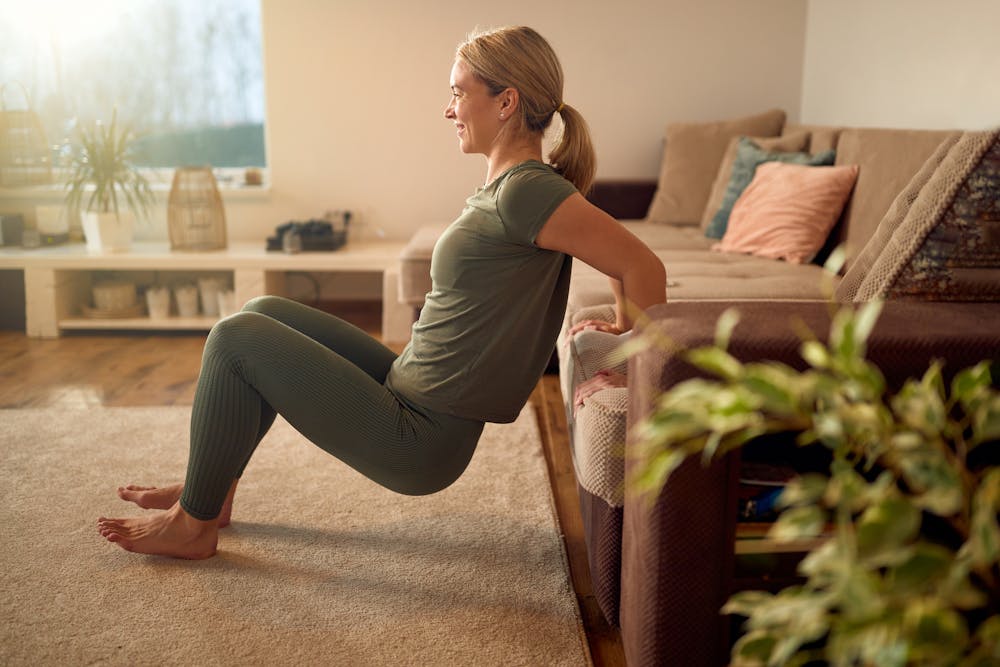 Strengthening exercises such as push-ups, planks, tricep dips, lunges, squats, calf raises and sit-ups can be done at home.
Shutterstock
Strengthening exercises such as push-ups, planks, tricep dips, lunges, squats, calf raises and sit-ups can be done at home.
Shutterstock
Aim for at least 30 minutes per day of moderate to vigorous activity. Brisk walking, jogging, cycling or swimming is great. However, at least two days a week you should be doing resistance exercises to build and maintain muscle mass.
If time is an issue, try splitting your exercise into short 5-10 minute “snacks” across the day. This “exercise snacking” is a great way to break up long periods of sedentary time during lockdown.
Try to integrate resistance exercises into your daily chores. If you need something from a lower drawer, for example, don’t bend down to get it — do a squat. Do some single-legged squats and calf raises while washing up.
Need a video for guidance? This one and this one are pretty good for younger and fitter people. If you’re older, or just getting into fitness, try this one or this one.
Start ‘banking’ muscle early in life
Through regular exercise, children, adolescents and young adults can accumulate and maintain higher amounts of muscle mass. In doing so, they can likely avoid significant loss of independence in older age.
Just like superannuation, we need to start making “muscle deposits” early and often throughout life.
Read more: How to stay fit and active at home during the coronavirus self-isolation
Authors: David Scott, Associate Professor (Research) and NHMRC Emerging Leadership Fellow, Deakin University


 Daily Bulletin


