

Brad Hazzard is wrong about multicultural western Sydney: new research shows refugees do trust institutions
- Written by: Tadgh McMahon, Adjunct Lecturer, College of Medicine and Public Health, Flinders University
With COVID numbers surging in Sydney’s multicultural western suburbs, NSW Health Minister Brad Hazzard speculated that migrant and refugee communities in the region “haven’t built up trust in government”, which might make them reluctant to engage with health authorities.
And yesterday, Hazzard made another oblique reference to residents in western Sydney by saying,
There are other communities and people from other backgrounds who don’t seem to think that it is necessary to comply with the law and who don’t really give great consideration to what they do in terms of its impact on the rest of the community.
Concerns about a lack of trust among migrants and refugees in institutions in Sydney’s west — or their alleged disregard for rules — mirror similar commentary by authorities in Melbourne during COVID outbreaks last year.
Our recent research among refugees in NSW shows these concerns about trust in government are unfounded, particularly among recently arrived refugees.
Our 2019 and 2020 surveys reveal these people, in fact, have very high levels of trust in Australian institutions and a high level of commitment to fulfil their social and civic responsibilities.
What our research reveals
The study, led by Settlement Services International (SSI) and researchers at Western Sydney University, explored refugees’ sense of participation and belonging in Australian society.
We surveyed 418 refugees in their preferred languages, reaching a diversity of backgrounds. All refugees had permanent residency, and those in our 2020 survey had lived in Australia for an average of 24 months.
In the 2020 survey, we found our respondents had very high levels of trust in the government (86% responding “a lot”) and the police (84% “a lot”), with no noticeable difference between women and men.
Trust in the media, however, was considerably lower (39% trusting the media “a lot” and 41% “some”), but still comparable to the general Australian population.
The lowest trust was expressed for people in the wider Australian community, with just 24% saying they trusted these people “a lot”, 45% saying “some” and 10% saying “not at all”. This was comparable to findings from a long-term study of refugees in Australia.
One typical resident in Sydney’s west
Muneera, who came to Australia from Iraq, lives in Sydney’s west with her family and is typical of the refugees we surveyed. Muneera was supported by SSI when she arrived in March 2019 through the Australian government’s humanitarian settlement program.
While she was not part of the research, she was happy to share her story of dealing with COVID-19 during the current lockdown.
With limited English, Muneera gets COVID-19 information from Arabic community social media groups and mainstream TV news. She also relies on her sister, who speaks English very well, for regular updates on public health restrictions.
Like many other families in lockdown, some of her children have lost work and her son struggles with high school from home without a laptop. Yet, Muneera and her family are committed to staying home and understand the need to stay informed and comply with restrictions.
Read more: We need to collect ethnicity data during COVID testing if we're to get on top of Sydney's outbreak
Why community support is so vital
In our survey, we found refugees in New South Wales were strongly motivated to fulfil their social and civic responsibilities, including obeying the law, being self-sufficient, treating others with respect and helping others. In fact, these sentiments were shared nearly universally among our respondents.
They also reported knowing how to get help and access essential services, including how to find out about government services (69% “know very well/fairly well”) and, importantly, what to do in an emergency (77% “know very well/fairly well”). They also knew how to get help from the police (78% “know very well/fairly well”).
When it came to helping others in the community, rates of volunteering among refugees in our survey dipped in 2020 (48%) compared to 2019 (60%), but were still on par with rates of volunteering (49%) in the wider Australian community during the pandemic.
All respondents in this survey had Australian permanent residency, a key factor in enabling their settlement and their access to services.
Read more: Understanding how African-Australians think about COVID can help tailor public health messaging
Refugees in our study also felt welcome in Australia, part of the Australian community and supported by range of networks, including their ethnic and religious communities and other groups. At this early stage of settlement, they found it relatively easy to make friends in Australia, talk to their neighbours and maintain mixed friendships networks.
In western Sydney and other parts of Australia with high cultural diversity, there are multiple challenges in containing COVID-19, including rapidly changing public health advice and the need for accurate information in community languages.
However, the premise that refugees have low levels of trust in institutions or are disinclined to follow rules is not supported by our research.
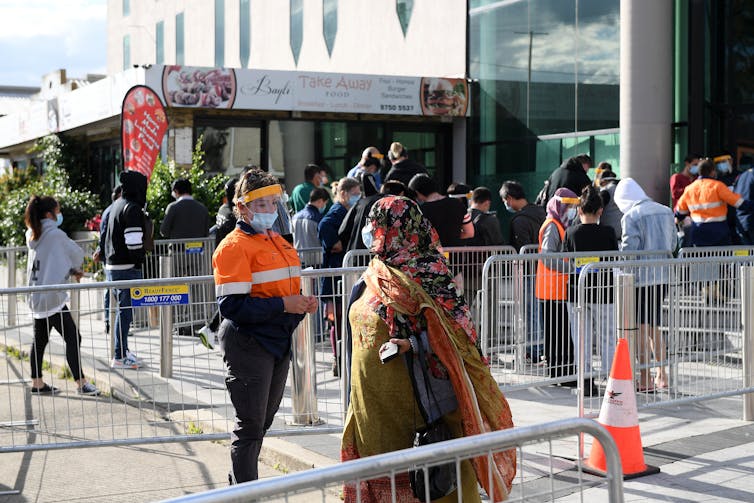 People are seen lining up at a pop-up COVID vaccination clinic at the Lebanese Muslim Association in Lakemba, south west of Sydney.
DAN HIMBRECHTS/AAP
People are seen lining up at a pop-up COVID vaccination clinic at the Lebanese Muslim Association in Lakemba, south west of Sydney.
DAN HIMBRECHTS/AAP
Rather than labelling diverse communities as lacking in trust, their existing social capital and breadth of their community relationships and networks can be a critical resource in the battle to contain COVID-19, as Muneera’s example shows.
Starting from a position of trust, the challenge becomes how to activate and effectively resource the span of organisations and networks that refugees and migrants engage with in their daily lives.
This should be coupled with clear and consistent messaging in community languages delivered through a variety of channels (including digital) and formats (including video). Peer-to-peer engagement from community members and trusted organisations can be incredibly effective to support behaviour change and maintain health and safety.
Targeted mental health promotion and financial assistance are also key to ensuring families like Muneera’s have the support they need during the pandemic.
The authors’ research on newly arrived refugees will be discussed in a moderated online panel discussion to be held on September 9 from 12:30-2pm (AEST). Registration is free, but essential.
Authors: Tadgh McMahon, Adjunct Lecturer, College of Medicine and Public Health, Flinders University


 Daily Bulletin


