

Japan signals a 'sense of crisis' over Taiwan — this is why it is worried about China's military aims
- Written by: Thomas Wilkins, Senior Lecturer, University of Sydney
In recent weeks, Japan has signalled a significant foreign policy shift that could have implications for security in the Asia-Pacific region.
Japan’s latest defence white paper, released last week, has for the first time made direct reference to the importance of Taiwan when it comes to peace and security in the region.
Noting an uptick in cross-strait tensions as a result of China’s “intensified military activities around Taiwan”, the document warns that Tokyo will “pay close attention to the situation with a sense of crisis.”
This follows even firmer language from Deputy Prime Minister Taro Aso, who said earlier this month that Japan “would have to defend Taiwan” alongside the United States if it was invaded by China. He later retracted the statement.
China reacted with predictable fury to the statements, both through official channels and its more bellicose media outlets.
Foreign Affairs Ministry spokesman Zhao Lijian decried the white paper as “extremely wrong and irresponsible”. Meanwhile, the Global Times newspaper claimed Japan “will lose badly” if it comes to Taiwan’s aid.
And a more incendiary video appeared on a military commentary channel advocating a nuclear response to any Japanese intervention, before being deleted.
Why Taiwan is a regional flashpoint
The unresolved status of Taiwan has long been considered a potentially dangerous flashpoint in the Asia-Pacific region. As US power has waned and China has become increasingly dominant in recent years, the issue has returned to the fore.
Beijing has never given up on its ultimate aspiration to reclaim what it dubs a “renegade province of China”. In 2005, it passed an “anti-secession law” declaring any attempt by Taipei to translate its de facto sovereignty into formal “independence” would be met by force.
Read more: China does not want war, at least not yet. It's playing the long game
Chinese President Xi Jinping has been particularly adamant in his desire to achieve “national reunification”, as he expressed, in colourful language, during the centenary celebration of the Chinese Communist Party in early July.
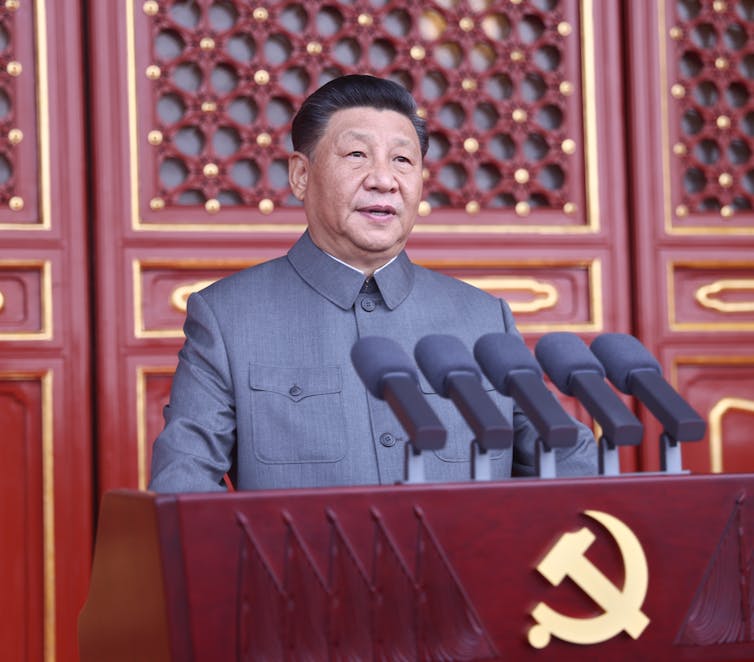 Xi Jinping pledged to complete ‘reunification’ with Taiwan as one of the ‘unswerving historical tasks’ of the Chinese Communist Party.
XINHUA/JU PENG/EPA
Xi Jinping pledged to complete ‘reunification’ with Taiwan as one of the ‘unswerving historical tasks’ of the Chinese Communist Party.
XINHUA/JU PENG/EPA
Having viewed Hong Kong’s unhappy return to the “motherland” in recent years, however, the people of Taiwan have resolved in the words of Foreign Minister Joseph Wu to “defend ourselves to the very last day”, should a Chinese attack actually materialise.
The ruling Democratic Progressive Party in Taipei has been buoyed by the increasing support of the Biden administration, though the US has sought to avoid possible military confrontation with China and stopped short of backing any move toward formal “independence”.
Why Japan is worried
This is where Japan enters the picture. Traditionally, Tokyo has been cautious in offering overt support to Taiwan due to the diplomatic sensitivities with Beijing, a major trading partner.
But for Tokyo, Taiwan’s predicament is indicative of the challenges that a more powerful and assertive China poses to Japan’s own security and to regional stability more widely. This has been heightened by the inexorable shift in the Asia-Pacific balance of power in China’s favour.
Read more: Morrison's Japan trip yields defence pact, but travel bubble less certain
Not only is Japan now more supportive of Taiwan as a fellow democracy, it fears for its own strategic vulnerability should China occupy Taiwan.
This is because Taiwan sits at a crucial strategic chokepoint for naval forces in the western Pacific — the so-called “first island chain” stretching from Japan in the north to the Philippines in the south.
Taiwan is just 100 kilometres from the closest island in Japan’s Ryukyu archipelago, meaning that without Taiwan as a friendly neighbour, Japan’s southern strategic flank would become extremely exposed.
How Japan is stepping up
This has led Japan to adopt a more robust stance in regional security matters, particularly under the leadership of former Prime Minister Shinzo Abe.
In 2015, for instance, Japan passed a controversial “peace and security” law that allowed it to engage in “collective self defence” with allies and strategic partners, providing the opportunity to contribute more meaningfully in any crisis scenario.
Japan has also increased its defence budget (it rose by 0.5% to 5.34 trillion yen or A$66.4 billion this year). And it has emphasised its new military capabilities, such as the retrofit of its helicopter destroyers into de facto aircraft carriers, the creation of an amphibious assault force, and the acquisition of stand-off or strike missiles.
Tokyo has also assumed the mantle of a more vocal regional leader in terms of its diplomacy. This is exemplified by its “Free and Open Indo-Pacific” vision for regional order, which emphasises the promotion of the rule of law, pursuit of economic prosperity and a commitment to peace and stability.
One of the most significant aspects of this “vision” has been the strengthening of bilateral strategic partnerships with countries such as Australia and India. Alongside the US, these countries form the “Quad”, a loose coalition seeking to counteract increasing Chinese dominance of the region.
Read more: Australia would be wise not to pound 'war drums' over Taiwan with so much at stake
Is a conflict between Japan and China likely?
Japan is also concerned about increasingly assertive moves by China to expand its maritime reach and exert more pressure on Japan’s Senkaku islands, which are claimed by Beijing (as well as Taiwan) as the Diaoyu islands.
To wit, Japan’s defence white paper notes the sharp increase in the number of Chinese Coast Guard vessels that have entered Japanese territorial waters since 2019, denouncing Chinese “attempts to unilaterally change the status quo by coercion”. Moreover, the Chinese Coast Guard is now empowered to use force against foreign vessels under a new law passed this year.
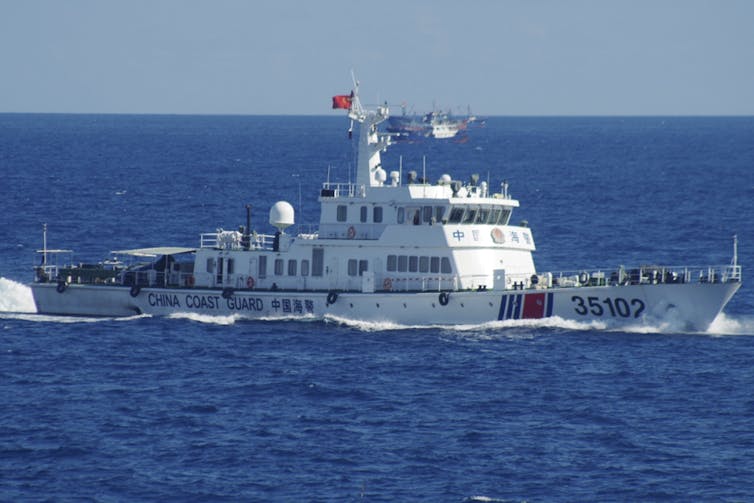 A Chinese Coast Guard vessel sails near disputed Japanese islands in the East China Sea.
11th Regional Coast Guard/AP
A Chinese Coast Guard vessel sails near disputed Japanese islands in the East China Sea.
11th Regional Coast Guard/AP
Seeing Taiwan’s plight as part of a larger pattern of Chinese assertiveness is surely a motivator behind Tokyo’s new declaration of interest in the Taiwan issue.
Nevertheless, it is important to underline that Japan is in no sense legally obligated to provide military assistance in a potential conflict over Taiwan. There are still strict legislative restraints on the use of force firmly in place.
Rather, the defence white paper should be viewed as a strong indication that Japan believes it cannot afford to idly stand by as the Asia-Pacific security environment continues to deteriorate. It is therefore assuming greater responsibility to maintain a rules-based order that it believes will provide stability and prosperity for this dynamic region.
Authors: Thomas Wilkins, Senior Lecturer, University of Sydney


 Daily Bulletin


