

The National Party used to be known for its leadership stability — what happened?
- Written by: Geoff Cockfield, Professor of Government and Economics, and Deputy Dean, University of Southern Queensland
Barnaby Joyce is back as Nationals leader, after a spill in Canberra on Monday morning.
This is the latest development in an unusually tumultuous period for the junior Coalition partner, beginning with Joyce’s reluctant resignation in 2018 and punctuated by his unsuccessful leadership challenge in February 2020 and ongoing discord and rebellion over climate policy.
Read more: View from The Hill: Nationals in crisis, with pressure on Michael McCormack's leadership
All this from a party that has a long history of relatively stable leadership, being out of the national media and settling disagreements with the Liberals behind closed doors
Some might argue the instability in recent years is the result of Joyce’s personality, ambition and behaviours. As well as the media’s focus on leadership and the contagious nature of leadership instability in other parties over the last decade.
But there are also other factors to consider.
Party differentiation
The federal Coalition has the characteristics of one party while formally remaining separate entities, which has been a successful, but unusual political arrangement.
In Canberra, party leaders largely act as one party, negotiating policy outcomes or implementing decisions. When in government, the Nationals leader gets the deputy prime ministership, Nationals MPs sit in Cabinet and there are joint party room meetings and joint Senate tickets.
Yet the Liberals and Nationals also have their own separate party room meetings and occasionally compete against each other for lower house seats when a previous member does not recontest a seat. During election season, the Nationals go on “the Wombat trail” as partial policy independents.
On the campaign trail, the Nationals speak the language of rural populism with its tropes of rural disadvantage and urban indifference or hostility, with the “urban enermy” implicitly including the Liberal Party.
The problem here
The problem for the Nationals is they struggle to deliver adequate agricultural support and rural services in a post-deregulation world. So they have no signature programs that show their policy value.
They fight for residual programs such as drought support or regional funding that are limited in scope, time and impact and subject to considerable criticism as to effectiveness and fairness.
The Nationals need new generation signature issues that deliver for regions, while still representing the values and aspirations of an earlier Australia. For example, large-scale irrigation projects and mining developments, but even many Liberals don’t want these.
Meanwhile, their vocal support for the coal industry only holds sway among select voters (and turns off others).
Geography
The Nationals are also trying to overcome geographical divides. At the federal level, National Party power is split between Queensland and NSW. The latter generally dominates party leadership, contributing to easily animated northern resentments.
The formation of the Liberal National Party (LNP) in Queensland in 2008 further complicated matters.
It created a party now pressing for greater influence within the Coalition, especially after the 2019 federal election, where the LNP was seen to have “delivered” government for the Coalition.
The results in the so-called “coal seats” of central Queensland (such as Flynn and Dawson) have given further encouragement to the resources focus. Joyce, though now a NSW representative, started his political career in Queensland and it is presumed much of his support for his leadership challenges came from the sunshine state.
Leadership
Balancing the Coalition relationship, with different strands of the Nationals’ base is a difficult task for a leader. And is seen as a significant reason for Joyce’s return.
Last century, longstanding National leaders, such as John McEwan and Doug Anthony, possessed combinations of strong personality, electoral leverage, political acumen and good relationships with the Liberal (or predecessor parties) leaders. From 1922 to 1984, the average length of tenure of a Nationals leader was more than 12 years, with two of them serving more than 17 years.
No other party comes close to this record of keeping multiple leaders in office for long periods — and this now seems a historical quirk. Since 1988, there has been an increased rate of turnover, though most transitions still occurred reasonably peacefully.
More recent leaders have been confronted with the declining electoral position of the Nationals and the discontent of people in the bush. Most — such as Tim Fischer, John Anderson and Warren Truss — opted for being collaborative Coalition partners and keeping disputes behind closed doors. McCormack was also of that persuasion (and indeed, was criticised for not pushing back enough).
This means he could be characterised as too close to the Liberals and too accommodating. The other approach is more public signalling of the differentiation and more implicit threats of splitting the Coalition.
Policy tightrope
The Nationals then, must operate in the zone between tight cooperation and political competition.
The Liberals need them to form government but if skirmishes break into open disagreement and competition, the Liberals may lose majority government and the Nationals would face an existential threat.
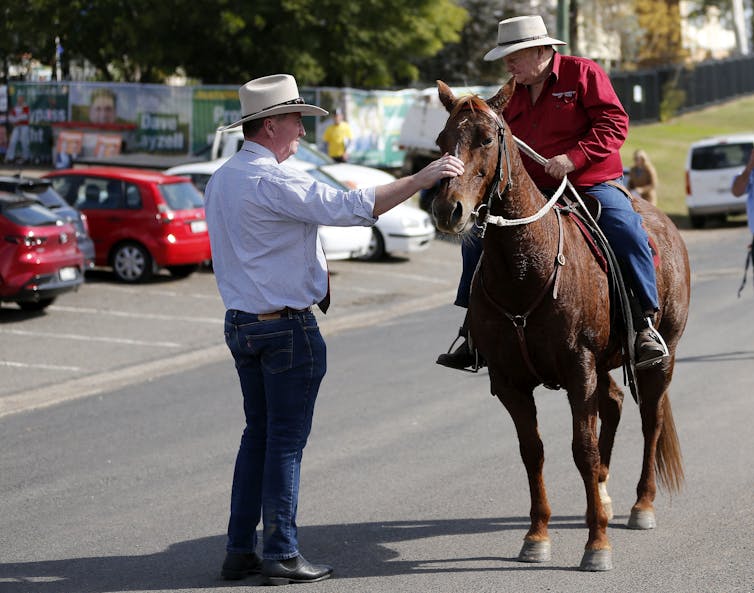 Since quitting the leadership, Joyce has never been far from the spotlight.
Darren Pateman/AAP
Since quitting the leadership, Joyce has never been far from the spotlight.
Darren Pateman/AAP
Open competition at the state level in Victoria (in the 1930s-50s) and Queensland (in the 1980s) did yield some increased power in the short run for the Nationals. But this was followed by long periods out of government.
As a standalone party in Western Australia, they got a signature program (“royalties for regions”) in 2008 but no sustained increase in either state or federal representation. Voters in southern NSW and northern and western Victoria have also shown that they will elect rural Liberals, which is one of many threats to Nationals’ parliamentary representation.
In amongst this, rebel Nationals — such as George Christensen and Matt Canavan — have not necessarily picked issues that are easy for a modern Coalition government to give way to. Arguing for more coal fire power stations goes against international political trends and the sciences around climate change.
Under the new leadership of United States President Joe Biden, global cooperation on emissions is likely to step up and pull Australia along with it. Business is moving ahead of government in investment decisions on energy and even the National Farmers Federation want an emissions reduction strategy.
Marriage of convenience
Earlier this year, Joyce characterised the Coalition as a “marriage of convenience”.
This may be so, but a love match is unlikely (otherwise the parties would merge) and a divorce would come at a huge cost.
As Joyce resumes leadership of the Nationals, he now takes on the difficulties of keeping the party relevant, united and electable as we head towards the next federal election.
Authors: Geoff Cockfield, Professor of Government and Economics, and Deputy Dean, University of Southern Queensland


 Daily Bulletin


