

97% of Indigenous people report seeing negative social media content weekly. Here's how platforms can help
- Written by: Tristan Kennedy, Senior Lecturer In Indigenous Studies, Macquarie University
Social media offers many benefits to Indigenous peoples, such as ways to establish and navigate identity, build and maintain strong connections to family and community, and seek and offer mutual support. While there are these positive experiences, many people also report having negative encounters online.
Recent research in the Department of Indigenous Studies at Macquarie University, with the support of Facebook Australia, has investigated the benefits of social media, as well as the impacts of negative and harmful content for Indigenous peoples.
The findings shed light on the types of harmful content Indigenous people are facing. These include references to white supremacy, Indigenous identity being challenged, and conflicts within Indigenous communities (also known as lateral violence) in which people attack or undermine each other, often based on colonial ideas about legitimate Indigenous identities.
Our research, which included Indigenous peoples from across Australia, was primarily concerned with identifying how negative content is conceptualised, identified and dealt with from Indigenous Australian perspectives.
Indigenous communities are facing a crisis in mental health, with harmful content on social media a major contributor to increased Indigenous suicide rates Our research responds to this crisis and can potentially help policy makers and social media companies make their platforms safer for Indigenous peoples.
Indigenous peoples’ experiences of social media: the good and the bad
Participants in our study were quick to identify the positive contributions that social media makes in their lives. 83% of respondents confirmed they had positive experiences on social media on a daily basis. In fact, every respondent in the study noted they had positive experiences at least weekly.
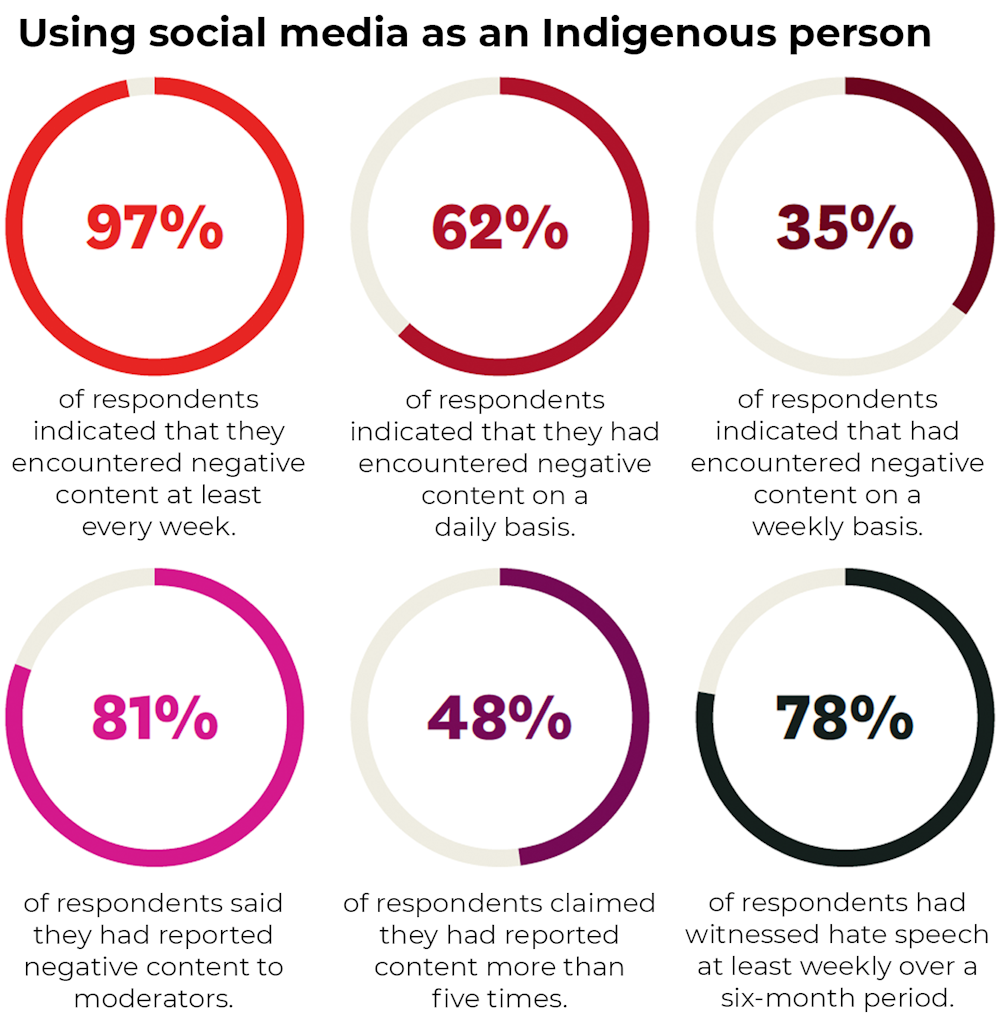 Negative findings shed light on the types of harmful content Indigenous people are facing on social media platforms.
Author provided, Author provided
Negative findings shed light on the types of harmful content Indigenous people are facing on social media platforms.
Author provided, Author provided
Among the most positive aspects, respondents cited accessing creative arts, Indigenous storytelling, and making contact with community members and services. Another positive was the ability to engage in political conversations — that is, to raise issues that are important to Indigenous people which may not receive adequate attention in mainstream media.
Despite these positive opportunities, there is a less comfortable side to social media which must be addressed. Bullying and harassment are having devastating effects on our young people and communities.
In 2019, academics Bronwyn Carlson and Ryan Frazer pointed to research that suggested
victims of cyberbullying are more likely to experience psychological ill-health, most seriously in the forms of depression, anxiety and thoughts of suicide.
Participants in our study agreed negative content was commonplace on social media. 63% of respondents said they experienced negative content on social media on a daily basis, while 97% reported witnessing negative content at least weekly.
Much of this content is grounded in ways of talking about Indigenous people and racist ideas that have pervaded Australian settler-colonial history.
This includes assimilationist policies that were based on the idea that Indigenous culture could be “bred out”. This line of thinking underpins assertions on social media that Indigenous people who live in cities or have fair skin are not genuinely Indigenous.
Read more: Why is it so offensive to say 'all lives matter'?
How can moderators and social media platforms help?
It comes as no surprise harmful speech exists on (and off) social media. What remains troubling, however, is that the cultural subtleties of offensive content are not readily identified by non-Indigenous platform moderators.
Our research included Indigenous voices in the discussion about what needs to be done to address these concerns. They identified a need to employ more Indigenous peoples in society generally – particularly in government, policy making institutions and education.
Indigenous perspectives and voices, which for too long have been silenced or ignored, need to be heard in these settings.
Participants also suggested social media platforms could employ more Indigenous people to assist with learning from Indigenous communities how to identify the cultural subtleties of harmful content online.
Indigenous people who contributed to this study had some advice for non-Indigenous individuals, too. They suggested people connect with Indigenous-led social media pages that showcase diverse cultures and knowledges.
In the wake of National Reconciliation Week, there is no better time to make an effort to reach out via social media and connect with Indigenous community pages and websites.
By listening to and engaging with Indigenous peoples’ opinions and perspectives on social media, non-Indigenous people can learn about the history of their local area and find out what is happening around them.
Most of all, they can learn about what is important to Indigenous communities and how we can work together toward a safer online, and offline, society.
Authors: Tristan Kennedy, Senior Lecturer In Indigenous Studies, Macquarie University


 Daily Bulletin


