

Why Indigenous knowledge should be an essential part of how we govern the world's oceans
- Written by: Meg Parsons, Senior Lecturer, University of Auckland
Our moana (ocean) is in a state of unprecedented ecological crisis. Multiple, cumulative impacts include pollution, sedimentation, overfishing, drilling and climate change. All affect the health of both marine life and coastal communities.
To reverse the decline and avoid reaching tipping points, we must adopt more holistic and integrated governance and management approaches.
Indigenous peoples have cared for their land and seascapes for generations, using traditional knowledge and practices. But our research on marine justice shows Indigenous peoples face ongoing challenges as they seek to assert their sovereignty and authority in marine spaces.
We don’t need to wait for innovative Western science to take better care of the oceans. We have an opportunity to empower traditional and contemporary Indigenous forms of governance and management for the benefit of all people and the ecosystems we are part of.
Our research highlights alternative governance and management models to improve equity and justice for Indigenous peoples. These range from shared decision-making with governments (co-governance) to Indigenous peoples regaining control and re-enacting Indigenous forms of marine governance and management.
Indigenous environmental stewardship
Throughout Oceania, Indigenous marine governance is experiencing a revival. The long-term environmental stewardship of Indigenous peoples is documented around the globe.
In Fiji, customary marine tenure is institutionalised through the qoliqoli system. This defines customary fishing areas in which village chiefs are responsible for managing fishing rights and compliance.
Coastal communities in Vanuatu continue to create and implement temporary marine protection zones (known as tapu) to allow fisheries stock to recover. In Samoa, villages are able to establish and enforce local fisheries management.
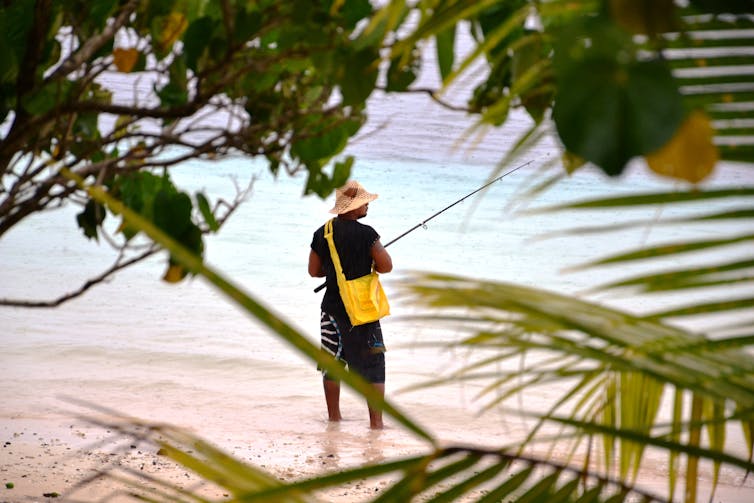 In Samoa, villages can set up and enforce marine protected areas.
Simon_sees/Flicker, CC BY-SA
In Samoa, villages can set up and enforce marine protected areas.
Simon_sees/Flicker, CC BY-SA
In Aotearoa New Zealand, Māori environmental use and management is premised on the principle of kaitiakitanga (environmental guardianship) rather than unsustainable extraction of resources.
Australian Aboriginal societies likewise use the term “caring for country” to refer to their ongoing and active guardianship of the lands, seas, air, water, plants, animals, spirits and ancestors.
From the mountains to the sea
These governance and management systems are based on Indigenous knowledge that connects places and cultures and emphasises holistic approaches. The acknowledgement of inter-relationships between human and nonhuman beings (plants, animals, forests, rivers, oceans etc.) is a common thread. So is an emphasis on reciprocity and respect towards all beings.
Read more: Respect for Indigenous knowledge must lead nature conservation efforts in Canada
Coastal and island Indigenous groups have specific obligations to care for and protect their marine environments and to use them sustainably. An inter-generational thread is part of these ethical duties. It takes into account the lessons and experiences of ancestors and considers the needs of future generations of people, plants, animals and other beings.
In contrast to Western ways of seeing the environment, the Australian Indigenous concept of country is not fragmented into different types of environment or scales of governance. Instead, land, air, water and the sea are all linked.
Likewise, for Māori, Ki uta ki tai (from the mountains to the sea) encapsulates a whole-of-landscape and seascape view.
Sharing knowledge across generations
Māori hold deep relationships with their rohe moana (saltwater territory). These are increasingly recognised by laws that emphasise Indigenous rights based on Te Tiriti o Waitangi. One example is the Integrated Kaipara Harbour Management Group, which co-manages the Kaipara Moana (harbour). The co-management agreement specifies shared responsibilities between different Māori entities (Kaipara Uri) and government agencies.
The agreement recognises Kaipara hapū (sub-tribes) and iwi (tribe) rights, interests and duties. It provides financial support to enable them to enact kaitiakitanga practices as they work to restore the mauri (life force) of the moana through practical efforts such as replanting native flora and reducing sedimentation.
They are using their mātauranga Māori (Māori Knowledge) alongside scientific knowledge to enact kaitiakitanga and ecosystem-based management.
Read more: When rehoming wildlife, Indigenous leadership delivers the best results
Another co-management agreement is operating in Hawai'i between the community of Hā‘ena (USA) and the Hawai’ian state government. The Hā‘ena community operates an Indigenous fishing education programme. Members of all ages camp together by the coast and learn where, what and how to harvest and prepare marine products.
In this way, Indigenous knowledge, with its emphasis on sustainable practices and environmental ethics, is transmitted across generations.
Indigenous knowledge, values and relationships with our ocean can make significant contributions to marine governance. We can learn from Indigenous worldviews that emphasise connectivity between all things. There are many similarities between ecosystem-based and Indigenous knowledge management systems.
We need to do more to recognise and empower Indigenous knowledge and ways of governing marine spaces. This could include new laws, institutions and initiatives that allow Indigenous groups to exercise their self-determination rights and draw on different types of knowledge to help create and maintain sustainable seas.
The authors acknowledge Roa Crease, Karen Fisher, and Gloria Hinestroza for their assistance with the research as well as Sustainable Seas National Science Challenge for providing funding.
Authors: Meg Parsons, Senior Lecturer, University of Auckland


 Daily Bulletin


