

About 500,000 Australian species are undiscovered – and scientists are on a 25-year mission to finish the job
- Written by: Kevin Thiele, Adjunct Assoc. Professor, The University of Western Australia
Here are two quiz questions for you. How many species of animals, plants, fungi, fish, insects and other organisms live in Australia? And how many of these have been discovered and named?
To the first, the answer is we don’t really know. But the best guess of taxonomists – the scientists who discover, name, classify and document species – is that Australia’s lands, rivers, coasts and oceans probably house more than 700,000 distinct species.
On the second, taxonomists estimate almost 200,000 species have been scientifically named since Europeans first began exploring, collecting and classifying Australia’s remarkable fauna and flora.
Together, these estimates are disturbing. After more than 300 years of effort, scientists have documented fewer than one-third of Australia’s species. The remaining 70% are unknown, and essentially invisible, to science.
Taxonomists in Australia name an average 1,000 new species each year. At that rate, it will take at least 400 years to complete even a first-pass stocktake of Australia’s biodiversity.
This poor knowledge is a serious threat to Australia’s environment. And a first-of-its kind report released today shows it’s also a huge missed economic opportunity. That’s why today, Australia’s taxonomists are calling on governments, industry and the community to support an important mission: discovering and documenting all Australian species within 25 years.
Australia: a biodiversity hotspot
Biologically, Australia is one of the richest and most diverse nations on Earth – between 7% and 10% of all species on Earth occur here. It also has among the world’s highest rates of species discovery. But our understanding of biodiversity is still very, very incomplete.
Of course, First Nations peoples discovered, named and classified many species within their knowledge systems long before Europeans arrived. But we have no ready way yet to compare their knowledge with Western taxonomy.
Finding new species in Australia is not hard - there are almost certainly unnamed species of insects, spiders, mites and fungi in your backyard. Any time you take a bush holiday you’ll drive past hundreds of undiscovered species. The problem is recognising the species as new and finding the time and resources to deal with them all.
Taxonomists describe and name new species only after very careful due diligence. Every specimen must be compared with all known named species and with close relatives to ensure it is truly a new species. This often involves detailed microscopic studies and gene sequencing.
More fieldwork is often needed to collect specimens and study other species. Specimens in museums and herbaria all over the world sometimes need to be checked. After a great deal of work, new species are described in scientific papers for others to assess and review.
So why do so many species remain undiscovered? One reason is a shortage of taxonomists trained to the level needed. Another is that technologies to substantially speed up the task have only been developed in the past decade or so. And both these, of course, need appropriate levels of funding.
Of course, some groups of organisms are better known than others. In general, noticeable species – mammals, birds, plants, butterflies and the like – are fairly well documented. Most less noticeable groups - many insects, fungi, mites, spiders and marine invertebrates - remain poorly known. But even inconspicuous species are important.
Fungi, for example, are essential for maintaining our natural ecosystems and agriculture. They fertilise soils, control pests, break down litter and recycle nutrients. Without fungi, the world would literally grind to a halt. Yet, more than 90% of Australian fungi are believed to be unknown.
Read more: How we discovered a hidden world of fungi inside the world’s biggest seed bank
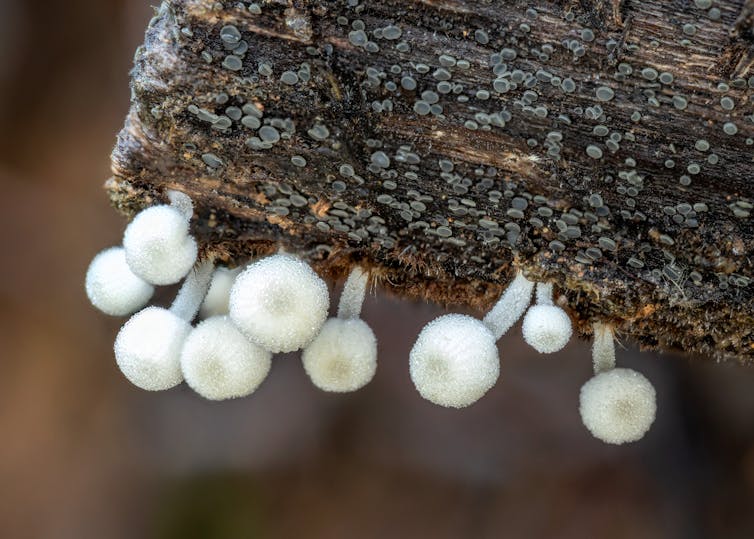 Fungi plays an essential ecosystem role.
Shutterstock
Fungi plays an essential ecosystem role.
Shutterstock
Mind the knowledge gap
So why does all this matter?
First, Australia’s biodiversity is under severe and increasing threat. To manage and conserve our living organisms, we must first discover and name them.
At present, it’s likely many undocumented species are becoming extinct, invisibly, before we know they exist. Or, perhaps worse, they will be discovered and named from dead specimens in our museums long after they have gone extinct in nature.
Second, many undiscovered species are crucial in maintaining a sustainable environment for us all. Others may emerge as pests and threats in future; most species are rarely noticed until something goes wrong. Knowing so little about them is a huge risk.
Third, enormous benefits are to be gained from these invisible species, once they are known and documented. A report released today by Deloitte Access Economics, commissioned by Taxonomy Australia, estimates a benefit to the national economy of between A$3.7 billion and A$28.9 billion if all remaining Australian species are documented.
Benefits will be greatest in biosecurity, medicine, conservation and agriculture. The report found every $1 invested in discovering all remaining Australian species will bring up to $35 of economic benefits. Such a cost-benefit analysis has never before been conducted in Australia.
The investment would cover, among other things, research infrastructure, an expanded grants program, a national effort to collect specimens of all species and new facilities for gene sequencing.
Read more: A few months ago, science gave this rare lizard a name – and it may already be headed for extinction
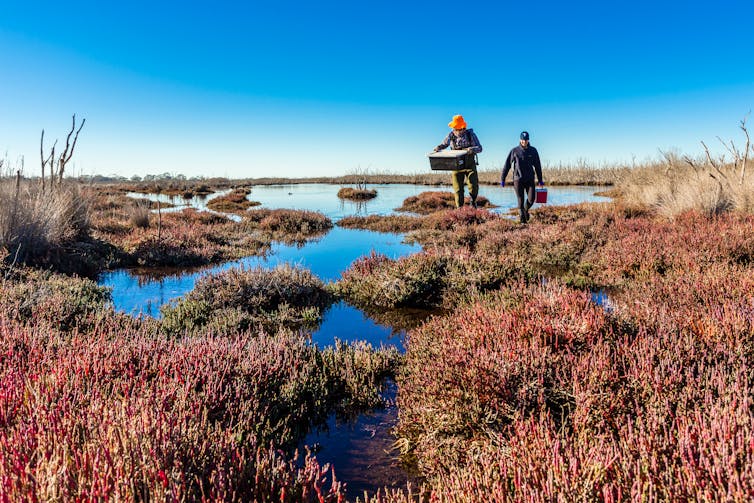 Discovering new species often involves lots of field work.
Shutterstock
Discovering new species often involves lots of field work.
Shutterstock
Mission possible
Australian taxonomists – in museums, herbaria, universities, at the CSIRO and in government departments – have spent the last few years planning an ambitious mission to discover and document all remaining Australian species within a generation.
So, is this ambitious goal achievable, or even imaginable? Fortunately, yes.
It will involve deploying new and emerging technologies, including high-throughput robotic DNA sequencing, artificial intelligence and supercomputing. This will vastly speed up the process from collecting specimens to naming new species, while ensuring rigour and care in the science.
A national meeting of Australian taxonomists, including the young early career researchers needed to carry the mission through, was held last year. The meeting confirmed that with the right technologies and more keen and bright minds trained for the task, the rate of species discovery in Australia could be sped up by the necessary 16-fold – reducing 400 years of effort to 25 years.
With the right people, technologies and investment, we could discover all Australian species. By 2050 Australia could be the world’s first biologically mega-rich nation to have documented all our species, for the direct benefit of this and future generations.
Read more: Hundreds of Australian lizard species are barely known to science. Many may face extinction
Authors: Kevin Thiele, Adjunct Assoc. Professor, The University of Western Australia


 Daily Bulletin


