

We need to prioritise teachers and staff for COVID vaccination — and stop closing schools with every lockdown
- Written by: Asha Bowen, Program Head of Vaccines and Infectious Diseases, and Head of Skin Health, Telethon Kids Institute
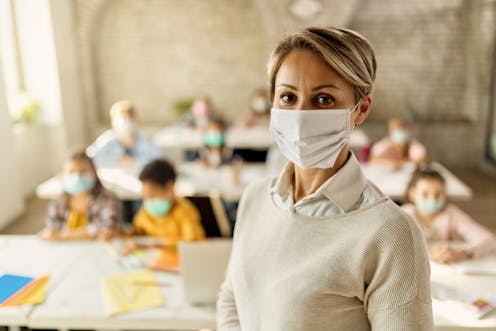
Yesterday Victoria announced a snap lockdown to last at least seven days starting from 11:59pm last night.
As part of the lockdown, schools will close and move to remote learning, and today is a pupil-free day while schools prepare to teach online. Only the children of authorised workers and vulnerable kids will continue to be able to learn in person.
It’s another episode of schools being closed seemingly as par for the course in any COVID-19 outbreak. While communities are concerned about the outbreak, the inclusion of schools in the lockdown should be as an extension of controls if transmission is more widespread, rather than the immediate response.
Despite good evidence, the previously developed traffic light system isn’t being used for schools during outbreaks in Australia. There’s currently no national plan to guide states and territories on how to manage schools during COVID outbreaks, and to advise them on the evidence and best-practice. This needs to change.
We argue schools should be prioritised to remain open, with transmission mitigation strategies in place, during low levels of community transmission.
What’s more, if schools are a priority, then vaccinating all school staff is something we should be urgently doing as part of these strategies.
Schools should be a priority
As paediatricians and vaccine experts, we believe kids’ well-being and learning should be among the top priorities in any outbreak.
We advocate for strategies to reduce the risk of COVID transmission in schools during outbreaks, including measures like:
minimising parents and other adults on the school grounds, including dropping kids off at the school gate rather than entering the school
parents, teachers, other school staff, and high-school students wearing masks
focusing on hand hygiene
enhanced physical distancing
good ventilation in classrooms and school buildings.
On top of this, we believe if schools, teachers and kids are viewed as a priority by decision makers, then vaccinating all school staff should urgently be considered.
Vaccinating all school staff would reassure those who have concerns about being at work in a school environment during a lockdown, and potentially lower the risk of spread in schools even further. This would increase the confidence in schools remaining open.
Kids are not major drivers of transmission
Kids can and do get sick with the SARS-CoV-2 coronavirus, though they tend to get less severe disease.
The best available evidence suggests kids and schools are not major drivers of transmission, even though children can transmit the virus.
Read more: Why do kids tend to have milder COVID? This new study gives us a clue
Snap lockdowns have become the new norm in Australia for managing COVID transmission emerging from hotel quarantine. We strongly argue snap lockdowns shouldn’t automatically include schools. Data from overseas, where widespread community transmission is occurring, suggests schools remaining open with public health measures in place hasn’t changed transmission rates very much.
We advocate for schools to remain open, and if a student or teacher attends a school while infectious, the measures in place to test, trace, and isolate the primary and secondary contacts are activated. We have done it before. NSW was able to continue with face-to-face learning and had 88% attendance in term three 2020 even with low levels of community transmission.
When there’s rampant community spread like some countries overseas, this changes the risk-benefit equation and school closures may be needed. The traffic light system has been developed for exactly this scenario.
But with an outbreak of 30 cases so far, we don’t think Victoria is near the flexion point where school closures are necessary. If there were many more, the risk equation would change, and the traffic light system could be applied.
Also, there’s a different risk equation for primary and secondary school students. Primary school kids are much less likely to transmit the virus than secondary school students. Daycare and early childhood centres remain open in Victoria. The evidence supports at least primary schools remaining open too.
We need a national plan on schools
Our concern is that jurisdictions are reaching for school closures as an almost predictable part of lockdown, without relying on a national plan to guide these decisions. The only current guidelines are the Australian Health Protection Principal Committee’s (AHPPC) statement from February on reducing the risk of COVID spread in schools.
Only about 13% of Australians have received at least one COVID vaccine dose, and ongoing community COVID outbreaks are expected for at least the next year or more. So, we need a proper national plan on COVID and schools. States and territories would benefit from a national plan, as they could lean on it to make informed decisions on schools during outbreaks.
School closures cause enormous strain
Whenever school closures are announced, we hear many parents sigh and say things like “I won’t be able to get any work done!”. Indeed, school closures put enormous strain on families, especially working parents with pre-school or primary school aged children. Younger children require some supervision and are less likely to have the skills necessary to get value out of online learning, compared to older kids in the latter stages of high school who may be more independent.
Challenges might also include poor or no internet, not being able to have relevant supervision, or not having the right devices.
Home learning has a substantial impact on children’s well-being and mental health. Over 50% of Victorian parents who participated in a Royal Children’s Hospital poll in August 2020 reported homeschooling had a negative impact on their kids’ emotional well-being during the second wave in 2020. This was compared to 26.7% in other states. Jurisdictions keep playing into this risk if they keep closing schools.
It’s an absolute priority we find and use ways to support kids to continue face-to-face learning in times of low community transmission, especially primary schools. One important way to do this is to prioritise teachers and other school staff for COVID vaccines.
Authors: Asha Bowen, Program Head of Vaccines and Infectious Diseases, and Head of Skin Health, Telethon Kids Institute


 Daily Bulletin


