

Laws governing police use of DNA are changing: are the proposals fair for all New Zealanders?
- Written by: Carrie Leonetti, Associate Professor of Law, University of Auckland
By helping identify perpetrators and the remains of victims, forensic DNA analysis holds enormous power to solve crimes. It also has enormous implications for privacy and fairness. But with science and society changing at such a pace, the law can struggle to keep up.
It is now 25 years since New Zealand’s Criminal Investigations (Bodily Samples) Act 1995 was written. Last year the New Zealand Law Commission recommended a complete overhaul of the law. Its report, The Use of DNA in Criminal Investigations, is now with the government for consideration.
While it contains 193 recommendations, the report still fails to engage with some of the most difficult issues involving DNA databanks.
At the heart of the issue is the offender databank, which the commission proposes limiting to DNA from people convicted of serious offences. While this might seem like a good balance between privacy and law enforcement, it sidesteps difficult philosophical questions:
If DNA analysis is crucial in catching the guilty, eliminating the innocent and identifying the missing, why do we bank only the DNA of “criminals”?
Is having one’s DNA placed in a databank a form of punishment, or are databanks merely a regulatory tool for more efficient and accurate resolution of crimes?
If DNA banking is viewed as an element of punishment, how is its inclusion in sentencing authorised?
If being included in a databank is merely an investigatory tool, why not include every New Zealander’s DNA from birth?
Whose DNA should we bank?
Proponents of DNA databanks have always sat at an uncomfortable intersection: they claim databanks are not punitive, but simultaneously seek to limit those included in such databanks to people with criminal records.
The Law Commission recommends separating the various databank categories: elimination samples (the “innocent”), the missing and unidentified (“victims”), investigations (“suspects”) and offenders (the “guilty”). While most index profiles are expunged as soon as they are no longer needed, offender profiles would be expunged only on evidence the offender had “rehabilitated”.
The problem with this distinction between the treatment of offender profiles and all other profiles in the databank is that it further entrenches the dichotomy between those who “deserve” to have their DNA banked and those whose privacy warrants protection.
DNA banking feels intuitively like a privacy invasion, but it is difficult to articulate why. When the US Supreme Court assessed the constitutionality of expanding DNA databanks from convicted offenders to people who had only been arrested, it struggled to identify the privacy interest in not having one’s DNA collected and banked.
DNA profiles, the court argued, are effectively no different to fingerprints or mug shots. At the same time, however, the court emphasised DNA collection was limited to individuals “in valid police custody” who were arrested for “serious offences”, and did not apply to the general public.
Māori are over-represented
Because New Zealand’s primary databank contains the DNA of “offenders” only, and because DNA profiles have hereditary components, who ends up in the databank has ethnic implications. Communities already over-represented in the criminal justice system are also over-represented in the DNA databank.
The commission acknowledged the over-representation of Māori in Aotearoa New Zealand’s databanks. But it didn’t adequately address the problem of potentially entrenching that disparity by filtering DNA profiles through the criminal justice system.
By recommending databanks remain limited to individuals involved in the criminal justice system, the commission helps perpetuate the mechanism that led to over-representation of Māori in databanks in the first instance.
Read more: Policing by consent is not ‘woke’ — it is fundamental to a democratic society
Creating databanks from a specific (and relatively powerless) segment of society – convicted criminals – also avoids greater political scrutiny of the privacy and ethical issues involved.
If we want to ensure there are adequate political safeguards against the abuse of databank information, we should include the DNA profiles of the rich and powerful.
This is not to advocate for a universal DNA databank. But the sound philosophical and scientific arguments for broadening the scope of databanks – more accurate identification and elimination of suspects, eliminating ethnic disparities – suggest political justifications, rather than philosophical or practical ones, underlie the commission’s decision to bank the DNA only of serious offenders.
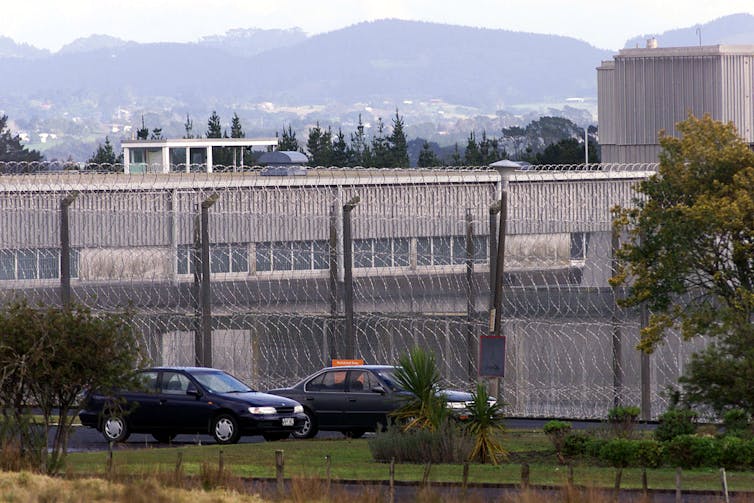 Paremoremo maximum security prison near Auckland: why store only the DNA of people in the criminal justice system?
GettyImages
Paremoremo maximum security prison near Auckland: why store only the DNA of people in the criminal justice system?
GettyImages
Casting the net too wide
Compounding the problem is the commission’s decision to endorse familial searches. These allow police to identify individuals in DNA databanks whose profiles have substantial similarity to a suspect sample. The police then use the identify of the family member in the databank to track down the suspect relative who is not.
Being Māori therefore not only increases an individual’s chances of being in the databank, but also of being targeted in a criminal investigation because a relative’s profile is in the databank.
The Human Rights Commission, Te Mana Raraunga (the Māori Data Sovereignty Network), the New Zealand Law Society, the New Zealand Bar Association and the Māori Law Society all expressed concerns about familial searching in their submissions.
Their arguments included that it intruded on privacy, constituted unjustified discrimination on the basis of family status under the Human Rights Act 1993, and was inconsistent with tikanga Māori.
The commission considered the issue, but ultimately endorsed familial searches with court authorisation.
Read more: DNA database sold to help law-enforcement crack cold cases
Who should have access?
The commission recommended restricting databank access to the police or their forensic providers, excluding independent researchers. But the commission’s reasoning for this could just as easily be used to argue against the use of databanks in the first place:
the privacy and discrimination risks if new technologies allow identification profiles that are currently anonymous
lack of consent by individuals whose profiles are banked
racial justice concerns from the skewed ethnic composition of the databank.
These are valid concerns, but independent research is the best way to determine the seriousness of the risks, how to mitigate them and whether they warrant discontinuing DNA banking and “cold hit” searching.
On the one hand, the commission acknowledges the risks. On the other, it insists there should be no independent (even anonymised) scrutiny of those risks.
Clearly, there is more work to be done here. The justice minister should seek answers to these questions before proposing an amendment to the law that could last another two decades.
Authors: Carrie Leonetti, Associate Professor of Law, University of Auckland


 Daily Bulletin


