

Was Phar Lap killed by gangsters? New research shows which conspiracies people believe in and why
- Written by: Mathew Marques, Lecturer in Social Psychology, La Trobe University
The Apollo moon landings were faked, Lee Harvey Oswald did not act alone to assassinate JFK, governments are hiding the existence of UFOs.
These are some classic conspiracy theories that almost everyone has heard about, and a sizeable number of people agree with. But little research has investigated “homegrown” conspiracy theories in Australia and New Zealand, and what drives people in these countries to believe in conspiracies. Are we much different from conspiracy believers elsewhere?
Our new research published in the journal Political Psychology delved into “homegrown” conspiracy beliefs of everyday Aussies and Kiwis, shedding light on which ones we buy into and which we put in the “tin foil hat” basket.
What conspiracies to Aussies and Kiwis believe?
When it comes to specifically Australian and New Zealand conspiracies, we found a majority of people in both countries (56.7% of Aussies and 50.1% Kiwis) endorsed at least one of the ones we asked about.
Sporting conspiracy theories were the most believed. For instance, almost one third of Aussies believed the racehorse Phar Lap’s sudden death in San Francisco in 1932 was the result of poisoning by US gangsters.
The most popular conspiracy theory amongst Kiwis was the All Blacks were deliberately poisoned prior to the 1995 Rugby World Cup final, which they narrowly lost to hosts South Africa.
 The All Blacks were stricken by a diarrhoea and vomiting bug two days before the final, a 15-12 loss in extra time.
John Parkin/AP
The All Blacks were stricken by a diarrhoea and vomiting bug two days before the final, a 15-12 loss in extra time.
John Parkin/AP
These are relatively innocuous narratives that perhaps are not all that surprising, given how central sports are to national identity.
But there was also a sizeable minority of people (8-12%) who believed in darker and more sinister conspiracies, such as the Port Arthur and Christchurch massacres were false flag operations by government agents with the aim of further restricting gun ownership.
Also, troublingly, 20% of Australian respondents and 16% of New Zealanders believed their governments were covering up the health risks of the new 5G cellular network.
Why do people believe in conspiracies?
Conspiracies are found to be true on occasion, which renders them no longer “theories”. For example, in the 1960s and 70s, the CIA really did engage in secretive experiments to identify drugs to force confessions (Project MKUltra).
But what is surprising is the degree to which people seem to believe in unfounded conspiracies, especially given the lack of evidence.
Previous research has highlighted three potential motives for why people buy into conspiracy theories.
First, people may latch onto conspiracy theories as a way of understanding and explaining a chaotic world, drawing links between unconnected events to create a sense of certainty.
For example, studies show people who prefer an intuitive style of thinking — “going with their gut” — are more likely to believe in conspiracy theories, while those who engage in more deliberative, analytic thinking are less convinced.
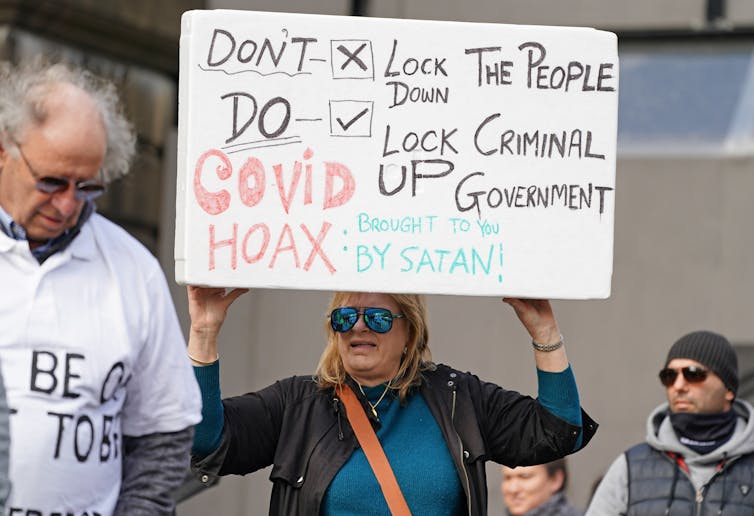 Anti-lockdown and anti-vaccine protests have been frequent sights in Australia throughout the pandemic.
Scott Barbour/AAP
Anti-lockdown and anti-vaccine protests have been frequent sights in Australia throughout the pandemic.
Scott Barbour/AAP
Second, for some people, believing in conspiracy theories gives them a greater sense of safety and control over the unknown. Central to this is a distrust of the “other” — as in, different types of people or groups.
Some researchers have pointed to this being evolutionary — a psychological mechanism that aims to minimise the risk of threats from enemies and maintain a safe environment for one’s “tribe”.
Read more: In defence of conspiracy theories (and why the term is a misnomer)
Lastly, conspiracy theories may serve as a way for people to maintain a positive sense of self and their identity as a member of a social group. This meets a fundamental human need for belonging. For example, those who felt socially excluded have been found to be more likely to engage in conspiracies.
In our research, we found evidence for all three motives being associated with belief in conspiracy theories.
We asked participants a series of validated questions and looked at their associations with beliefs in conspiracies. Those who were more likely to endorse conspiracy theories were less analytical in their thinking, less trusting of others, or felt alienated from mainstream society.
What does this mean for combating conspiracies?
Research has shown that belief in conspiracy theories, on balance, is harmful to society. Climate change conspiracy theories can motivate people away from social action, while conspiracy theories about 5G telecommunications have been associated with support for violent tendencies.
Also, research shows people who believe in one conspiracy theory tend to believe in others.
Read more: How misinformation about 5G is spreading within our government institutions – and who's responsible
Our other recent research shows people who engage in some kinds of conspiratorial thinking are also more likely to reject beneficial scientific innovations.
For example, those who believe in criminal conspiracies within governments and conspiracies related to restrictions on personal health practices and liberties are more likely to reject childhood vaccinations.
Trying to extricate friends and family from these webs of conspiracies can be difficult. But appealing to why they believe in them — rather than just what they believe — may be more effective at countering these beliefs.
Research suggests avoiding ridicule, showing empathy, affirming critical thinking and appealing to trusted message sources can help when talking to someone who believes in conspiracy theories.
We are currently planning and conducting further research to track people’s beliefs over time so we can pinpoint the key ingredients to their continued endorsement of conspiracies — and what convinces them to climb out of the rabbit hole.
We hope this will help counter the pernicious effects conspiracy theories have on societal cohesion.
Authors: Mathew Marques, Lecturer in Social Psychology, La Trobe University


 Daily Bulletin


