

So a helicopter flew on Mars for the first time. A space physicist explains why that's such a big deal
- Written by: Gail Iles, Senior Lecturer in Physics, RMIT University
Yesterday at 9pm Australian Eastern standard time, the Ingenuity helicopter — which landed on Mars with the Perseverance rover in February — took off from the Martian surface. More importantly, it hovered for about 30 seconds, three metres above the surface and came right back down again.
It may not sound like a huge feat, but it is. Ingenuity’s flight is the first powered flight of an aircraft on another planet. It marks a milestone in the story of human space exploration.
While the Apollo 11 spacecraft famously touched down on the Moon, upon re-launch it simply had to exit the Moon’s gravity and return to Earth. To sustain flight within the environment of a world with no atmosphere, however, is a different story.
The now historic Ingenuity helicopter took six years to make. We can understand why, once we understand the complexities of what was required.
Why local flight on Mars is a big deal
There are several technological challenges to conducting a helicopter flight on another world. First, and most significantly, helicopters need an atmosphere to fly.
The blades, or “rotors” of a helicopter must spin fast enough to generate a force called “lift”. But lift can only be generated in the presence of some kind of atmosphere. While Mars does have an atmosphere, it’s much, much thinner than Earth’s — about 100 times thinner, in fact.
Flying Ingenuity in Mars’s atmosphere is therefore the equivalent of flying a helicopter on Earth at a height of 100,000 feet. For reference, commercial aircraft fly between 30,000-40,000 feet above the Earth’s surface and the highest we’ve ever been in a helicopter on Earth is 42,000 feet.
Testing the craft on Earth required a pressurised room, from which a lot of air would have been extracted to emulate Mars’s atmosphere.
Then there’s the Martian gravity to consider, which is about one-third the strength of gravity on Earth. This actually gives us a slight advantage. If Mars had the same atmosphere as Earth, it’s lesser gravity means we’d be able to lift Ingenuity with less power than would be required here.
But while Mars’s gravity works to our advantage, this is offset by the lack of atmosphere.
Ingenuity’s success marks the first time such a flight has even been attempted outside of Earth. And the reason for this may simply be that, as laid out above, this task is very, very difficult.
Read more: '7 minutes of terror': a look at the technology Perseverance will need to survive landing on Mars
Advanced manufacturing
There are two main ways Ingenuity was able to overcome the hurdles presented in Mars’s atmosphere. Firstly, to generate lift, the two rotors (made from carbon fibre) had to spin much faster than any helicopter’s on Earth.
On Earth, most helicopters and drones have rotors that spin at about 400-500 revolutions per minute. The Ingenuity’s rotor spun at about 2,400 revolutions per minute.
It also has a distinct aircraft-to-wingspan ratio. While Ingenuity’s body is about the size of a tissue box, its blades are 1.2m from tip to tip.
Even transmitting the signal for the flight to begin required an array of advanced technology. Whilst it only requires minutes for radio signals to travel between Earth and Mars, there was still a delay of hours for those signals to reach the helicopter.
This makes sense when you consider the journey those signals have to take – from a computer on Earth, to a satellite dish, to the Mars Reconnaissance Orbiter, to the Perseverance rover and then, finally, to the helicopter.
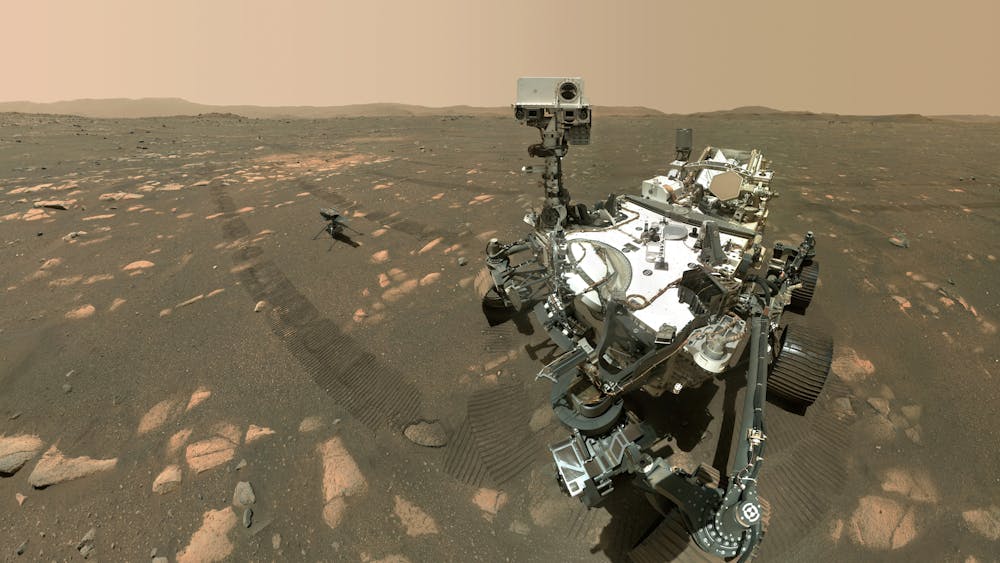 This image shows the Perseverance Mars rover with the Ingenuity helicopter about 4m behind it.
NASA/AP
This image shows the Perseverance Mars rover with the Ingenuity helicopter about 4m behind it.
NASA/AP
Remote controlled flight on Mars
Ingenuity is what we call a “technology demonstrator”. Simply, its only purpose is to prove it can complete a series of simple missions. Over the next few weeks, the helicopter will undertake three or four more flights, the most adventurous of which will involve taking off and travelling about 300m away from Perseverance.
Data retrieved from the flights will be analysed and used as crucial input for future designs of more sophisticated aircraft. Once this technology is applied, its potential will be vast.
Drones and helicopters operating on Mars could act as scouts, checking the land ahead of a rover to confirm whether it’s safe to travel there. Such aircraft could even assist in the search for water and life on the Martian surface.
And in 2035, it’s expected the first humans will land on Mars. There’s a good chance these crews will be trained in operating aircraft locally and in real-time, surveying the land for obstacles and dangerous terrain that could harm humans, or damage suits, aircraft or rovers.
Homage to the past, with the future in sight
As a touching tribute to the first powered flight on Earth, scientists at the NASA Jet Propulsion Laboratory added a historic artefact to the Mars helicopter. Attached to a cable underneath one of its solar panels is a small piece of the wing from the Wright brothers’ 1903 Wright flyer.
This item of flight history is the second piece of an Earth aircraft to go into space; a similar piece of the wing was taken to the Moon during the Apollo missions.
Missions are already in work to push the barriers of powered flight on other worlds. In particular, the Dragonfly helicopter is planned to fly above the surface of Titan, one of Saturn’s moons, with arrival scheduled for 2034.
Maybe it too will take a piece of Earth’s history along for the ride as we continue our exploration of other planetary bodies, one world at a time.
Authors: Gail Iles, Senior Lecturer in Physics, RMIT University


 Daily Bulletin


