

Double trouble: floods and COVID-19 have merged to pose great danger for Timor-Leste
- Written by: Mark Quigley, Associate Professor of Earthquake Science, The University of Melbourne
Timor-Leste is reeling after heavy rain caused severe floods and landslides over the Easter weekend, killing at least 42 people. Rates of COVID-19 in Timor-Leste are also on the rise. Together, these hazards threaten to interact with deadly consequences.
Our research has assessed the likelihood of natural hazards coinciding with, and influencing, the COVID-19 pandemic. Unsurprisingly, we found temporary relaxations of COVID-19 restrictions during natural disasters are likely to cause large spikes in infection rates.
In Timor-Leste’s capital Dili, the floods and the pandemic have combined to form a dangerous dynamic. Flood damage prompted authorities to temporarily lift COVID-19 restrictions. Evacuees are gathered in group shelters where social distancing may be challenging. Flooding cut power to some COVID treatment centres and put extra pressure on Timor-Leste’s health system.
The situation offers lessons for other populated, flood-prone cites battling the COVID-19 pandemic. Natural hazards will, of course, persist throughout the pandemic. Better understanding the complex interactions between double disasters will help societies and systems become more resilient.
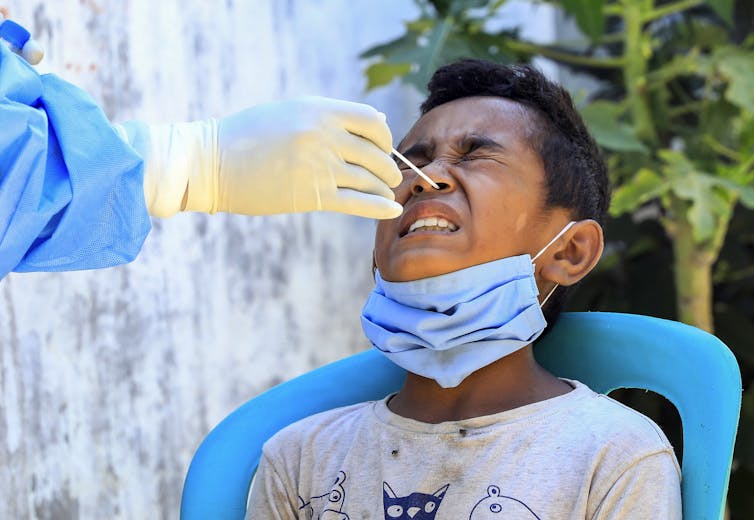 A boy undergoes a COVID test in Timor-Leste, where the pandemic response has been complicated by flooding.
Antonio Dasiparu/EPA
A boy undergoes a COVID test in Timor-Leste, where the pandemic response has been complicated by flooding.
Antonio Dasiparu/EPA
Dili: a recipe for disaster
On April 3 and 4, more than 400mm of rain was recorded in Dili. Floodwater and debris washed into populated areas. Recent reports indicate at least 42 people died and 13,554 were displaced. Nearby Indonesian islands were also hit and at least 130 deaths were reported.
Several natural and human factors combine to make Timor Leste vulnerable to flooding.
The country’s mountainous topography (see image below) encourages rainfall and creates steep stream systems that rapidly transfer floodwater into adjacent populated areas. Weak rocks and steep catchments are highly susceptible to landslides.
Read more: Cyclone Seroja just demolished parts of WA – and our warming world will bring more of the same
Flowing water interacts with the mountains, causing sediment to accumulate in the shape of a fan or cone. This directs flood waters and sediment into central Dili. Also, rampant deforestation and development has increased soil erosion and stream discharge during heavy rain.
Rapid and largely uncoordinated population growth, particularly in Dili, has concentrated vulnerable populations into flood plains and low-elevation coastal areas highly exposed to flooding.
Other factors increasing the flood risk in Dili include:
concrete structures that don’t allow water to sink into the ground
multi-pylon concrete bridges that trap flood debris
urban drainage channels choked with sediment and urban waste.
More broadly in the region, three climate features combined to create ideal conditions for the recent high rainfall and tropical storms: the West Pacific Monsoon, the Madden Julian Oscillation and a La Niña
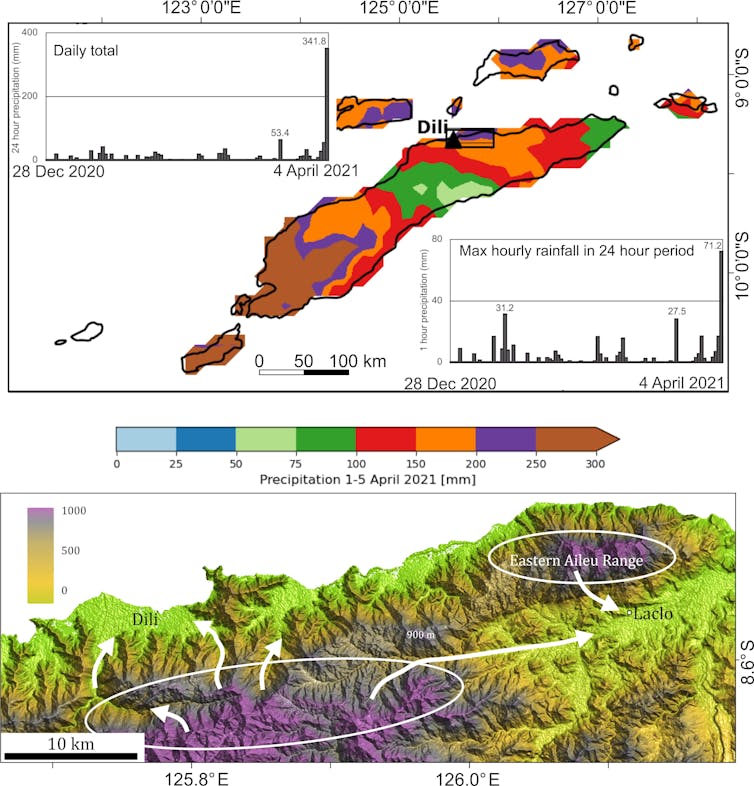 The top image shows modelled rainfall from April 1 to 5 across Timor-Leste. Inset images show the total daily rain (top left) and maximum hourly rain over a 24-hour period (bottom right) recorded at Dili. The bottom image shows the topography of northern Timor-Leste, where high-elevation catchments exit into low-elevation populations centres of Dili and Laclo.
The COVID combination
Dili is frequently hit by large floods – most recently in March 2020. But this time, the disaster coincided with an escalation in Timor Leste’s COVID-19 infection rate.
In late March this year, the number of new daily cases in Timor-Leste was rising quickly. On April 10, there were 70 new daily cases, bringing the total confirmed cases to more than 1,000.
Even without these twin disasters, many in Timor-Leste already lacked access to medical services and lived below the poverty line. COVID-19 restrictions exacerbated food shortages and poverty.
Then the floods hit. They left thousands homeless with severely restricted access to food and clean water. Roads and bridges collapsed. Crops were destroyed and firewood collection – essential for cooking – has been difficult in some areas.
The floods disrupted a COVID-19 lockdown in Dili, and forced people into crammed refuge centres. Flooding of a national medical storage facility damaged supplies. The national laboratory also flooded and a COVID-19 isolation facility was temporarily evacuated.
During floods, the risks of waterborne and vector-borne disease outbreaks increases. Should this occur, Timor-Leste’s fragile health system would be under even greater pressure.
The first batch of COVID-19 vaccines arrived in Timor Leste on April 5 and the vaccination program has managed to operate despite the flood-related challenges.
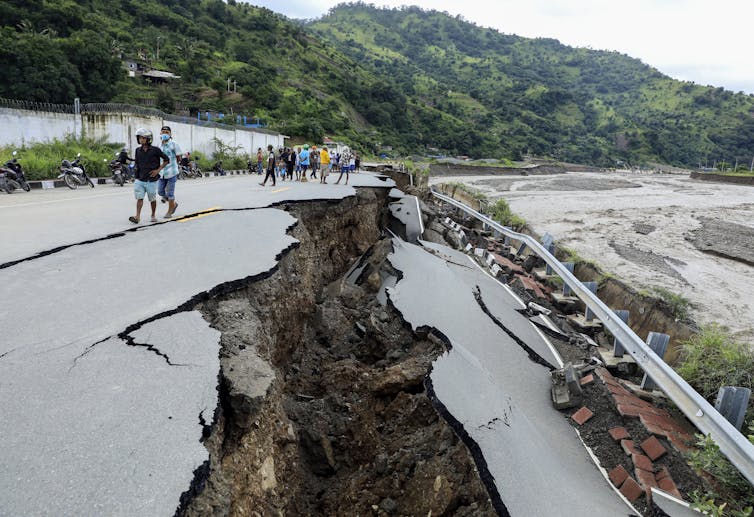 Floods in Timor-Leste caused roads to collapse.
Antonio Dasiparu/EPA
Floods in Timor-Leste caused roads to collapse.
Antonio Dasiparu/EPA
A global problem
Many global cities are vulnerable to multiple interacting hazards like those now faced by Timor-Leste. Our analysis suggests 16 of the world’s 20 most populous cities, comprising 5% of the world’s population, have similar geology, population density and/or land use to Dili and could face similar multiple disasters. These cities include Jakarta, Tokyo and Manila.
In emergency situations, the need for disaster response and recovery may justify temporarily lifting COVID-19 restrictions. But pandemic measures must be reinstated as soon as possible. Our modelling, pictured below, suggests when COVID restrictions are lifted in response to a disaster, infection rates ascend rapidly.
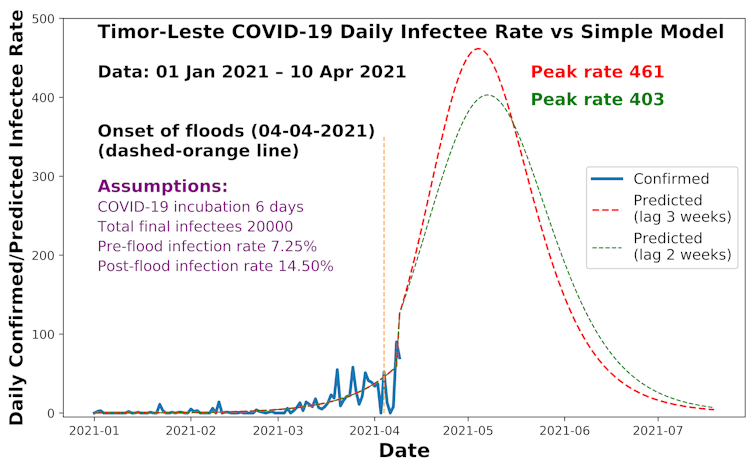 Blue line shows confirmed daily COVID-19 infections, which have increased since mid-March. The red and green lines are modelled forecasts for daily infection rates assuming relaxation of COVID-19 restrictions for two weeks (green) and three weeks (red). Testing delays may produce a time-lag between our forecast scenarios and the real-world data.
What can be done?
Potential solutions are more likely to be effective when they involve multiple groups working together. This includes international and local experts, diverse support agencies and affected communities.
Our research identifies ways to improve disaster preparedness and response in a COVID-19 world. They include:
developing scenarios and forecasts to deal with the interaction of multiple hazards, including COVID-19
using centrally operating disaster coordination platforms to assist and empower local disaster responders
evacuation centres that allow for social distancing
storing supplies of personal protective gear and medical equipment in areas less exposed to natural hazards
mobile teams of humanitarian workers, volunteers and medical staff that can respond to natural disasters in COVID-affected regions.
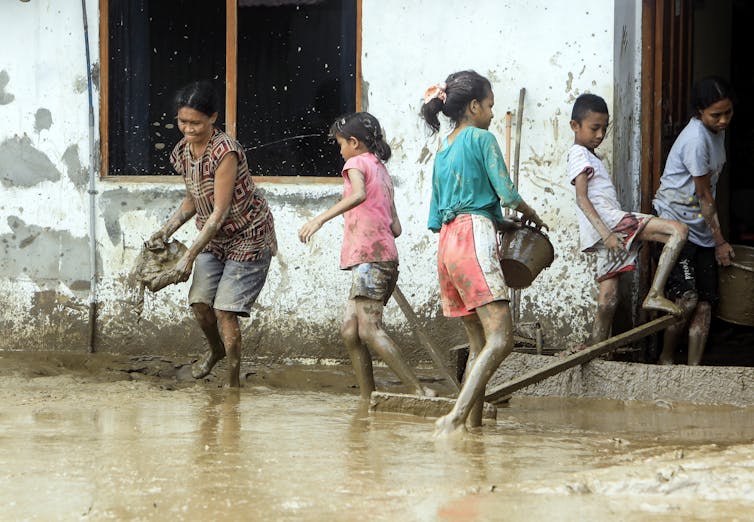 Widespread change is needed to protect vulnerable Dili residents from future disasters.
Antonio Dasiparu/EPA
Widespread change is needed to protect vulnerable Dili residents from future disasters.
Antonio Dasiparu/EPA
Finally, measures must be taken to reduce the risks posed by future disasters. This must be done in culturally informed ways and includes:
improving land and water management
land-use planning that considers disaster risk
urban clean-up after events such as floods.
Such actions are crucial in developing nations such as Timor-Leste, where urban development can amplify natural hazards with tragic results.
Oktoviano Tilman de Jesus, Demetrio Amaral Carvalho and Josh Trindade contributed invaluable expertise to this work.
This article is part of Conversation series on the nexus between disaster, disadvantage and resilience. Read the rest of the stories here.
Authors: Mark Quigley, Associate Professor of Earthquake Science, The University of Melbourne


 Daily Bulletin


