

Even with a vaccine, we need to adjust our mindset to playing the COVID-19 long game
- Written by: Robert Hoffmann, Professor of Economics and Chair of Behavioural Business Lab, RMIT University
Incredibly, a whole year has passed since the first emergence of COVID-19. What looked like a temporary inconvenience at first is turning into a permanent fixture that might forever change life as we knew it before 2020.
But how long will people continue to comply with the measures necessary to overcome the virus as complacency and fatigue set in?
As new outbreaks have cropped up in New South Wales, Victoria and Queensland in recent weeks, governments have responded with stringent new measures to prevent the spread of the virus, including border closures, mask mandates and temporary lockdowns.
In response, there has been some pushback. In Sydney, anti-mask protests are making a comeback, while hundreds partied on Bronte Beach in violation of distancing regulations. Others have absconded from quarantine hotels and airports.
Are these isolated cases, or signs of an increasingly exhausted public growing less tolerant of restrictions with the knowledge of vaccines on the way?
And could this kind of complacency could cost us the war against the virus?
The importance of psychology to winning the war
The absence of medical science would surely lose us the war against COVID-19. But psychology is no doubt equally important if we’re going to win it.
What ultimately stops a highly infectious disease is people’s compliance with the measures that governments put in place. This is why self-isolation, social distancing, curfews, good hygiene and face masks have become ingrained in our daily lives over the past year.
One might think these hard-learned behaviours will become habits that stick no matter how long the pandemic continues. But behavioural science warns us that dashed hopes, uncertainty, changing goalposts and broken credibility can play a major role in how long people strictly follow rules and maintain good habits.
A battle of willpower
The sacrifices that governments are continuing to ask people to make require self-control. Willpower has been likened to a mental muscle that can tire. There is some evidence that exercising self-control takes so much mental effort, it can eventually deplete people’s willpower.
Evidence also shows that as willpower wanes, people are more likely to make decisions that can pose risks to themselves and harm others.
Participants in one study, for instance, were asked to perform a tedious task. For some of these participants, the task was also designed to require more concentration. These participants later registered a higher willingness to take risks.
Read more: Beyond the police state to COVID-safe: life after lockdown will need a novel approach
In another study, a tedious and complex task made participants more likely to behave dishonestly. Depleted willpower undermined their ability to tell right from wrong.
These controversial results from experimental situations may not be directly applicable to today’s circumstances — they may not tell us anything about people’s long-term determination to fight the virus.
However, they do show us how important psychology is when assessing people’s abilities to comply with rules that go against their natural instincts and inclinations.
 A three-day lockdown in Brisbane prompted an immediate flurry of panic shopping.
Darren England/AAP
A three-day lockdown in Brisbane prompted an immediate flurry of panic shopping.
Darren England/AAP
Shifting goalposts and false hope
Performing a task, like following complex COVID rules and regulations, also depends on clear and achievable objectives. Vague or shifting goalposts and a lack of feedback on people’s progress toward a specific goal tend to undermine people’s motivation.
Shifting goalposts and mixed messages have been a consistent feature of governmental responses to COVID-19 — not just in Australia, but everywhere.
This is partly related to our evolving understanding of the virus and the most effective ways to stem transmissions. For instance, there has been much debate about the effectiveness of face masks, which has sown acrimony and confusion.
Governments have also made plenty of mistakes, such as providing incorrect COVID exposure sites to the public or mistranslated or out-of-date information to migrant communities.
All of this has can affect compliance. From a psychological standpoint, consistency plays an important role when it comes to people’s trust in authority and their willingness to follow rules, particularly when it comes to the type of long-term response required in a pandemic.
What people are willing to sacrifice also depends on their expectations. This is why optimism can be such a powerful tool to help people get through hard times. But if optimistic messages from governments begin to sound like false hope, this can have the opposite effect. Dejection can cause many to abandon good habits.
Anyone who took courage from Prime Minister Scott Morrison’s goal of making Australia “whole again by Christmas”, for example, may feel disheartened now that borders are once more closed, just a week into the new year. This could, in turn, sap people’s motivations to continue to behave in the right way.
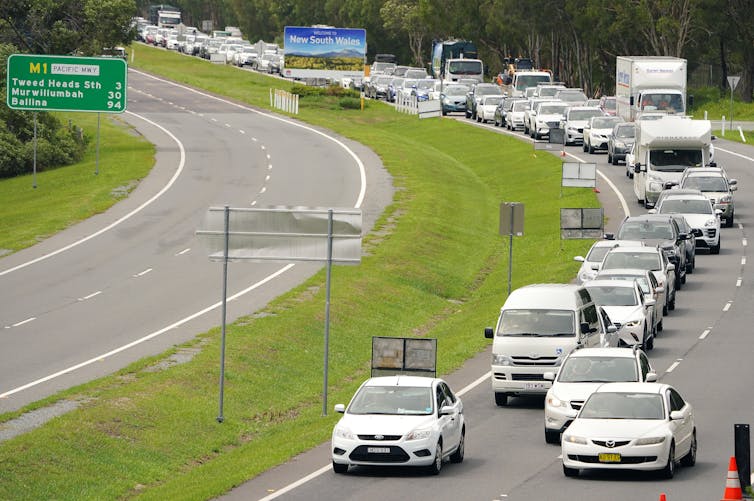 Many borders are closed again within Australia just weeks after opening.
Dave Hunt/AAP
Many borders are closed again within Australia just weeks after opening.
Dave Hunt/AAP
Balancing the message
As we enter a new year with no end in sight to the pandemic, many will surely wonder what the endgame is. Yes, vaccines will hopefully bring a return to normal life, but this may take considerable time. We may be living with COVID restrictions longer than we think.
What is clear is that government messaging continues to matter greatly. People need to be informed how we are travelling in the fight against the virus and how long the journey will take.
Read more: Australia's vaccine rollout will now start next month. Here's what we'll need
But this kind of messaging must be done with extreme care. Governments face the unenviable task of communicating enough positivity to motivate people to continue the fight without eventually losing credibility when unexpected bad news or delays occur.
With many more months of lockdowns, mask mandates and quarantining in our futures, we all need to manage our expectations appropriately, too. We need to remember the long game is what matters.
Authors: Robert Hoffmann, Professor of Economics and Chair of Behavioural Business Lab, RMIT University


 Daily Bulletin


