

People on Vanuatu's Malekula Island speak more than 30 Indigenous languages. Here's why we must record them
- Written by: Julie Barbour, Senior Lecturer, Linguistics, University of Waikato
Malekula, the second-largest island in the Vanuatu archipelago, has a linguistic connection to Aotearoa. All of its many languages are distantly related to te reo Māori and the island is the site of a long-term project to document them.
Vanuatu has been described as the world’s “densest linguistic landscape”, with as many as 145 languages spoken by a population of fewer than 300,000 people.
Malekula itself is home to about 25,000 people, who between them speak more than 30 Indigenous languages. Some are spoken by just a few hundred people.
For 20 years, our team of linguists has been working with small communities to document their languages and to develop resources to help preserve them.
Indigenous languages around the world are declining at a rapid rate, dying out with the demise of their last speakers. The UN Permanent Forum on Indigenous Issues (UNPFII) estimates one Indigenous language dies every two weeks.
As each language disappears, its unique cultural expression and world views are lost as well. Our project in Malekula hopes to counter this trend.
Read more: Indigenous languages matter – but all is not lost when they change or even disappear
Malekula languages
The work in Malekula began in the 1990s when the late Terry Crowley hosted a Neve’ei-speaking university student from a small village. The encounter inspired his interest in the island’s many Indigenous languages.
The Malekula project works with communities to facilitate literacy initiatives, often in the form of unpublished children’s books and thematic dictionaries. The research highlights the value of Indigenous languages as an expression of local cultural identity.
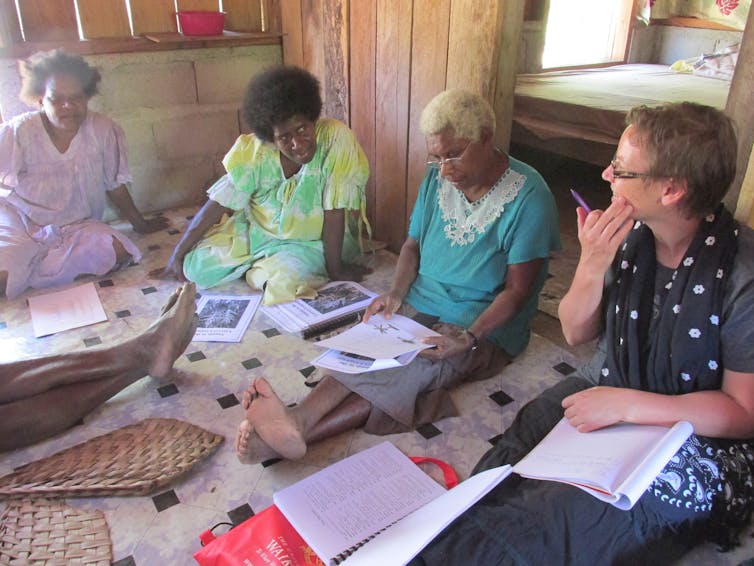 One of the authors, Julie Barbour, with a group of women at Larevet Village, Malekula.
Royce Dodd, Author provided
One of the authors, Julie Barbour, with a group of women at Larevet Village, Malekula.
Royce Dodd, Author provided
The Malekula project is a response to the urgent need to record the island’s Indigenous languages in the face of significant changes to almost every aspect of traditional life.
These changes have brought indigenous languages into contact and competition with colonial English and French and the home-grown Bislama, a dialect of Melanesian pidgin. From education to religion, administration and domestic life, Bislama is now often the language of choice.
Why is that a problem? The value of Indigenous languages lies in the fact that they articulate the way in which people have engaged with and understood their natural environment.
Malekula has a 3,000-year history of human settlement. Each language spoken on the island encodes unique ways in which its speakers have sustained life.
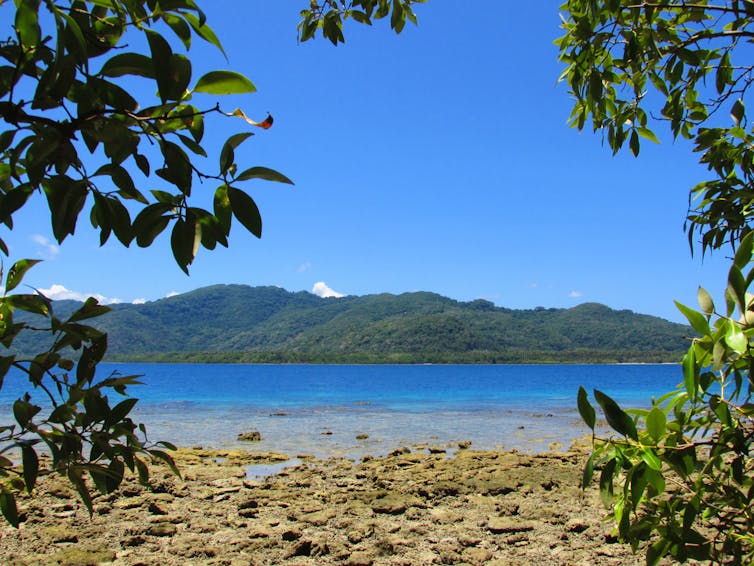 Indigenous languages preserve ways in which people engage with their environment.
Royce Dodd, Author provided
Indigenous languages preserve ways in which people engage with their environment.
Royce Dodd, Author provided
Another fundamental aspect of Indigenous languages is their direct link to cultural identity. In a place where distinctive local identities are the norm, the increasing use of Bislama reduces the linguistic diversity that has been sustained for millennia.
Returning knowledge to communities
In recent times, the way of life for the people of Malekula has shifted from intensely local communities to broader formal education. Imported religions have similarly influenced local belief systems.
The same centralised governance that facilitates infrastructure development and access to medical care also affects the autonomy of small communities to govern their affairs, including the languages in which children are taught.
Read more: The state of Australia's Indigenous languages – and how we can help people speak them more often
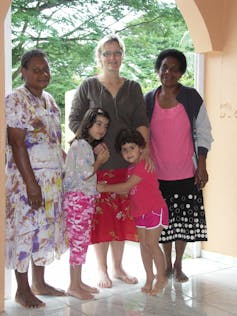 The author with speakers of the Uripiv language.
Royce Dodd, Author provided
The author with speakers of the Uripiv language.
Royce Dodd, Author provided
Traditionally, linguistic field research has produced valuable research for a highly specialist linguistic audience. Most scholars had no expectation of returning their research to the community of speakers.
We initially followed this tradition in writing about the Neverver language of Malekula, but grew increasingly dissatisfied with the expectations of the discipline. Looking to modern decolonising research methodologies and ethical guidelines in Aotearoa, we developed the “first audience principle”. This means Indigenous language communities should be the first to hear about any field research findings.
The Malekula project has a dual purpose: to conduct linguistic research and to develop language resources with and for their people. In 2019, its mandate was closely aligned with the three topics of the International Year of Indigenous Languages: support, access and promotion.
In 2020, the COVID-19 pandemic and travel bans brought linguistic fieldwork to an abrupt halt. During this unwelcome hiatus from fieldwork with Malekula communities, it has been tempting to focus on more technical analysis for our fellow academics. But our obligation to communities remains, and we are developing new ways of working with our archived field data in preparation for the time when we can return to Malekula.
Authors: Julie Barbour, Senior Lecturer, Linguistics, University of Waikato


 Daily Bulletin


