

Climate emergency or not, New Zealand needs to start doing its fair share of climate action
- Written by: Robert McLachlan, Professor in Applied Mathematics, Massey University
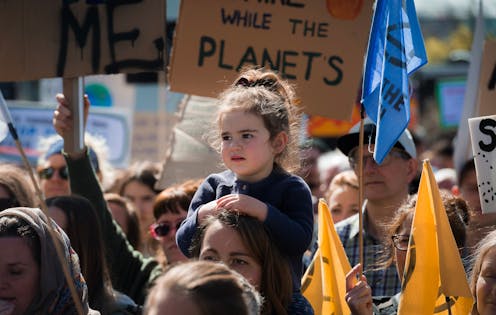
Following this week’s climate emergency declaration, New Zealand will have to face up to the fact it has one of the worst climate records of industrialised nations.
Of 43 industrialised countries — known as Annex 1 countries — 31 are experiencing a drop in emissions. But 12 have seen net emissions increase between 1990 and 2018, and New Zealand is near the top of this group.
As part of the Paris Agreement, countries were asked to submit emissions reduction targets. These Nationally Determined Contributions (NDCs) are a measure of a nation’s commitment to contribute to the goal of limiting warming to well below 2℃.
New Zealand submitted its NDC in 2015, with a headline target of bringing emissions down over the coming decade to 30% below 2005 levels. But this is not what it seems.
New Zealand’s NDC confuses the issue by adopting a target of net emissions in 2030 compared to a baseline of gross emissions in 2005. This target actually allows New Zealand to increase net emissions.
Read more: By declaring a climate emergency Jacinda Ardern needs to inspire hope, not fear
Last year, New Zealand introduced the Zero Carbon Act, making it one of few countries to have a zero-emissions goal enshrined in law. But current short-term policies do not yet keep up with the ambition to reach net zero emissions by 2050.
Fair and ambitious climate action
It was clear at the time of the Paris Agreement that countries’ initial targets would be woefully insufficient for limiting warming to well below 2℃. Therefore, the agreement requires countries to show a “progression over time” to reflect each country’s “highest possible ambition”.
In addition to increasingly more ambitious targets, countries were also asked to explain why their intended contribution to the common aim was fair. Many did so, but not New Zealand.
Some countries argued their contribution was fair because their total share of global emissions was small. Others said their per-capita emissions were small, while some high-emitting nations pointed out their per-capita emissions were falling. If those arguments weren’t applicable, some countries said it was particularly hard for them to reduce emissions, so their fair share should be smaller.
As any child in the playground complaining “That’s not fair!” would recognise, these are just self-serving excuses for inaction, rather than justifiable bases for determining fairness.
Read more: Why our response to climate change needs to be a just and careful revolution that limits pushback
Who decides what’s fair
The official United Nations (UN) review of climate plans won’t happen until 2023. For now, we have to rely on outside assessments. Two major ones, by Climate Action Tracker and the Climate Equity Reference Project, illustrate some possible approaches.
Climate Action Tracker argues an approach is fair if it would lead to the outcomes agreed in Paris, were it to be followed by all countries. On that basis, New Zealand’s NDC was rated insufficient, consistent with a world that would be 3℃ warmer.
The Climate Equity Reference Project attempts to determine universally agreed criteria of fairness, based on UN agreements and on discussions with social, environmental, development and faith groups around the world. They found there should be a component of historical responsibility — who got us into this mess, and who benefited from it?
This can be assessed by cumulative emissions from some starting point, such as 1850 or 1950. There should also be an element based on a country’s ability to act, assessed by GDP above a certain threshold.
Under this approach, New Zealand’s target would need to be for net emissions to reach zero by 2030, and to go negative after that by storing carbon and by investing in emission reductions in other countries. These conclusions were recently endorsed in a detailed study by Oxfam NZ.
Zero net emissions by 2030 is just not possible. New Zealand hasn’t even started reducing emissions yet.
Wealthy nations should shoulder more responsibility
So what can you do when you’ve agreed to something that you can’t achieve? The first step has to be to acknowledge the situation and to determine a fair contribution. New Zealand hasn’t done that yet — our present NDC (updated in April 2020 to reflect the Zero Carbon Act) does not mention fairness.
The second step is to work out the highest possible ambition. For example, New Zealand could follow the EU lead of cutting emissions by a further 42–48% in the next decade.
The Climate Change Commission, set up under the Zero Carbon Act, gives New Zealand a framework for addressing this. The commission is expected to release a consultation document in February, reviewing the NDC and preparing emissions budgets out to 2035.
The commission’s chair, Rod Carr, has acknowledged the importance of fairness in determining the NDC, saying:
I think fair share is a really good conversation for New Zealanders to have […] We’re a wealthy, developed nation. The wealthy nations, with the higher incomes per capita, do have a responsibility for doing more than the average.
The commission will also advise on how much of New Zealand’s contribution should be met domestically or internationally, and how much should be met by planting trees versus actually reducing emissions.
The latter is already a contentious issue, as the payments for “carbon farming” (which New Zealand’s Emissions Trading Scheme, uniquely in the world, includes) are leading to unrest in the farming and environment sectors.
If people are paid to store carbon in trees today, who bears the responsibility for maintaining that store indefinitely, and who bears the risk should it fail?
Climate change minister James Shaw has acknowledged the present target is weak, compared to what the US, EU and China are now considering, and that he is expecting a stronger target to be recommended by the commission next year.
New Zealand has put in place new institutions and mechanisms to cut emissions and to phase out fossil fuels. Now, we put them to work.
Authors: Robert McLachlan, Professor in Applied Mathematics, Massey University


 Daily Bulletin


