

Analysis shows how the Greens have changed the language of economic debate in New Zealand
- Written by: Geoffrey Ford, Lecturer in Digital Humanities / Postdoctoral Fellow in Political Science and International Relations, University of Canterbury
When Health Minister Chris Hipkins recently quipped that the Green Party is “to some extent the conscience of the Labour Party” he was not simply referring to polls suggesting Labour may need the Greens’ support to form a government.
Hipkins was also suggesting Green policies help keep Labour honest on environmental and social issues. So, what difference has the Green Party really made to New Zealand’s political debate?
Drawing on a study of 57 million words spoken in parliament between 2003 and 2016, our analysis shows the presence of a Green party has changed the political conversation on economics and environment.
In the recent Newshub leaders’ debate, both Jacinda Ardern and Judith Collins agreed that “growing the economy” was the best way to respond to the economic crisis driven by COVID-19.
Their responses varied only on traditional left-right lines. Ardern argued that raising incomes and investing in training would grow the economy. Collins suggested economic growth should be advanced by increasing consumer spending through temporary tax cuts.
By contrast, Green parties in New Zealand and elsewhere have long questioned the impact of relentless growth on the natural resources of a finite planet. Green thinking is informed by ecological economics, which aims to achieve more sustainable forms of collective prosperity that meet social needs within the planet’s limits.
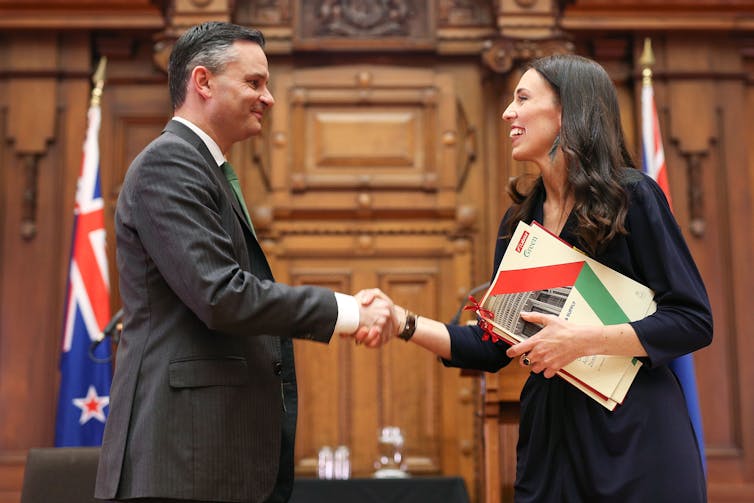 ‘Labour’s conscience’: Jacinda Ardern and James Shaw sign the confidence and supply agreement that brought the Greens into coalition in 2017.
GettyImages
‘Labour’s conscience’: Jacinda Ardern and James Shaw sign the confidence and supply agreement that brought the Greens into coalition in 2017.
GettyImages
The language of economic growth
The impact of this radically different view can be observed in New Zealand parliamentary debates. When MPs from National and Labour used the word “economy” they commonly talked about it in the context of “growth” (“grow”/“growing”/“growth”).
On average, National MPs said “growth” once every four mentions of “economy”. Labour MPs said “growth” once every six mentions.
Green MPs used “growth” once every 20 mentions of “economy”. When they did mention growth it was primarily to question the idea and to present alternative ideas about a sustainable economy.
Our analysis of the most recent parliamentary term (2017-2020) is ongoing. However, while Labour has recently introduced “well-being” into discussions of the economy, it is striking how the COVID crisis has reinvigorated the party’s traditional focus on growth economics.
The research also shows Green MPs mention “economy” primarily in relation to the environment, climate change, sustainability and people, rather than in relation to growth. Their distinct focus is on the connections between the economic system and the environment.
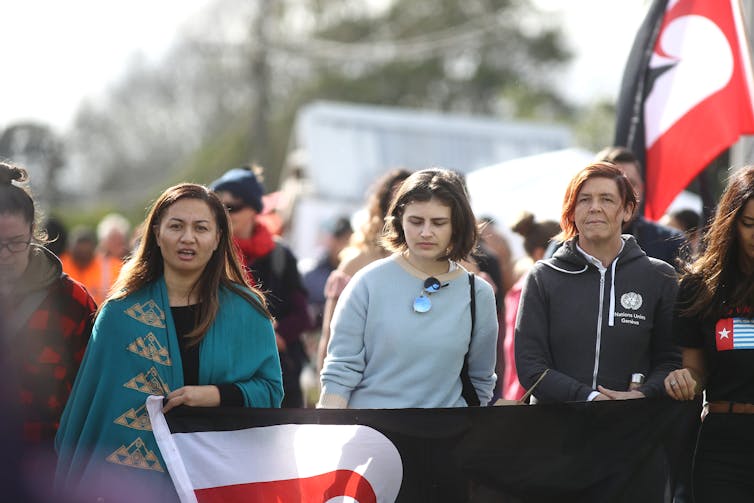 Not just an environmental party: Green MPs Marama Davidson, Chlöe Swarbrick and Jan Logie arrive at Ihumātao in Auckland to support protesters occupying disputed Māori land.
GettyImages
Not just an environmental party: Green MPs Marama Davidson, Chlöe Swarbrick and Jan Logie arrive at Ihumātao in Auckland to support protesters occupying disputed Māori land.
GettyImages
From Labour to the Greens
Despite criticism that the Greens have not focused enough on “environmental” concerns, Green MPs used words related to environment, climate and conservation more frequently than Labour or National MPs over the 13-year study period.
For example, after controlling for the number of words spoken by each party’s MPs in parliament, Green MPs mentioned “climate change” four times more than National or Labour MPs.
Read more: NZ election 2020: survey shows voters are divided on climate policy and urgency of action
This represents something of an historical shift. Atmospheric warming and CO₂ were first talked about in parliament by Labour MP Fraser Coleman in 1979. And Labour’s Geoffrey Palmer was the first prime minister to place climate change on parliament’s agenda.
But it has been the Greens who have maintained the momentum, using their speaking opportunities in the House to hold governments to account, including progressing legislation on the Climate Change Response (Zero Carbon) Amendment Act 2019.
Making women’s voices heard
The Green Party has also made a difference to who speaks. By institutionalising gender balance in their leadership and party organisation, and in the way they select their party list for each election, the Greens have consistently elected a higher proportion of female MPs than the other parties.
Historically, female Green MPs have contributed significantly to debates and policy action on inequality, child poverty, Treaty of Waitangi issues, gender equality and action on domestic violence.
Read more: Climate explained: are consumers willing to pay more for climate-friendly products?
This is significant. Analysis of political language globally, particularly on social media, has shown that politicians who identify as women and people of colour are subject to far higher rates of verbal abuse than their male counterparts. This is also the experience of female MPs in New Zealand, including women representing the Greens.
‘Quantity of life or quality of life?’ A 1972 election ad from the Values Party, political ancestor of the Greens.A history of disruption
Minority parties often struggle to maintain their identity in coalition arrangements with larger parties, but the Greens have retained a unique position in New Zealand.
In 1972 the Values Party became the first “green” party to contest a national election anywhere in the world. Former Values activists, including the first Green Party co-leaders Jeanette Fitzsimons and Rod Donald, were later successful in taking the Greens into parliament.
The language of green politics in New Zealand and the questioning of growth can be traced back to these origins. Language and words are significant as vehicles for articulating new ideas and provoking transformative action.
Linguistic analysis therefore shows how influential the Green Party has been in presenting alternatives to the idea that economic growth based on unlimited use of New Zealand’s natural resources is a sustainable option.
If Chris Hipkins is correct and the Greens are Labour’s conscience, it is because they have effectively disrupted a historical near-consensus among the major parties that economic growth is the only driver of prosperity.
Authors: Geoffrey Ford, Lecturer in Digital Humanities / Postdoctoral Fellow in Political Science and International Relations, University of Canterbury


 Daily Bulletin


