

PhD students need support at the best of the times. How can you help in a pandemic?
- Written by: Melissa Hart, Graduate Director, ARC Centre of Excellence for Climate Extremes, UNSW
A typical Australian PhD often involves a focused research project at one university, with one to two supervisors, and often far from your home or home country. It can be a quite isolating experience.
PhD students are also at great risk of mental health problems. A pre-COVID study from Belgium found one in two PhD students experiences psychological distress. One in three is at risk of psychiatric disorder.
And this year a pandemic has been thrown into the mix.
The cross-institutional, collaborative nature of the Australian Research Council (ARC) Centres of Excellence has allowed a re-imagining of the Australian PhD experience. Here we outline the steps the ARC Centre of Excellence for Climate Extremes has taken to support our graduate students during COVID. There’s a checklist later in this article.
The graduate director, a dedicated academic position, leads the program and also acts as an advocate and mentor to our students. At any one time the centre has 100 graduate students, 60% of them international, enrolled in one of five universities across four cities.
COVID added to existing needs
The cross-institutional nature of our centre meant our students went into the pandemic already used to videoconference meetings, seminars and training. What was lost, however, was the important and often ad-hoc supportive and collaborative conversations with peers and colleagues. These chats could happen at conferences and workshops, or simply with office mates in the work kitchen.
 Many PhD students feel the strain of juggling multiple challenges, often a long way from home.
Shutterstock
Many PhD students feel the strain of juggling multiple challenges, often a long way from home.
Shutterstock
Beyond the challenges of continuing their research under new, even more isolating, conditions, our students also have a range of individual factors to deal with in the current circumstances. These may include: caring responsibilities, challenging work-from-home environments, being far from family, or simply the mental load of undertaking a PhD during a pandemic.
Early on in the centre’s life we set up mental health initiatives to ensure centre-wide support and well-being. These initiatives range from weekly hump-day tips focused on mental well-being through to ensuring we had staff and students at each university trained in mental health first aid. This sort of support has become increasingly important during the calamity 2020 has become.
Help where you can, or call on others
Importantly, we recognise as supervisors we cannot resolve all issues. While we can provide an empathetic ear, in many cases students need to be redirected to the mental health support our universities’ counselling services provide.
We realised early on in the pandemic leaders in the centre can only offer support when they themselves are supported. Therefore, members of our centre executive received guidance, and have undertaken training, on managing others in a time of crisis. This was offered via their universities’ employee assistance program.
Our researchers were specifically tasked with checking in on all their students. We asked questions about working-from-home environments to ensure students had the computing and internet resources needed to continue their research. We also made note of any circumstances that might affect progress, such as caring responsibilities.
Any issues the centre could resolve we did. Those we could not resolve we reported in student progress review documents. We ensured students were aware of extra support available such as university counselling services.
Read more: 3 ways the coronavirus outbreak will affect international students and how unis can help
Financial hardship increased
 Three-quarters of PhD students surveyed expected the pandemic to cause them financial hardship.
Shutterstock
Three-quarters of PhD students surveyed expected the pandemic to cause them financial hardship.
Shutterstock
A recent study of Australian PhD students showed 75% expected to experience financial hardship as a result of the pandemic, and we have seen that. Students close to completion were hit hardest. They were faced with the end of their scholarships at a time of employment uncertainty, often with no access to government support, and closed borders that prevented them returning home.
The centre quickly offered scholarships to provide bridging funds after thesis submission. These scholarships were offered once individual university support was exhausted and required a tangible outcome at the end, such as writing up a thesis chapter for submission to a journal.
Working to stay connected
At the same time as we dealt with the practical realities of student finances and research, we made every effort to keep everyone socially connected.
Our annual winter school, a cornerstone event of the graduate program, shifted online. To avoid Zoom fatigue we replaced the week-long face-to-face schedule with a winter school offered in two-hour slots. Sessions were recorded and breakout rooms used to focus student engagement with each other. When we saw how delighted students were to see each other in small groups and catch up, it was a sign for us to step out and let them engage with their peers.
We introduced additional Slack channels, held virtual morning and afternoon teas and put together a weekly centre-wide lunch for all early career researchers. The numbers in these virtual meet-ups declined as students settled into new routines. In contrast, our research meeting and seminar attendances went through the roof. We found if an event has a purpose people attend, even while social check-ups became less successful.
Finally, we continued to celebrate successes and PhD submissions in a long-running weekly email update. In these updates, we made it clear we understood the impacts of these uncertain times on students’ progress.
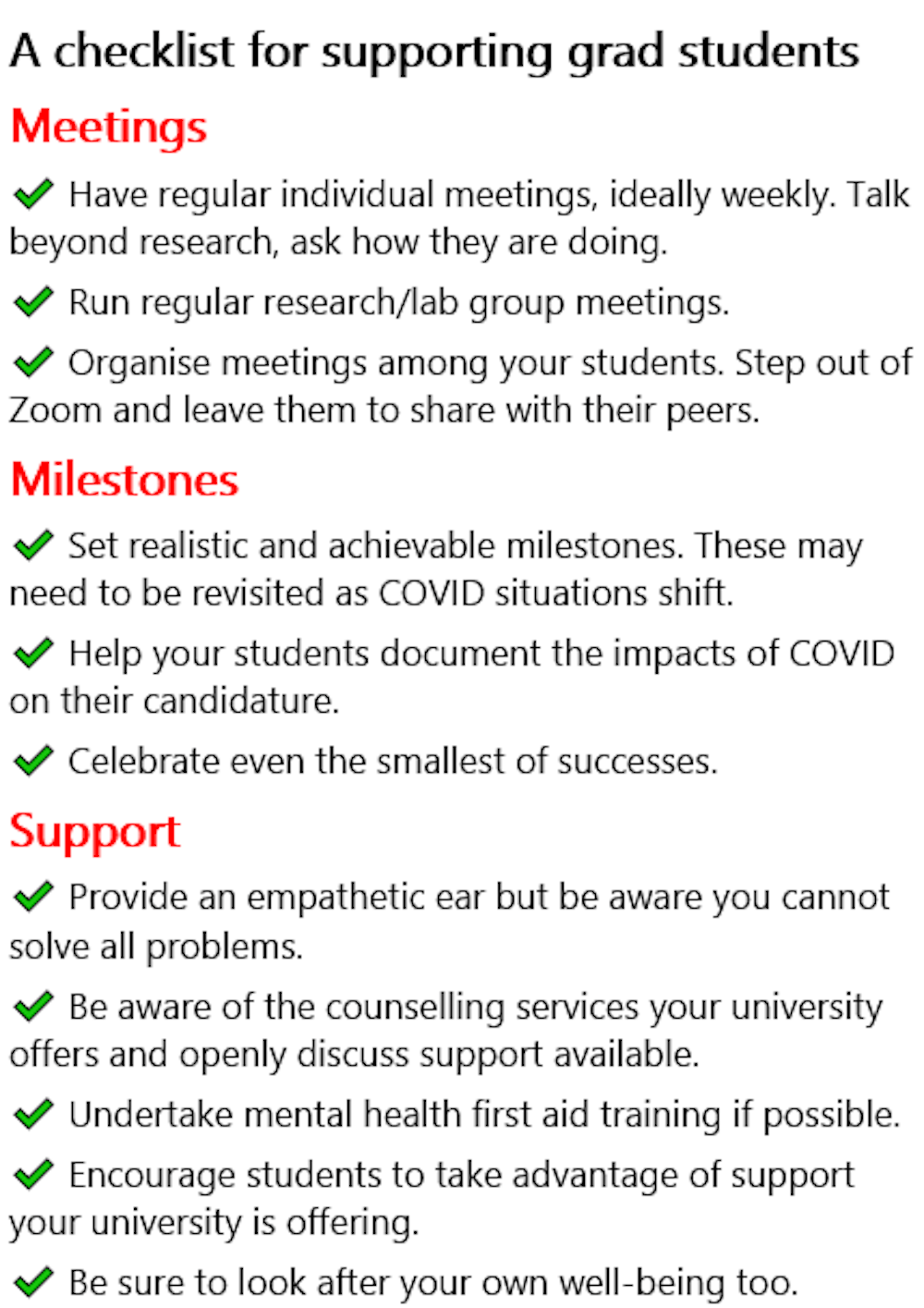 Author provided
While not everything worked perfectly, our centre-wide relationship with students put us in an excellent position to respond quickly, transparently and with student input as the pandemic unfolded.
We do not know how long this pandemic will last. What we do know is all current and any incoming PhD candidates will feel the impacts in some way. With PhD students producing more than half of university research in Australia, this crisis illustrates the importance of ongoing development and support of higher-degree research students.
Author provided
While not everything worked perfectly, our centre-wide relationship with students put us in an excellent position to respond quickly, transparently and with student input as the pandemic unfolded.
We do not know how long this pandemic will last. What we do know is all current and any incoming PhD candidates will feel the impacts in some way. With PhD students producing more than half of university research in Australia, this crisis illustrates the importance of ongoing development and support of higher-degree research students.
Authors: Melissa Hart, Graduate Director, ARC Centre of Excellence for Climate Extremes, UNSW


 Daily Bulletin


