

Shinzo Abe, Japan's longest-serving leader, leaves office a diminished figure with an unfulfilled legacy
- Written by: Craig Mark, Professor, Faculty of International Studies, Kyoritsu Women's University
Japanese Prime Minister Shinzo Abe ended weeks of speculation about the state of his health by announcing his surprise resignation today.
The 65-year-old Abe was finally forced to concede to the ulcerative colitis intestinal disease that had brought his first brief term in office to an end in 2007.
After being treated with a new course of medication, Abe made a remarkable political comeback in 2012. He regained the leadership of the conservative Liberal Democratic Party (LDP), and led it back into government, three years after it was knocked out of power.
Abe easily defeated the weak and disorganised opposition parties in the 2014 and 2017 elections, and in 2018 secured an unprecedented third three-year term as LDP president, with his supporters speculating he could lead for yet another.
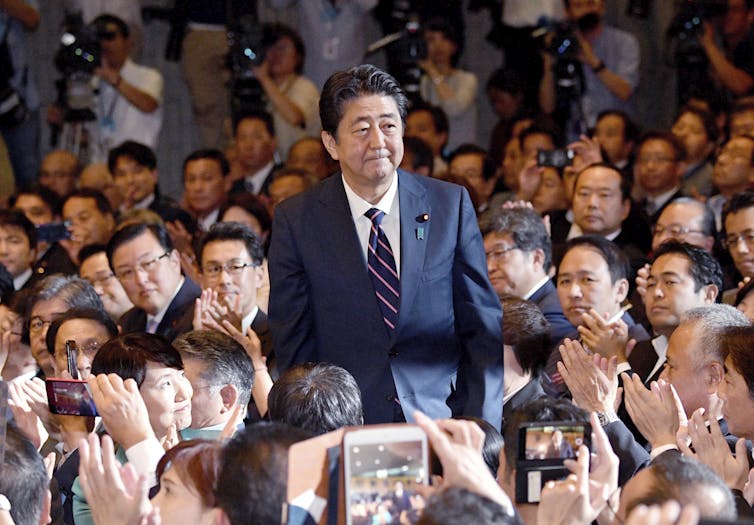 Abe was re-elected as LDP president in a landslide victory in 2018.
Takehiko Suzuki/AP
Abe was re-elected as LDP president in a landslide victory in 2018.
Takehiko Suzuki/AP
Partial successes in the economy, defence
Abe kept up this political success based around his core economic policy, prominently marketed as “Abenomics”. This comprised the three “arrows” of record stimulus spending, quantitative easing (printing money to buy assets), and attempts at deregulation.
Abenomics was partially successful at restoring mild economic growth, but this started to wane after consumption tax hikes last October. The country then slipped into recession with the coronavirus pandemic.
In foreign policy, the nationalistic Abe reinterpreted Japan’s pacifist constitution, passing bills in the Diet in 2015 to allow collective self-defence with its US ally — despite a lack of public support and large student-led demonstrations.
Accompanied by a sharp increase in defence spending, Abe’s long-held desire to change the constitution to allow even more assertive use of the Japanese Self-Defence Forces was left unfulfilled. In 2019 Upper House elections, the LDP and its coalition partners lost the two-thirds majority required to allow any constitutional referendum.
Despite this setback, the lack of a strong challenger within the LDP — as well as the failure of the opposition parties to pose any credible threat — allowed Abe eventually to become the longest-serving prime minister in Japanese history.
Deeper relations with regional states
Abe energetically pursued foreign affairs throughout his tenure, maintaining the key US alliance through presidents Barack Obama to Donald Trump.
He sought greater Japanese participation in regional security by promoting a “free and open Indo-Pacific” region, and in doing so, deepened Japan’s strategic relations with India, ASEAN and Australia.
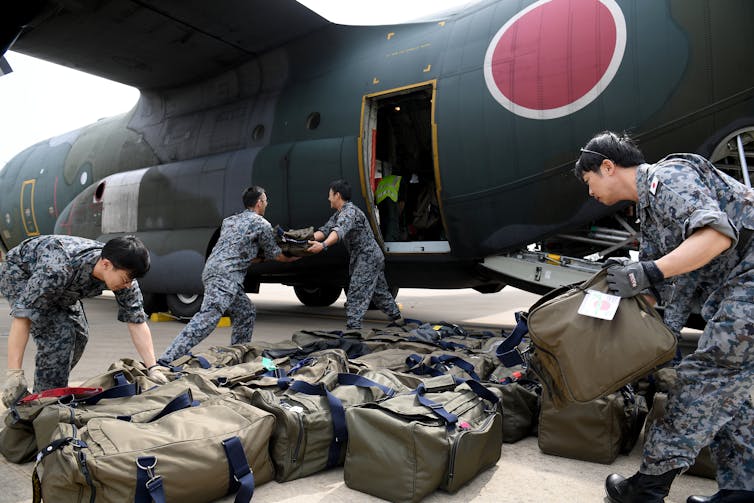 Japan’s Self-Defence Force brought recovery equipment and personnel to help in Australia’s response to bushfires this year.
DAN HIMBRECHTS/AAP
Japan’s Self-Defence Force brought recovery equipment and personnel to help in Australia’s response to bushfires this year.
DAN HIMBRECHTS/AAP
Abe managed largely stable relations with China, Japan’s largest trading partner, but territorial disputes with Beijing, as well as with Russia and South Korea, also went unresolved. Relations with South Korea, in particular, reached a low point over their wartime and colonial history.
Abe nevertheless built on his image as a senior world leader, culminating in hosting the G20 summit in Osaka last year.
Read more: Shinzo Abe's latest cabinet reshuffle could transform Japan
A bungled response to coronavirus
Abe’s erratic response to the coronavirus caused a sharp decline in his authority this year. A massive stimulus spending program sought to limit the damage to the economy, but the overall public response by Abe’s government lacked clear direction.
Regional leaders such as Tokyo Governor Yuriko Koike pushed early for a national state of emergency, but Abe only reluctantly declared one in April — and it only lasted around a month. Abe also delayed making a decision to postpone the Tokyo Olympics until foreign delegations announced they wouldn’t attend.
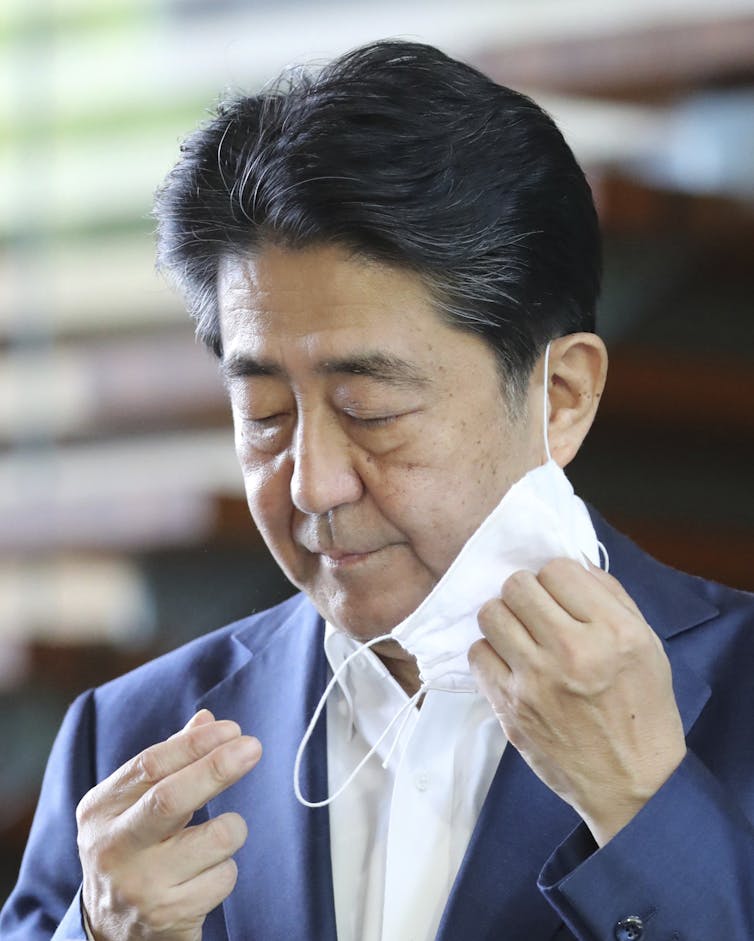 Abe’s leadership was damaged by the government’s initial missteps in its coronavirus response.
Masanori Genko/AP
Abe’s leadership was damaged by the government’s initial missteps in its coronavirus response.
Masanori Genko/AP
While Japan has fared relatively well dealing with COVID-19, there have been other ill-considered responses by the government. These included the widely ridiculed “Abenomasks” and the “GoTo Travel” domestic tourism campaign, which entrenched the public’s impression Abe was failing to respond energetically enough to the crisis.
Persistent political scandals also continued to erode Abe’s legitimacy.
From mid-June, Abe held no press conferences for nearly 50 days, and made few public appearances until the commemorations around the 75th anniversary of the end of the second world war in mid-August.
As his approval ratings dropped to their lowest levels since 2012, Abe made a series of hospital visits in recent weeks. This sparked media speculation over his health, which LDP officials vainly tried to downplay.
Read more: How Shinzo Abe has fumbled Japan's coronavirus response
Who will be the next prime minister?
Abe will stay on as caretaker until the LDP’s Diet members elect a new president sometime over the next two or three weeks. This person will then be confirmed as prime minister by a vote in the Diet.
Speculation about his successor was already building in anticipation of the end of his term in September 2021, but this has now been rushed forward.
Prime candidates include his main old rival, former Defence Minister Shigeru Ishiba, who enjoys the highest public approval ratings as an alternative leader. Fumio Kishida, the LDP policy council chief and former foreign minister, is widely considered to be favoured by Abe as his replacement.
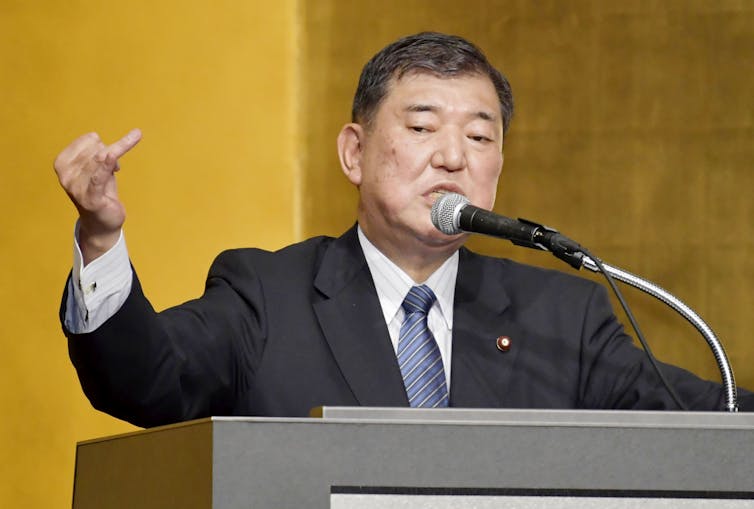 Shigeru Ishiba is seen as a potential successor to Abe.
KYDPL KYODO/AP
Shigeru Ishiba is seen as a potential successor to Abe.
KYDPL KYODO/AP
Another long-standing ally, Chief Cabinet Secretary Yoshihide Suga may also be in contention, as could Defence Minister Taro Kono or Economic Revitalisation Minister Yasutoshi Nishimura.
Whoever is chosen by the LDP is unlikely to greatly change the direction of Japan’s economic and foreign policy. The new leader will have the ongoing responsibility of dealing with the persistent “second wave” of the COVID-19 pandemic and trying to engineer a post-pandemic recovery, while still burdened with record public debt and an ageing population.
Japan’s next prime minister will also soon face the judgement of the electorate, as the next national election is due by October 2021. The end of this patrician era of conservative politics has dramatically brought Japanese politics into an suddenly uncertain future.
Read more: Why the fall-out from postponing the Olympics may not be as bad as we think
Authors: Craig Mark, Professor, Faculty of International Studies, Kyoritsu Women's University


 Daily Bulletin


