

Google's 'open letter' is trying to scare Australians. The company simply doesn't want to pay for news
- Written by: Belinda Barnet, Senior Lecturer in Media and Communications, Swinburne University of Technology
If you went to use Google yesterday, you may have been met with a pop-up, warning that the tech giant’s functionality was “at risk” from new Australian government regulation.
Google Australia’s managing director, Mel Silva, wrote an open letter in response to the Australian Competition and Consumer Commission (ACCC) News Media Bargaining Code, which would require Google (and Facebook) to negotiate “fair payment” for Australian news content published on their services.
The letter, pinned to the Google homepage, claims the code would force Google “to provide you with a dramatically worse Google Search and YouTube”. The ACCC has already labelled several of the letter’s statements as “misinformation”.
It seems Google isn’t keen to set a global precedent by paying Australian news outlets for their content. Google claims the ACCC’s proposed code is disastrous, for a variety of reasons.
Its letter is part of a campaign designed to scare Australian web users. Don’t fall for it.
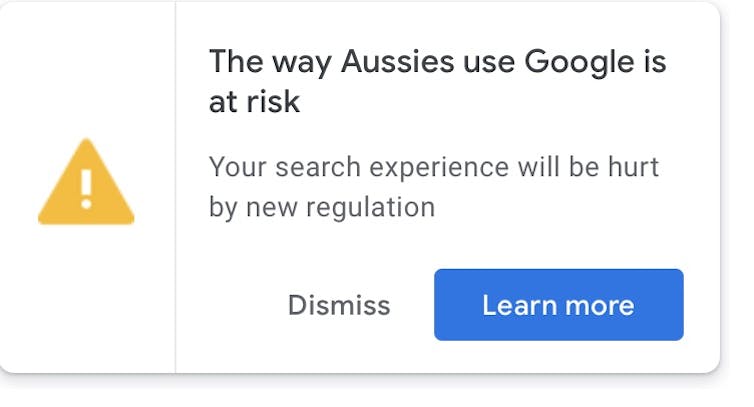 Hordes of people took to social media to express dismay and confusion about the unexpected prompt.
Screenshot
Hordes of people took to social media to express dismay and confusion about the unexpected prompt.
Screenshot
Google’s claims don’t stack up
First, Google is objecting to a specific part of the legislation designed to stop it downranking (or refusing to list) news content if Google has to pay for it.
This is precisely how Google responded when similar legislation was introduced in Spain. Google changed its search results and even shut some outlets out completely to avoid paying for news content.
The ACCC is heading that off at the pass. The legislation states if Google intends to change the search ranking of a news organisation, for example by downranking that outlet’s stories in Google’s search results, it must give the organisation 28 days’ notice of this change.
The open letter claims this is unfair and would help news outlets “artificially inflate their ranking over everyone else”.
When asked how this was this case, a Google spokesperson told The Conversation the code would require the company to “give all news media businesses advance notice of algorithm changes and explain how they can minimise the effects”.
They said this provision would “seriously damage” Google’s products and user experience and impact its ability to provide users the most relevant results.
However, this claim doesn’t bear logical scrutiny. Notifying a news company of its impending downranking would not give it an unfair advantage, as no other types of content providers would be targeted for demotion anyway.
It would simply warn the outlet if Google was about to drop them down in search results, or boot them off altogether. The 28 days’ notice requirement is an insurance policy in case Google retaliates by deciding to simply downrank media outlets demanding payment for content. That’s why Google hates it.
It’s tempting to conclude that Google is simply trying to gaslight its users by sowing doubt about the wisdom of the new regulations – because it doesn’t want to pay.
Actively misleading users
Google’s open letter went on to claim Australians might experience data privacy violations if it’s forced to hand advertising data over to “big news businesses”.
Setting aside for a minute the fact that Google is trying to play the “little guy” here, which is laughable, let’s first look at why this is also a falsehood.
The proposed code states Google would have to share data collected about users’ engagement with news content with news media outlets. For example, this would include details about the specific articles a user has clicked on from that outlet, or how long they were reading it for.
Read more: The ACCC is suing Google for misleading millions. But calling it out is easier than fixing it
This is exactly the kind of data media outlets (including The Conversation) already collect from readers on their own platforms. Yet Google’s letter claims “there’s no way of knowing if any data handed over would be protected, or how it might be used by news media businesses”.
This is pretty rich coming from one of the world’s most data hungry companies, and one of its most prolific privacy violators.
In a further statement to The Conversation, Google’s spokesperson added:
The code requires Google to tell news media businesses what user data we collect, what data we supply to them and ‘how the registered news business corporation can gain access to’ that data which we don’t supply to them … This goes beyond the current level of data sharing between Google and news publishers.
But Google itself has oceans of information about its users’ searches, habits and preferences. In fact, the ACCC is currently pursuing Google over alleged privacy violations in a separate lawsuit.
Google is not the underdog here
Finally, Google’s open letter ends with the veiled threat its free services may be “at risk” if the proposed ACCC code becomes law.
Google’s spokesperson told The Conversation that Google “did not intend to charge users for [its] free services”.
“What we did say is that Search and YouTube, both of which are free services, are at risk in Australia,” they said.
Google is now a trillion-dollar company. Its parent company Alphabet earned US$46 billion in worldwide advertising revenue in the last quarter alone.
Google claiming its free services for Australians are “at risk” if it has to return a tiny fraction to the companies that actually provide news content – well, I’m sceptical of all the claims in the letter, but this one takes the cake.
Authors: Belinda Barnet, Senior Lecturer in Media and Communications, Swinburne University of Technology


 Daily Bulletin


