

Call for clearer risk information for tourists following Whakaari/White Island tragedy
- Written by: Freya Higgins-Desbiolles, Senior Lecturer in Tourism Management, University of South Australia
In the aftermath of the tragedy at Whakaari/White Island on December 9, many are analysing the risks of adventure tourism, particularly volcano tourism, and asking pointed questions.
It is a sensitive time, with 15 people now confirmed dead, many hospitalised in critical condition, and two bodies yet to be retrieved from the disaster zone.
We question whether the tourists caught up in the events actually knew the risks they faced, and whether other tourist groups may be unaware of the potential risks that their travel decisions may carry.
Although geologists are monitoring Whakaari/White Island, some volcanic activity cannot be predicted.Read more: Why were tourists allowed on White Island?
Risk assessment and visitor safety
The websites for White Island Tours and the promotion pages on the Bay of Plenty website are currently not viewable. But the Trip Advisor site for Whakaari calls it “New Zealand’s most active volcano”. It mentions the need for gas masks and hard hats and describes conditions of a still active volcano, including steam vents and sulphurous fumes.
But it is doubtful that cruise ship passengers, such as those from the Ovation of the Seas, would have done such research. Cruises offer a variety of shore excursions when in port, ranging from passive sightseeing to adventure activities.
Many tourists will assume endorsed excursions have been properly vetted by their cruise company and assume there is negligible risk to personal safety. But this may not be the case.
Major cruise lines such as Royal Caribbean visit multiple destinations with very different regulatory environments. The assumption that shore excursions will be safe may be misplaced, both by the cruise line and the visitors they book on such excursions. This is now clear from the events at Whakaari but also in previous incidents, such as last year’s fatal bus crash in Mexico.
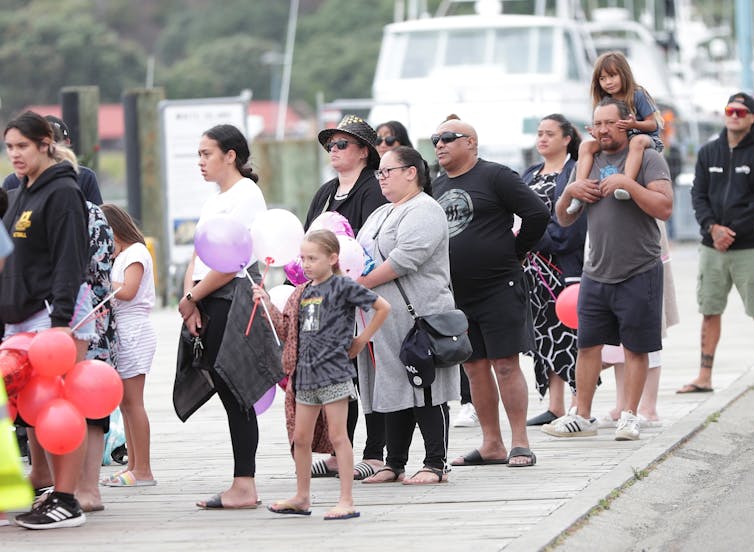 Local supporters gather on the quayside as a boat that carried families for a morning blessing at White Island returns during a recovery operation to retrieve the remaining bodies.
AAP/David Rowland, CC BY-ND
Local supporters gather on the quayside as a boat that carried families for a morning blessing at White Island returns during a recovery operation to retrieve the remaining bodies.
AAP/David Rowland, CC BY-ND
Adventure capital
New Zealand is known as an adventure tourism destination, but its regulatory systems have undergone recent change. After 37 deaths over four years, then prime minister John Key ordered an urgent safety audit in 2009.
This resulted in a shift, from 2013, from a voluntary system under Outdoors New Zealand and the regulatory system under Worksafe NZ to the New Zealand adventure activity certification scheme. Some tour operators have found this audit system too onerous. Striking the right balance between risk management while allowing the adventure tourism sector to thrive has proved difficult.
But the case of Whakaari/White Island is unique in many ways. The island is privately owned. GeoNet monitors volcanic activity and rates the threat level. The tour companies then assess the risk and determine if visits can proceed or should be temporarily suspended.
Three companies have operated tours to Whakaari/White Island, including the Māori-owned White Island Tours (owned by Ngāti Awa). The other two are helicopter companies Kahu and Volcanic Air Safaris. White Island Tours was accredited under AdventureMark, which is a Worksafe NZ approved certification body.
We must await the Worksafe investigation to know whether it was reasonable to allow the tours to go ahead when volcanic risk rating had risen from level 1 to level 2. We also still await the full human toll, knowing that recovery for survivors may take years. It is also clear that the impact on Ngāti Awa and the Whakatāne community has been profound.
Inherent risk in active environments
In laying out these complexities in which small private tour companies and large internationally owned cruise ships took thousands of visitors to Whakaari each year, we underscore how difficult an assessment of risk might be for some visitors.
Adventure tourists typically make an assessment weighing up risks against the thrills they seek to achieve. New Zealand’s reputation for adventure tourism is built in part on well developed policy settings and regulatory regimes, and an expectation among visitors of high adventure safety standards.
Risk - both perceived and actual – is carefully managed to ensure that perceived risk is high but actual risk is as low as humanly possible. The reputation of the sector and, indeed, the interests of the wider New Zealand tourism industry hinge on high safety standards. For example, bungy jumping appears to be very high risk, but its commercial viability comes from the highly controlled operation, which means actual risk is in fact very low.
Set against this are longstanding activities that take visitors into spectacular settings to experience firsthand the wonders of nature. Such environments do present inherent risk even if many decades may pass between natural events.
The Pink and White Terraces – the largest silica sinter deposit on earth - were a spectacular visitor attraction in the mid-19th century, and the centrepiece of Māori tourism development. That was until they were completely destroyed by the eruption of Mount Tarawera in 1886.
New Zealand’s most stunning natural vistas – Aoraki/Mount Cook, the fjords of Te Wahipounamu world heritage area, towering glaciers and raging rivers - are the result of millions of years of seismic activity on the Pacific and Australian tectonic plate boundary. These environments are dynamic and, at times, very destructive.
These settings contrast adventure tourism activities. Risk may be perceived as low or non-existent given that these environments may be largely inactive for years.
Read more: Why White Island erupted and why there was no warning
Informed consent
In a complex international environment, the ultimate decision to participate in activities in dynamic and potentially destructive environments rests with the visitors.
Ultimately, visitor welfare depends on informed visitor choice. This case highlights the need for consent forms to be signed in many more cases, beyond those already used in adventure tourism and medical tourism.
Such documents should make clear the nature of the possible risks. Elevated risk levels on the day of the visit as well as changing risk levels in the days prior to the scheduled visit should be clearly communicated. Participation should only proceed after informed consent is secured.
Such an approach does not obviate the need for accreditation, audits, regulations and strict oversight by relevant authorities. But it does ensure that tourists play their part in deciding what risks are worth taking on their holidays.
We cannot undo the events that unfolded at Whakaari/ White Island, but we can honour lives lost by making absolutely sure that we learn from this tragedy.
Authors: Freya Higgins-Desbiolles, Senior Lecturer in Tourism Management, University of South Australia


 Daily Bulletin


