

Lessons for a destabilising planet: insights from the 2009 South Pacific earthquake-tsunami disaster
- Written by: Dale Dominey-Howes, Professor of Hazards and Disaster Risk Sciences, University of Sydney
Just before 7am on September 29, 2009, a magnitude 8 earthquake struck the sea floor in the central South Pacific, about 190kms south of Samoa. It was exactly the sort of earthquake – in fact, it was two almost simultaneous quakes – that create devastating tsunami.
The Earth’s crust tore apart, triggering a region-wide tsunami. Within minutes it inundated Samoa’s coastline, before rolling on to American Samoa and Tonga.
Read more: Explainer: after an earthquake, how does a tsunami happen?
While a tsunami warning was issued by the Pacific Tsunami Warning Center and relayed by Samoan officials, it was not rebroadcast everywhere. Regardless, the tsunami arrived too quickly for many to escape. In Samoa, 189 people died when the tsunami reached up to 14 metres above normal sea level and many more were injured across the region. Hundreds of millions of dollars of damage was done.
Ten years on from this tragedy, it’s time to look back at the lessons we learned – and how they can help us adapt to a rapidly changing climate, which is making similar natural disasters more and more likely.
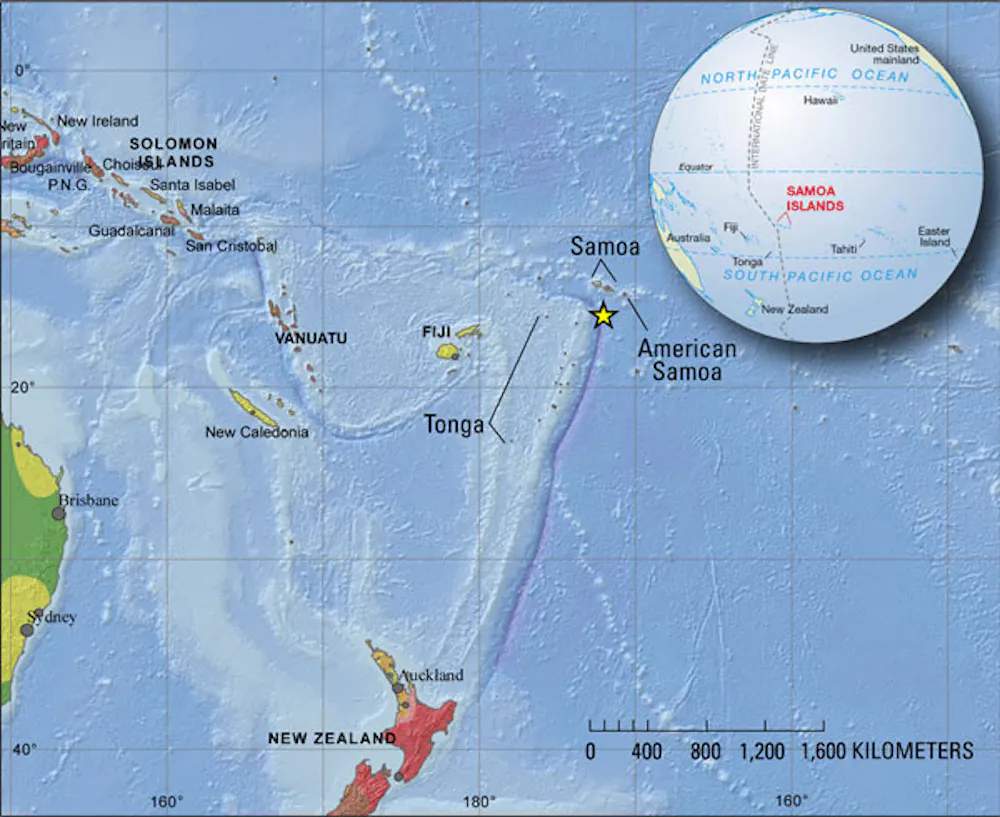 Location of earthquake shown by yellow star in South Pacific south of Samoa (Source: USGS)
A new approach to post-disaster research
As is common after a major disaster, Samoa’s government and emergency services quickly began assessing the damage and the needs of affected communities, to direct relief and recovery efforts. The government did an excellent job given the logistical challenges that face small island developing states after such events.
It is also common for researchers from a wide range of disciplines, from earth sciences to engineering to health studies, to visit impacted areas to study the causes and effects of such disasters, and make suggestions to improve future disaster management planning and practice.
Such researcher-led field reconnaissance surveys are usually small, comprising just a few individual researchers and usually from the same discipline. These expeditions are quickly organised, and the researchers get in and out fast – too often focused on their own interests, and not working with the government or scientists of the affected country. This means serious ethical issues can arise.
Read more: Making waves: the tsunami risk in Australia
After this earthquake and tsunami, I thought we could do better.
I proposed bringing incoming researchers from multiple disciplines, to collaborate with local communities and Samoan researchers and officials. This proposal was accepted, and I was quickly appointed to head up what became the largest ever international post-tsunami survey team.
Our team ended up comprising nearly 200 local and international participants working in multidisciplinary teams for up to a month between October and November 2009.
Critically, for the first time, the team negotiated between incoming scientists with specific questions, and local scientists and the government to ensure their research really did benefit Samoan communities.
As team leader, I reported daily to the prime minister and King of Samoa updating them on research findings, gave local TV and radio interviews on how things were going and worked with researchers to nudge field activity in directions that benefited everyone.
At the end of the survey the team provided a report to the prime minister and government on our findings. This set a new global benchmark for how post-disaster surveys could be done.
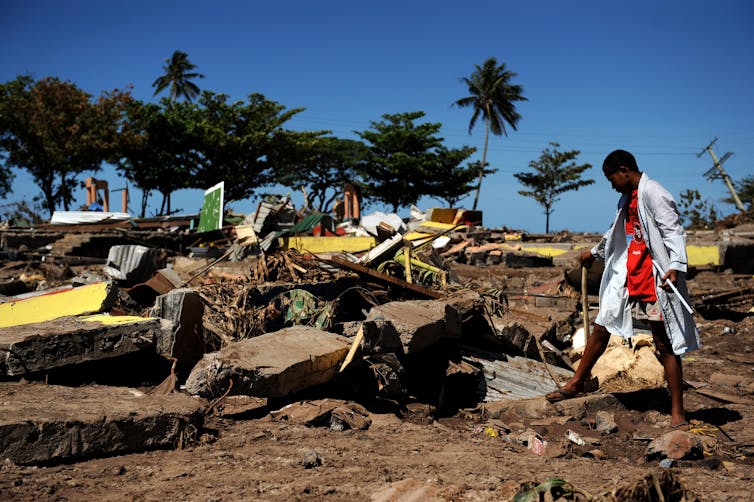 A boy looks through the wreckage of a Samoan village after the 2009 tsunami.
Paul Miller/AAP
A boy looks through the wreckage of a Samoan village after the 2009 tsunami.
Paul Miller/AAP
The lessons we learned
As a consequence of this approach, I was appointed by the United Nations to co-lead a global working group that rewrote the handbook on how post-disaster surveys should be organised and operated.
We learned so much from the Samoan survey team, and from continuing research efforts over the last ten years following other major disasters such as the 2011 Japan earthquake-tsunami and 2013 Philippines Typhoon Haiyan disasters. Key lessons include that:
geological studies show us these large hazard events occur much more frequently than we realised before
natural ecosystems on which humans depend exhibit both great vulnerability and resilience to the forces of nature, but human management of those ecosystems really affects resilience
different types of buildings experience damage and destruction in different ways. This knowledge can be used in land use zoning and improving building codes and design standards
despite continuing public education campaigns about natural hazards and disasters, individuals, families and communities still don’t always do what emergency management agencies want them to do (for example, evacuate to high ground if you feel a strong earthquake at the coast)
human beings are the most remarkable of species – capable of incredible resilience and generosity in the aftermath of disasters
there is still so much we do not understand about natural hazards and disasters
as a global community, we must work hard to reduce inequality which makes too many people vulnerable to disasters, and rise to the challenge presented by human-induced climate change.
Future disasters on a rapidly changing planet
Disasters are on the rise and climate change will only make things much worse. Earth is destabilising rapidly.
Climate change (coupled with environmental degradation and an increasing population which increases exposure to hazard events) are driving more frequent and intense disasters.
Read more: Explainer: are natural disasters on the rise?
In fact, according to the United Nations Office for Disaster Risk Reduction, weather and climate related disasters have more than doubled over the last 40 years. They have said,
90% of recorded major disasters caused by natural hazards from 1995 to 2015 were linked to climate and weather including floods, storms, heatwaves and drought.
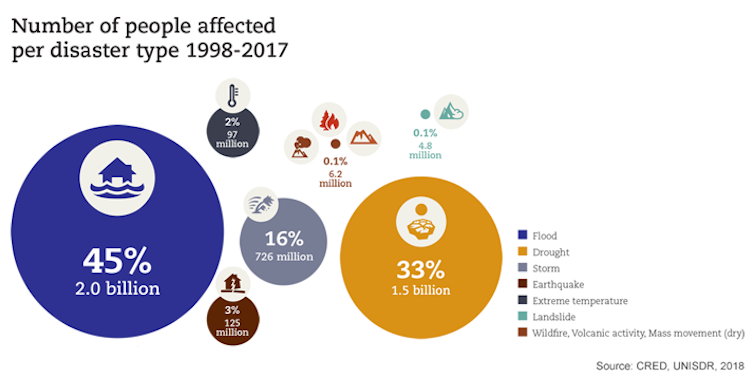 Number of people affected by disasters of different types between 1998 and 2017.
UNISDR
Number of people affected by disasters of different types between 1998 and 2017.
UNISDR
A heart wrenching factor is the poorest people around the world always bear the greatest burden of loss to natural disasters due to inequality and poverty. Layered on top of the particular vulnerability of poorer people to disasters, global statistics show the Asian region experiences the most disasters of all types.
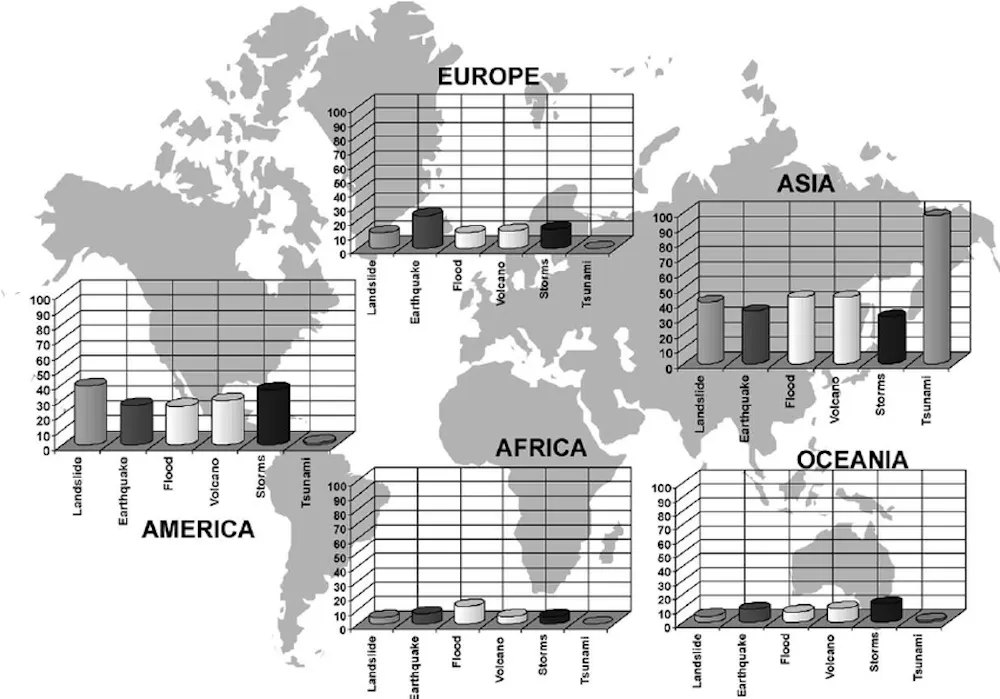 Occurrence of different types of disasters by regions. Cylinders show the percentage of each particular disaster in a given region in relation to the whole world.
Alcantara-Ayala, 2002
Occurrence of different types of disasters by regions. Cylinders show the percentage of each particular disaster in a given region in relation to the whole world.
Alcantara-Ayala, 2002
Earth is unique, dynamic, fragile and dangerous. Human activity is driving changes that, if not addressed soon, will result in disasters in the near future that are outside our experience and capacity to cope with.
Authors: Dale Dominey-Howes, Professor of Hazards and Disaster Risk Sciences, University of Sydney


 Daily Bulletin


