

The UK Supreme Court ruling on suspending parliament is a warning for Australian politicians
- Written by: Anne Twomey, Professor of Constitutional Law, University of Sydney
The UK Supreme Court’s finding that Boris Johnson’s suspension of parliament (or prorogation) was unlawful has raised the question of whether similar judicial action could be taken to challenge a controversial prorogation in Australia.
There have been several occasions in the past when prorogation has been used in Australia to achieve political aims.
For example, in 2016, the Turnbull government used prorogation as a means of forcing the Senate to sit and reconsider a previously defeated bill in order for it to become a double dissolution trigger.
The Keneally government in NSW and the Rann government in South Australia both prorogued parliament for long periods prior to elections. The moves prompted allegations they were intended to shut down embarrassing inquiries, but no one sought to challenge them in court.
In light of the UK legal challenge to Johnson’s prorogation that impeded parliamentary action prior to the Brexit date of October 31, will similar court challenges to these types of suspensions be more likely in the future? And would Australian courts consider hearing such challenges?
What the UK Supreme Court ruled
The UK case potentially has relevance for Australia because it neatly side-stepped the more contentious question of whether the prime minister’s advice to the Queen could be the subject of judicial review on the ground it was given for an improper purpose.
Or as the British media more bluntly put it, whether Johnson lied to the Queen.
Instead, the Supreme Court focused on its judicial power to determine the existence and extent of the executive’s “prerogative” powers.
These are the traditional powers of the monarch that have been passed down over centuries rather than being conferred by law. Australian and UK courts have long recognised that it is up to the courts, through applying the common law, to determine the scope of these powers.
Read more: Boris Johnson, 'political Vegemite', becomes the UK prime minister. Let the games begin
In doing so, the UK court looked to fundamental constitutional principles, such as parliamentary sovereignty and responsible government, as imposing limits on the executive’s power to prorogue.
It recognised that parliamentary sovereignty would be undermined if the executive could prevent parliament from exercising its legislative authority for as long as it pleased.
It also expressed concern that responsible government would be undermined and replaced by “unaccountable government” if parliament were prevented by the executive from scrutinising its actions.
The Supreme Court held that advice to the Queen to prorogue parliament, and any decision based upon that advice, will be
unlawful if the prorogation has the effect of frustrating or preventing, without reasonable justification, the ability of parliament to carry out its constitutional functions as a legislature and as the body responsible for the supervision of the executive.
Whether or not the prorogation has this effect is a question of fact which falls well within the jurisdiction of the courts to determine.
‘Reasonable justification’ to suspend parliament
More controversial is the assessment of what is a “reasonable justification” to suspend parliament.
The Supreme Court pointed out that a short period of prorogation for the purpose of ending a session of parliament and starting a new one would not require further justification.
The court would only need to consider additional justification in “unusual circumstances”. In doing so, it would need to be sensitive to the responsibilities and experience of the prime minister.
In this particular case of the prorogation of the UK parliament for five weeks, the court deemed the circumstances to be not only “unusual”, but “exceptional”.
This was because a “fundamental change” in the Constitution of the United Kingdom is to occur on October 31 when the country is due to leave the European Union. In addition, the House of Commons had already demonstrated that it does not support the government on Brexit, and the prorogation would prevent parliament from carrying out its constitutional role for a significant period before that date.
The Supreme Court was also not offered a reasonable justification by the UK government for the length of the prorogation. It was merely told that a new session of parliament was desired so the government’s agenda could be set out in the Queen’s Speech.
Moreover, there was no consideration by the government of how much time was needed to scrutinise and enact legislation prior to the October 31 deadline, or the competing merits of adjourning or proroguing parliament.
The court pointed to the prime minister’s constitutional responsibility to take into account all relevant interests, including those of parliament, when advising the Queen. In an unusually pointed observation, it noted there was “no hint” of Johnson exercising that responsibility.
Based on this evidence, the court ruled it was impossible to conclude there was “any reason, let alone a good reason” to prorogue parliament for five weeks.
This meant that not only was the advice to prorogue parliament unlawful, but also that parliament would be able to continue in session.
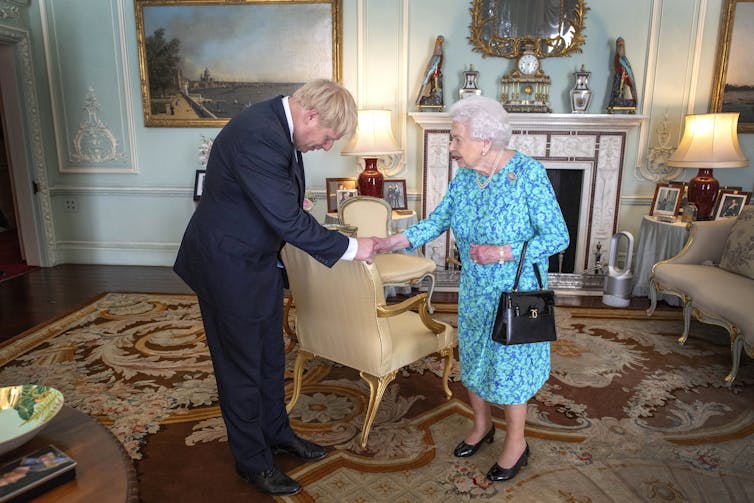 Boris Johnson sought the Queen’s approval to prorogue parliament for five weeks. The Supreme Court ruled there was no reason for him to do so.
Victoria Jones/EPA
Boris Johnson sought the Queen’s approval to prorogue parliament for five weeks. The Supreme Court ruled there was no reason for him to do so.
Victoria Jones/EPA
Will the UK ruling set a precedent in Australia?
Would the same kind of challenge occur if a government prorogued parliament in Australia?
Proroguing parliament for a short time to ensure it sits to exercise its functions, as was done by the Turnbull Government in 2016, would clearly be acceptable.
Proroguing parliament for a long period would be much more vulnerable to challenge if it prevented parliamentary inquiries from continuing, for example, or delayed the tabling of embarrassing documents.
The government would have to be prepared to provide evidence to the courts showing “reasonable justification” for the period of prorogation, if it were challenged.
Would Australian courts be prepared to follow the UK Supreme Court precedent?
They would certainly give serious consideration to it, as this is the only precedent on the prorogation of parliament in a Westminster-style system of government, and the unanimous judgement of a significant court.
Moreover, the UK court’s reasoning is very similar to existing Australian cases in which courts have ruled that the common law must be interpreted in a manner that is consistent with constitutional principles.
This means that Australian governments should, in the future, be quite careful when proroguing parliament. They will need to ensure they do not do so for unnecessarily long periods of time and to prevent parliament from fulfilling its legislative and scrutiny functions, especially during periods of political controversy.
If their action is challenged in the courts, they will also need to be prepared to provide evidence of a reasonable justification for doing so.
Authors: Anne Twomey, Professor of Constitutional Law, University of Sydney


 Daily Bulletin


