

2℃ of global warming would put pressure on Melbourne's water supply
- Written by: Ben Henley, Research Fellow in Climate and Water Resources, University of Melbourne
Melbourne’s existing water supplies may face pressure if global warming hits the 2℃ level, according to our new research published today in Environmental Research Letters.
The effects of drying and warming in southern Australia are expected to reduce natural water supplies. If we overshoot 2℃ of warming, even the desalination plant might not provide enough drinking water to a growing population.
However, keeping warming to 1.5℃ would help avoid many of these negative consequences. This brings home the local benefits of acting swiftly to limit global warming. Luckily, there are options available to secure our water supply.
Warming and drying effects
The Earth has warmed by about 1.1℃ since pre-industrial times, causing ongoing global changes to our atmospheric composition. The Paris Agreement commits the world to holding the increase to “well below” 2℃, and “pursuing efforts” to limit the increase to 1.5℃.
While we’re confident there will be more hot extremes and fewer cold extremes as global temperatures rise, the consequences of further global warming for other climate extremes – such as drought – in different parts of the world are harder to pinpoint.
Read more: Is Australia's current drought caused by climate change? It's complicated
Our study uses climate models to identify the possible changes in average rainfall and temperature in four different worlds:
the “Natural” world, where humans have had no influence on the climate,
the “Current” world, which approximates the impacts humans have had to date, and
two future worlds, which are “1.5℃” and “2.0℃” warmer than pre-industrial times.
In line with previously published results, southern Australia is projected to undergo drying and warming. But we are not alone. The Mediterranean and Southwestern North America are also predicted to dry out.
Desalination is increasingly important
Most Australians recall the severity and length of the Millennium Drought. This event severely stressed agricultural and natural systems, and led to the commissioning of desalination plants in the five largest cities in Australia, at a cost of several billion dollars.
Desalination offers an important lifeline. Although it comes with high short-term costs, it supplies vital water security over the long term. Successful efforts to improve water-use efficiency have reduced per capita demand rates, but growing populations in major centres will lead to increasing water demand.
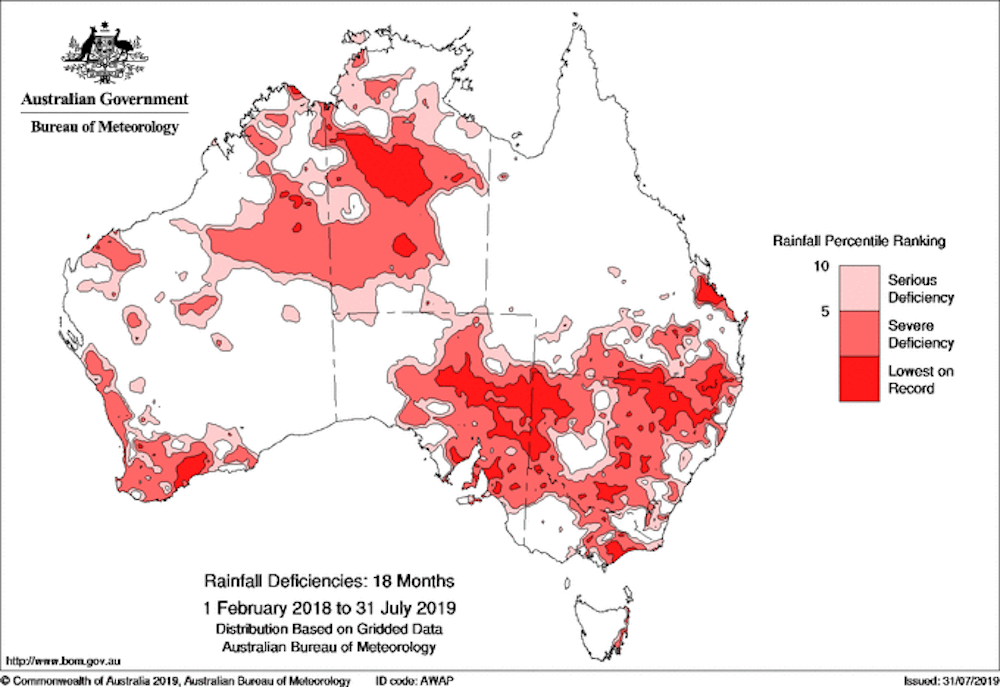 Rainfall deficiencies over Australia for the 18 months between 1 Feb 2018 and 31 July 2019.
Bureau of Meteorology
Rainfall deficiencies over Australia for the 18 months between 1 Feb 2018 and 31 July 2019.
Bureau of Meteorology
Right now, large parts of southeastern Australia are in the grips of another drought. Although drought is a common natural feature of Australia’s climate, in recent decades we have observed long-term drying trends over much of southern Australia.
Currently, all capital city urban reservoir systems in southern Australia are below 60%, and several are nearing or below 50%. The Victorian government recently ordered 125 gigalitres of water from the desalination plant.
 Urban water storage levels for Australia’s capital cities.
Bureau of Meteorology
Urban water storage levels for Australia’s capital cities.
Bureau of Meteorology
With these challenges in mind, our paper explores the effects of future climate change on the surface water supply infrastructure for Melbourne.
Climate models and hydrological models together indicate future declines in catchment inflows as global warming increases from 1.5℃ to 2℃. The good news is when desalination is added to the mix, which it is, pressure on our water storage is dramatically reduced. However, population growth and climate change remain key challenges into the future.
The buffer is shrinking
The take-home message is, if global warming approaches 2℃ and beyond, the combined impacts of climate change and population growth will ultimately begin to outstrip the buffer desalination provides for us without ongoing investment in water security. Fortunately, desalination plants, storm water, water recycling and continuing to improve efficiency are all viable options.
To ensure our water security, and with it, the safety and prosperity of the urban centres which are the engine houses of the Australian economy, we all need to be vigilant in managing water resources.
We also all need to play an active part in the global effort to reduce the impacts of climate change. The commitments by the world’s nations for the 2020-30 period remain insufficient to achieve the temperature goals. Global emission rates continue to rise, and atmospheric greenhouse gas concentrations are steadily accelerating.
The task of turning around our emissions in time to avert many of the serious impacts of climate change is becoming ever more implausible. In the coming 10–20 years, we expect to shoot past 1.5℃.
Read more: Meet El Niño’s cranky uncle that could send global warming into hyperdrive
With so much momentum in both human and natural systems it is becoming increasingly unlikely that we will avoid warming beyond 1.5℃. However, if we can achieve it, the list of benefits includes greatly reduced stress on the water supplies we rely on for our very existence.
Authors: Ben Henley, Research Fellow in Climate and Water Resources, University of Melbourne
Read more http://theconversation.com/2-of-global-warming-would-put-pressure-on-melbournes-water-supply-118389


 Daily Bulletin


