

Women, rural and disadvantaged Australians may be missing out on care in the NDIS
- Written by: Eleanor Malbon, Research Fellow, UNSW
While the National Disability Insurance Scheme (NDIS) has made incredible improvements to the lives of many Australians living with disabilities, not everyone is benefiting from the scheme in the same way.
Our review, published recently in journal BMC Public Health, found the structure of the NDIS may be exacerbating existing social inequities. Women, rural and regional Australians, and those from poor households are more likely to miss out on disability care than their peers.
In a survey of of economically disadvantaged people with a disability, 31% were not even aware of the NDIS. A further 41% had heard of the NDIS and were eligible but had not applied due to bureaucratic complexities.
Read more: Understanding the NDIS: how does the scheme work and am I eligible for funding?
Women make up 49% of Australians with a disability but just 37% of NDIS participants. Further research is underway to help us understand why this is the case but it’s likely a reflection of broader gender inequities.
Men are also more likely to successfully secure NDIS services than women, which allows them to negotiate better deals and services from their allocated funds.
Accommodating the diversity of people’s circumstances is essential for the NDIS to achieve its goal of improving the lives of Australians with disability.
Market-based policies can exacerbate inequities
A 2018 Senate inquiry into NDIS readiness found there were often too few providers equipped to deliver disability support services, especially in remote and regional areas.
Without enough good-quality providers with space to take on more clients, people may miss out on services. Our review found this was more likely to occur for women, people with lower education levels, and those in remote and regional areas.
Where markets are failing or thin, those who are most equipped to get in early and establish service contracts are at an advantage over those who cannot.
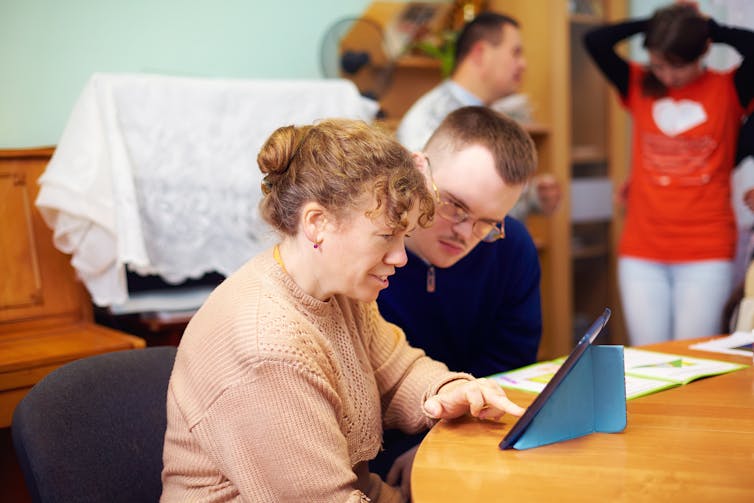 Those who get in early have more options.
Olesia Bilkei
Those who get in early have more options.
Olesia Bilkei
A local service provider can only take on so many customers before it hits limits on staffing and resources. Those who get in early manage to secure services for themselves. Those who don’t may miss out on services entirely, especially where there are only a few specialist providers.
There are many reasons why someone might not get in early, such as having other care duties, living remotely, living in unstable housing, or not having the energy to work through the complicated system.
Self-managers get better services
Every NDIS participant is allocated a personal budget that matches their needs and goals. There are three ways for participants to manage NDIS budgets:
- administered by the participant (self-managed)
- chosen by the participant but administrated through a plan manager who pays invoices on behalf of the participant (plan-managed)
- NDIA managed, where services are chosen by the participant from registered NDIS providers only.
Or the participant may opt for a combination of these options.
The 24% of self-managed participants carry the most administrative burden. They manage contracts and invoices themselves. But they also have the most flexibility to secure services, negotiate with service providers on price and access tailored services.
Read more: Here's what needs to happen to get the NDIS back on track
Many service providers are declining to take on contracts with people who do not self-manage, because these participants take more time and pay less. This leaves those least able to manage their services without access to the most flexible and boutique services.
Up to 40% of NDIS participants with an intellectual disability would like more training on NDIS tasks so they can better self-manage or choose services. In particular, they want to develop their skills in looking after money, using computers, finding the right service, making choices and ensuring they’re heard.
The system privileges an ‘ideal norm’
The NDIS system is bureaucratically complex, and many people find it difficult to navigate. In this way, it seems be catering to a concept of an “ideal norm”: a person who can navigate the NDIS bureaucracy and take on complex additional administrative burdens.
The National Disability Insurance Agency (NDIA, the agency charged with implementing the NDIS), for example, has been sending letters to blind people in formats they cannot read, such as printed letters without braille and PDF files that are incompatible with screen readers. This is due to to be rectified this month.
 Communication should always be tailored to the participant.
Chinnapong/Shutterstock
Communication should always be tailored to the participant.
Chinnapong/Shutterstock
Control over services may also be limited for people who are geographically or socially isolated, or do not have the skills to navigate NDIS systems to access plans, run budgets and find services.
What can be done?
Addressing market failures and a scarcity of providers is essential to ensuring the benefits of the NDIS are equitable.
Supporting people to navigate bureaucratic complexity in the scheme will level the playing field.
The recent pricing changes for service providers to travel to remote and regional areas may help address provider shortfalls. Further, plans to maintain critical supports for essential services such as feeding and bathing in areas with too few providers will help address market failure.
Read more: The NDIS is delivering 'reasonable and necessary' supports for some, but others are missing out
Greater funding support is needed for advocacy groups to help NDIS participants, including those economically disadvantaged and homeless, to access and navigate the NDIS bureaucracy.
Finally, to allow better assessment of equity in the NDIS, we need better data. We need a large-scale evaluation of the performance of the NDIS, similar to the previous evaluation of NDIS trials. Existing data held within government on NDIS access should be reported publicly.
We need such actions to bridge the gap between Australians who are socially and financially equipped to navigate the NDIS and those who are not, or else people with critical needs may go without services and support.
Authors: Eleanor Malbon, Research Fellow, UNSW


 Daily Bulletin


