

The mighty mulga grows deep and lives long
- Written by: Gregory Moore, Doctor of Botany, University of Melbourne
Sign up to the Beating Around the Bush newsletter here, and suggest a plant we should cover at batb@theconversation.edu.au.
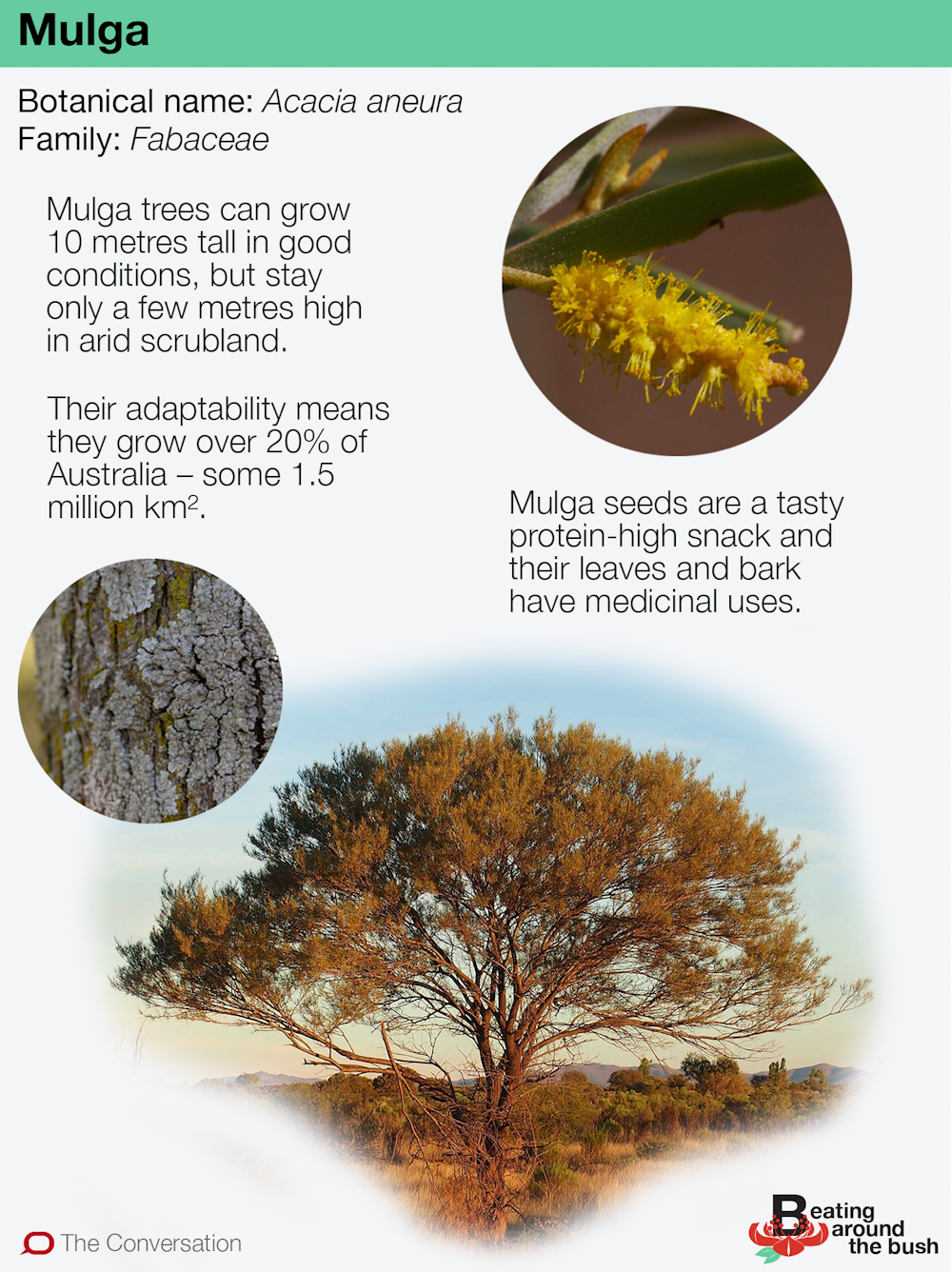
Among the nearly 1,000 species of Australian acacias, there are few with a reputation for hardiness, resilience and endurance to match mulga. Once the higher rainfall of the coastal fringes of the continent diminishes, from west to east and south to north, the mulga prevails.
It grows over the vast expanse of about 20% of our continent and is often the dominant woody species of the grassland communities that are themselves known as the mulga. It is also an important shrub component of inland woodlands, such as those dominated by poplar box, Eucalyptus populnea.
Any species that covers 1.5 million km² of any landmass is clearly a vital part of its ecosystems.
The scientific name of mulga is Acacia aneura, which refers to the lack of a prominent mid-rib in their leaves (a means “no” and neura means “nerve”). Interestingly, like most Australian acacias, mulga lacks spines which their African relatives possess in abundance on their foliage, and they don’t actually have leaves.
Read more: A detailed eucalypt family tree helps us see how they came to dominate Australia
The structures that appear to be leaves are actually flattened leaf stems called phyllodes. They function as leaves, but are very efficient in arid conditions. The narrow and rolled mulga leaves often have a sharp tip, so while they are not spiny they are still prickly.
Mulga plays an important ecological role in drier parts of Australia. It is a nitrogen-fixing species that enriches often impoverished soils, provides habitat for birds, insects, reptiles and mammals, and is important for honey production.
They drop many of their phyllodes during very dry spells, which not only reduces demand for water, but provides a vital mulch to their ecosystems during tough times. Acacia aneura is fire-sensitive, and changes to fire regimes can see it displaced by grass species. In parts of the outback, the species is not regenerating, and as the old specimens die the mulga is disappearing.
 The Conversaion
Mulga are brilliantly designed for coping with the arid Australian interior, as they do not get too big in places where resources are limited. In good conditions they are small trees that can grow taller than 10m, but in dry conditions they may be shrubs little more than 2-3m tall. They have a very deep root system that begins with a tap root 3m or more in length when the tree is only 20cm tall, and which exploits a large volume of soil for water.
This biology often leads to individual specimens being evenly spaced in the landscape as if they were positioned by design. The roots may be considerably longer than the tree is tall!
The little apertures on the phyllodes that regulate water loss and gaseous exchange (stomata) are located at the bottom of deep pits called stomatal crypts, which further slows water loss.
It is common for gardeners to think of acacia species as being short-lived, but with nearly 1,000 different species there is great variation in the age that various species can reach. While many shrubby species might only survive for a decade or two, Acacia aneura can live for three centuries or more. It is hard to believe many of the scrubby little specimens only a metre or two high growing in the arid heart of Australia are such a venerable age.
Mulga can be very slow-growing, and its wood can be both strong and durable. It grows a light cream sapwood that surrounds a dark reddish-brown or black heartwood. The combination is ideal for wood carving, especially of ornaments, utensils, and of course prized souvenirs of a trip to the red centre. It is durable as indigenous weapons, digging sticks or modern fence posts, and its foliage can provide emergency fodder for stock during prolonged dry periods. Resin from the leaves is also used for sealing cracks and splits in cups and bowls.
Read more:
The art of healing: five medicinal plants used by Aboriginal Australians
Like many acacia species, the seeds of mulga are protein-rich and have made an excellent food source for many centuries, particularly in seed cakes. Boiling young leaves and twigs in water has been used for treating colds, and lerps – the sticky protective coverings of insects that grow on the leaves – provide a sugary treat.
Many of those who have never seen the outback of Australia imagine it to be a vast and barren red sandy desert. However, for those areas where mulga rules, it is a place of diversity and complex ecosystems. Acacia aneura typifies the resilience of a huge part of the Australian landscape, and its wonderful biology deserves to be better known.
The Conversaion
Mulga are brilliantly designed for coping with the arid Australian interior, as they do not get too big in places where resources are limited. In good conditions they are small trees that can grow taller than 10m, but in dry conditions they may be shrubs little more than 2-3m tall. They have a very deep root system that begins with a tap root 3m or more in length when the tree is only 20cm tall, and which exploits a large volume of soil for water.
This biology often leads to individual specimens being evenly spaced in the landscape as if they were positioned by design. The roots may be considerably longer than the tree is tall!
The little apertures on the phyllodes that regulate water loss and gaseous exchange (stomata) are located at the bottom of deep pits called stomatal crypts, which further slows water loss.
It is common for gardeners to think of acacia species as being short-lived, but with nearly 1,000 different species there is great variation in the age that various species can reach. While many shrubby species might only survive for a decade or two, Acacia aneura can live for three centuries or more. It is hard to believe many of the scrubby little specimens only a metre or two high growing in the arid heart of Australia are such a venerable age.
Mulga can be very slow-growing, and its wood can be both strong and durable. It grows a light cream sapwood that surrounds a dark reddish-brown or black heartwood. The combination is ideal for wood carving, especially of ornaments, utensils, and of course prized souvenirs of a trip to the red centre. It is durable as indigenous weapons, digging sticks or modern fence posts, and its foliage can provide emergency fodder for stock during prolonged dry periods. Resin from the leaves is also used for sealing cracks and splits in cups and bowls.
Read more:
The art of healing: five medicinal plants used by Aboriginal Australians
Like many acacia species, the seeds of mulga are protein-rich and have made an excellent food source for many centuries, particularly in seed cakes. Boiling young leaves and twigs in water has been used for treating colds, and lerps – the sticky protective coverings of insects that grow on the leaves – provide a sugary treat.
Many of those who have never seen the outback of Australia imagine it to be a vast and barren red sandy desert. However, for those areas where mulga rules, it is a place of diversity and complex ecosystems. Acacia aneura typifies the resilience of a huge part of the Australian landscape, and its wonderful biology deserves to be better known.
 Sign up to Beating Around the Bush, a series that profiles native plants: part gardening column, part dispatches from country, entirely Australian.
Authors: Gregory Moore, Doctor of Botany, University of Melbourne
Read more http://theconversation.com/the-mighty-mulga-grows-deep-and-lives-long-118838


 Daily Bulletin


