

How to answer the argument that Australia's emissions are too small to make a difference
- Written by: Matt McDonald, Associate Professor of International Relations, The University of Queensland
After a recent foray into the debate over Australia’s so-called “climate election”, I received plenty of critical replies to my argument that Australians should take climate action more seriously. The most common rebuttal was that Australians were right to focus on other issues at the ballot box because Australia’s contribution to global climate change is small anyway.
This is precisely the argument Alan Jones advanced in a now notorious Sky News segment in which he used a bowl of rice to explain away Australia’s climate obligations.
Australia, Jones noted, contributes only 1.3% of global carbon dioxide emissions from human activity, which in turn represents just 3% of the overall amount of CO₂ in the atmosphere, which in turn makes up little more than 0.04% of the whole atmosphere. So why, he asked while triumphantly brandishing a single rice grain, are we so obsessed with Australia’s climate policy when the planet is so big and the consequences of our actions are so tiny?
Read more: Why old-school climate denial has had its day
This is a powerful critique and, on the face of it, a simple and compelling line of argument, which is precisely why it’s so often used. Why bother, if we lack the power to do anything that makes a difference?
But there are at least three obvious responses to it.
The ‘per capita’ problem
The first and most obvious response is that Australia emits much more than our fair share.
Sure, our emissions are 1.3% of the global total. But our population is 0.3% of the global total.
This isn’t the only way to allocate national emissions targets. But if rich countries like Australia aren’t doing more to reduce their disproportionately high emissions, what possible incentive is there for developing countries to take the issue seriously? Nations such as India, Brazil and China can ask – as indeed they have at various climate talks – why they should reduce emissions when Australia does so little.
In this sense, Australia’s position on climate action is significant, not only for the 1.3% of greenhouse gases we produce, but for the potential influence on global policy.
As a nation so proud of “punching above its weight” in fields such as sport and technology, Australia is missing a big chance to show global leadership on climate.
The ‘coal exports’ problem
The 1.3% statistic is only true if we focus purely on greenhouse emissions within Australia itself. Fair enough, you might say, given that this is the way the Paris Agreement, and the Kyoto Protocol before it, measures countries’ emissions.
But this approach excludes some significant factors.
First, it fails to take proper account of emissions created in one country while manufacturing goods for export to other countries. Emissions due to Chinese-produced goods destined for Australian consumers, for example, count towards China’s emissions, not Australia’s. If we take this “consumption shadow” into account, the climate impact of developed countries, including Australia, becomes much higher.
Second, there is a similar issue with coal exports. Coal dug up by one country but burned in another counts towards the latter’s emissions. As one of the world’s largest coal exporters, this is clearly important for Australia.
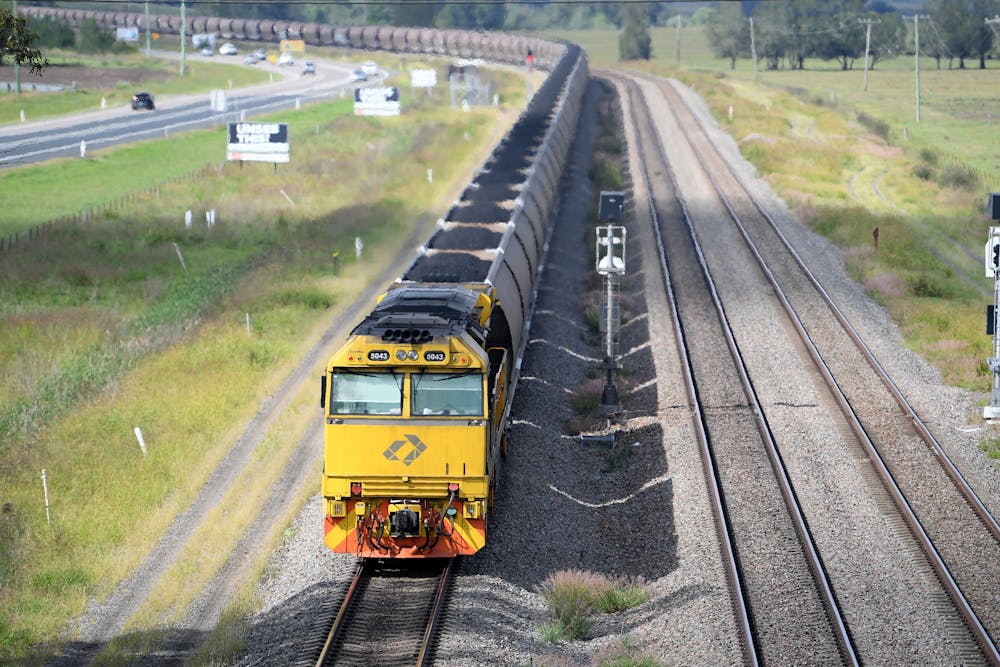 Time to get off the global coal train?
Dan Himbrechts/AAP
Time to get off the global coal train?
Dan Himbrechts/AAP
In 2012, the campaign group Beyond Zero Emissions estimated that if Australian coal was factored into Australia’s emissions, our contribution to global emissions would be 4% rather than 1.3%. This would make Australia the world’s sixth-largest contributor to climate change.
Are we responsible for what other countries do with Australian coal? According to the Paris treaty, the answer is no. But drug barons and arms dealers use similar arguments to wash their hands of drug addiction and war.
What’s more, Australia already limits a range of exports based on concerns about their use in importing countries, including weapons, uranium and even livestock.
So there’s certainly a precedent for viewing exports through the lens of our international responsibilities. And with the UN secretary-general joining recent calls to end all new coal power plants, a global coal treaty or even embargo might eventually force Australia’s hand.
The ‘capacity to respond’ problem
The third rebuttal to Alan Jones’s arguments is that Australia has far more capacity to take climate action than many other nations. Again, this works at two levels.
First, we’re rich. Australia is a top-20 world economy in terms of both size and average wealth. This means we are more able than most countries to manage the economic costs of moving away from fossil fuels.
Second, thanks to decades of relative climate policy inaction and modest targets, there’s a lot of low-hanging fruit for Australia to ratchet up its climate ambition. This applies most obviously to the renewable energy sector, but also to areas such as energy efficiency and transport.
Australia’s land-clearing rates are also among the highest in the world – we are the only developed nation to feature in a 2018 WWF list of deforestation hotspots. Reducing this would significantly cut emissions while also protecting important carbon stores.
As economist John Quiggin has noted, the longer we wait to move away from fossil fuels, the more expensive it will be.
What does this all mean for Australia?
Jones’s argument is a beguilingly simplistic response to a wicked problem. Climate change is a global problem that requires global action. But the calculations around who should take the lead, and how much constitutes each nation’s fair share, are fiendishly complex.
But, by almost any measure, a country like Australia should be leading the way on climate policy, not being dragged kicking and screaming to take action that falls far behind that of comparable nations.
Read more: Not everyone cares about climate change, but reproach won't change their minds
The current reluctance to act seriously on climate change appears at best self-serving and at worst an outright moral failing.
We should take the argument that Australia’s climate contribution is insignificant with a grain of salt. Or perhaps rice.
Authors: Matt McDonald, Associate Professor of International Relations, The University of Queensland


 Daily Bulletin


