

How indigenous expertise improves science: the curious case of shy lizards and deadly cane toads
- Written by: Georgia Ward-Fear, Post doctoral fellow and Conservation Ecologist , University of Sydney
It’s a common refrain – western ecologists should work closely with indigenous peoples, who have a unique knowledge of the ecosystems in their traditional lands.
But the rhetoric is strong on passion and weak on evidence.
Now, a project in the remote Kimberley area of northwestern Australia provides hard evidence that collaborating with Indigenous rangers can change the outcome of science from failure to success.
Read more: We've cracked the cane toad genome, and that could help put the brakes on its invasion
Fighting a toxic invader
This research had a simple but ambitious aim: to develop new ways to save at-risk predators such as lizards and quolls from the devastating impacts of invasive cane toads.
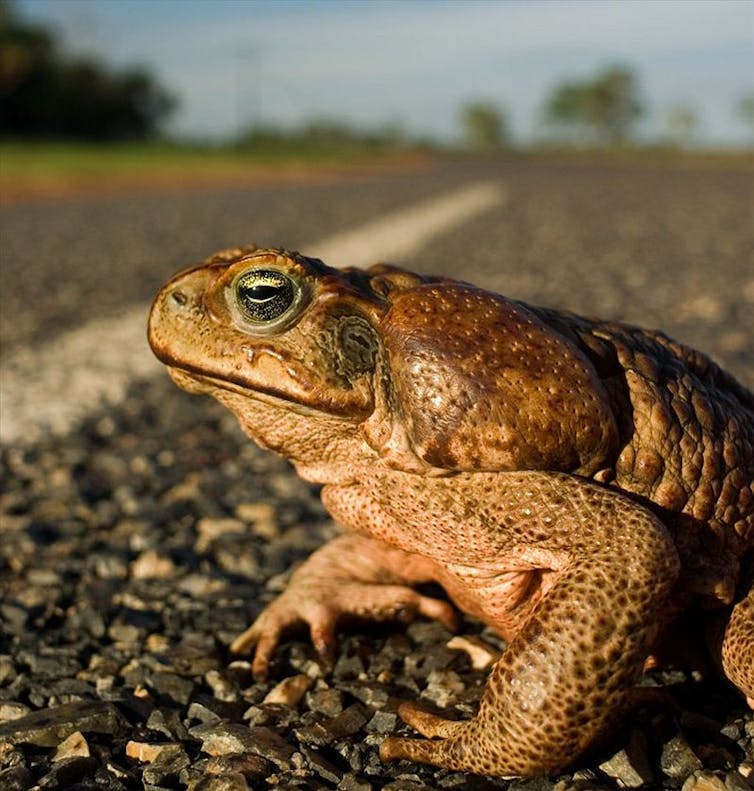 Cane toads are invasive and highly toxic to Australia’s apex predators.
David Nelson
Cane toads are invasive and highly toxic to Australia’s apex predators.
David Nelson
All across tropical Australia, the arrival of these gigantic alien toads has caused massive die-offs among meat-eating animals such as yellow-spotted monitors (large lizards in the varanid group) and quolls (meat-eating marsupials). Mistaking the new arrivals for edible frogs, animals that try to eat them are fatally poisoned by the toad’s powerful toxins.
Steep population declines in these predators ripple out through entire ecosystems.
But we can change that outcome. We expose predators to a small cane toad, big enough to make them ill but not to kill them. The predators learn fast, and ignore the larger (deadly) toads that arrive in their habitats a few weeks or months later. As a result, our trained predators survive, whereas their untrained siblings die.
Read more: What is a waterless barrier and how could it slow cane toads?
Conservation ‘on Country’
But it’s not easy science. The site is remote and the climate is harsh.
We and our collaborators, the Western Australian Department of Biodiversity, Conservation and Attractions, decided at the outset that we needed to work closely with the Indigenous Traditional Owners of the east Kimberley – the Balanggarra people.
So as we cruised across the floodplain on quad bikes looking for goannas, each team consisted of a scientist (university-educated, and experienced in wildlife research) and a Balanggarra Indigenous ranger.
Although our study species is huge – a male yellow-spotted monitor can grow to more than 1.7 metres in length and weigh more than 6kg – the animals are well-camouflaged and difficult to find.
Over an 18-month study, we caught and radio-tracked more than 80 monitors, taught some of them not to eat toads, and then watched with trepidation as the cane toad invasion arrived.
Read more: Yes, you heard right: more cane toads really can help us fight cane toads
Excitingly, the training worked. Half of our trained lizards were still alive by the end of the study, whereas all of the untrained lizards died soon after toads arrived.
That positive result has encouraged a consortium of scientists, government authorities, conservation groups, landowners and local businesses to implement aversion training on a massive scale (see www.canetoadcoalition.com), with support from the Australian Research Council.
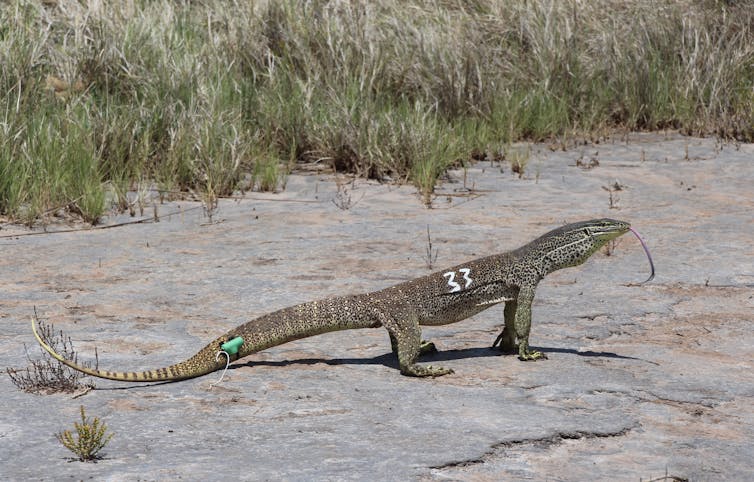 A yellow-spotted monitor fitted with a radio transmitter in our study. This medium-sized male was trained and lived for the entirety of the study in high densities of cane toads.
Georgia Ward-Fear, University of Sydney
A yellow-spotted monitor fitted with a radio transmitter in our study. This medium-sized male was trained and lived for the entirety of the study in high densities of cane toads.
Georgia Ward-Fear, University of Sydney
Read more: Teaching reptiles to avoid cane toads earns top honour in PM's science prizes
Cross-cultural collaboration key to success
But there’s a twist to the tale, a vindication of our decision to make the project truly collaborative.
When we looked in detail at our data, we realised that the monitor lizards found by Indigenous rangers were different to those found by western scientists. The rangers found shyer lizards, often further away from us when sighted, motionless, and in heavy cover where they were very difficult to see.
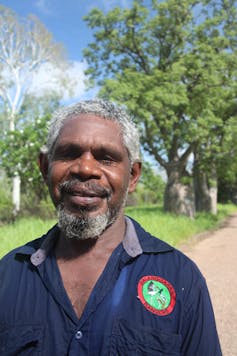 Gregory Johnson, Balanggarra elder and ranger.
Georgia Ward-Fear
Gregory Johnson, Balanggarra elder and ranger.
Georgia Ward-Fear
We don’t know how much the extraordinary ability of the rangers to spot those well-concealed lizards was due to genetics or experience – but there’s no doubt they were superb at finding lizards that the scientists simply didn’t notice.
And reflecting the distinctive “personalities” of those ranger-located lizards, they were the ones that benefited the most from aversion training. Taking a cautious approach to life, a nasty illness after eating a small toad was enough to make them swear off toads thereafter.
In contrast, most of the lizards found by scientists were bold creatures. They learned quickly, but when a potential meal hopped across the floodplain a few months later, the goanna seized it before recalling its previous experience. And even holding a toad briefly in the mouth can be fatal.
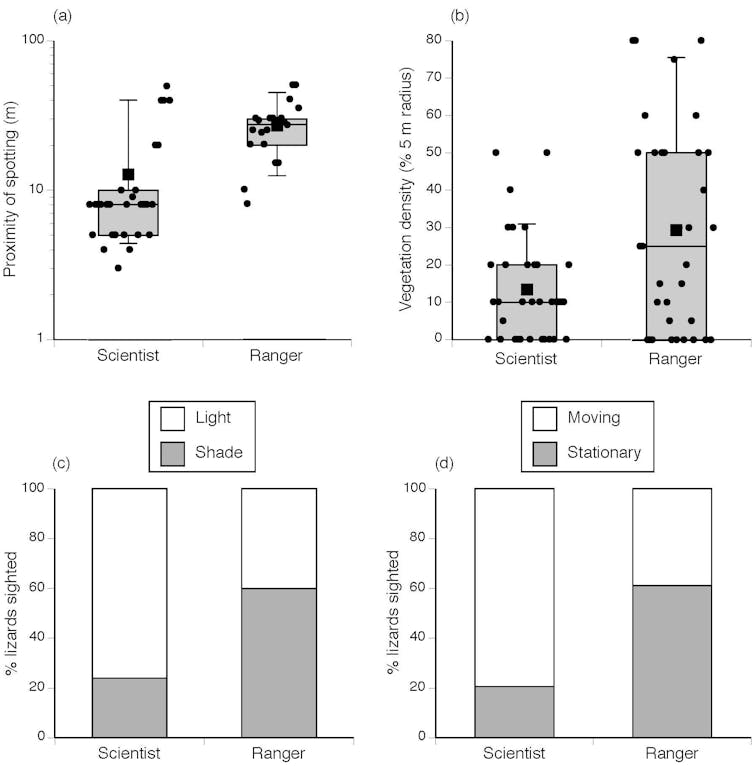 Comparisons of conditions under which lizards were initially sighted in the field by scientists and Indigenous rangers (a) proximity to lizards in metres (b) density of ground-cover vegetation (>30cm high) surrounding the lizard (c) intensity of light directly on lizard (light or shade) (d) whether the lizard was stationary or moving (i.e. walking or running). Sighting was considered more difficult if lizards were further away, in more dense vegetation, in shade, and stationary.
Georgia Ward-Fear, University of Sydney
Comparisons of conditions under which lizards were initially sighted in the field by scientists and Indigenous rangers (a) proximity to lizards in metres (b) density of ground-cover vegetation (>30cm high) surrounding the lizard (c) intensity of light directly on lizard (light or shade) (d) whether the lizard was stationary or moving (i.e. walking or running). Sighting was considered more difficult if lizards were further away, in more dense vegetation, in shade, and stationary.
Georgia Ward-Fear, University of Sydney
As a result of the intersection between indigenous abilities and lizard personalities, the overall success of our project increased as a result of our multicultural team.
If we had just used the conventional model – university researchers doing all of the work, indigenous people asked for permission but playing only a minor role – our project could have failed, and the major conservation initiative currently underway may have died an early death.
So our study, now published in Conservation Letters, provides an unusual insight – backed up by evidence.
Moving beyond lip service, and genuinely involving Indigenous Traditional Owners in conservation research, can make all the difference in the world.
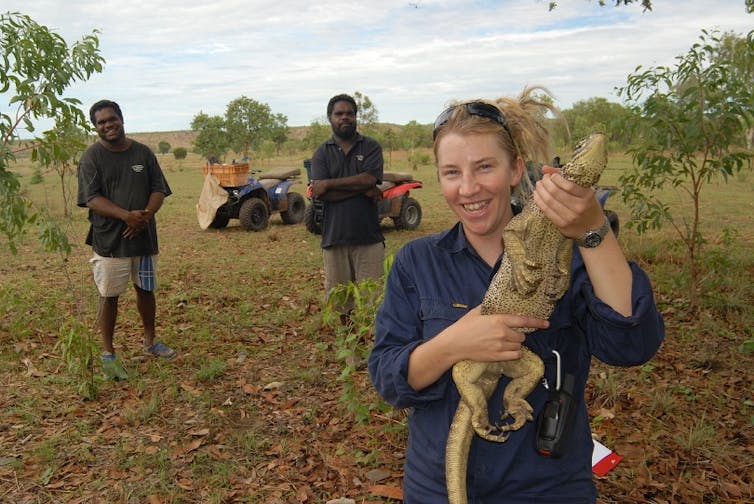 Georgia Ward-Fear (holding a yellow-spotted monitor) with Balanggarra Rangers Herbert and Wesley Alberts.
David Pearson, WA Department of Biodiversity, Conservation and Attractions
Georgia Ward-Fear (holding a yellow-spotted monitor) with Balanggarra Rangers Herbert and Wesley Alberts.
David Pearson, WA Department of Biodiversity, Conservation and Attractions
This research was published in collaboration with James “Birdy” Birch and his team of Balanggarra rangers in the eastern Kimberley.
Authors: Georgia Ward-Fear, Post doctoral fellow and Conservation Ecologist , University of Sydney


 Daily Bulletin


