

Christchurch attacks provide a new ethics lesson for professional media
- Written by: Denis Muller, Senior Research Fellow in the Centre for Advancing Journalism, University of Melbourne
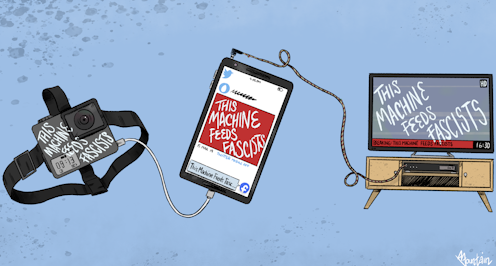
Two basic rules of media ethics apply to the coverage of terrorism: avoid giving unnecessary oxygen to the terrorist, and avoid unnecessarily violating standards of public decency.
The way to do this is to apply a test of necessity: what is necessary to publish to give the public a sufficiently comprehensive account of what has happened?
Significant elements in the Australian media – mainly commercial television, the online platform of News Corp and that company’s broadsheet, The Australian – failed to adhere to these basic rules in their coverage of the Christchurch massacre.
The television channels were particularly culpable.
They broadcast segments of the footage supplied by the terrorist showing him getting his gun from the back of his car and then firing as he walked towards the front door of one of the mosques. The backs of three men were visible in the doorway. Scenes from inside the mosque after the killings were also shown.
Read more: Why news outlets should think twice about republishing the New Zealand mosque shooter's livestream
Sky News, also owned by News Corp, showed some of this footage repeatedly.
It came from a camera mounted on the terrorist’s head and was obviously designed for propaganda purposes: to glorify this act of barbarism, to inspire weak-minded people to copy it, and to sow fear in the community.
The test of necessity would have been satisfied by showing the first minute, where the terrorist is getting his gun from the car and where white supremacist slogans can be seen written on his equipment.
A voice-over drawing attention to the fact that the terrorist was using a head-mounted camera and promoting white supremacy was all that was needed to give the public a sufficient idea of this aspect of the atrocity.
It made clear the cold-blooded planning involved and it explained the motives: racial hatred and the glorification of bloodshed as a means of expressing it.
Beyond that, the use of the footage was obscenely voyeuristic and gave the terrorist the propaganda dividend he wanted.
It also grossly violated standards of public decency. It is getting on for 200 years since civilised societies treated the killing of people as a public spectacle.
Not content with exploiting the violence, some media outlets, notably The Australian, published substantial extracts from the terrorist’s manifesto. Once more, it handed the terrorist a propaganda victory.
Read more: Christchurch attacks are a stark warning of toxic political environment that allows hate to flourish
It is enough to know that the manifesto suggests the terrorist was radicalised during his travels in Europe and seemed determined to take revenge for atrocities committed there by Islamist terrorists.
Publishing his words of hate was not necessary to an understanding of that.
An influential factor in how this story unfolded was the interaction between the professional media and social media.
The atrocities were designed for social media. The camera footage was uploaded there and so was the manifesto.
The professional media took this material from social media platforms such as Facebook and Twitter which, as usual, had published them in full without any regard for the ethics involved.
The significance of this for the way the story unfolded was that the propaganda supplied by the perpetrator was available to the professional media, even as the story was breaking.
This naturally placed the perpetrator at the centre of the story from the start.
Only when footage of victims started to become available some time later did attention switch to them.
Comparisons have been made between the way the professional media covered the Christchurch atrocity and the massacre by Islamist terrorists at the Bataclan theatre in Paris in 2015, where 89 people were killed.
The immediate focus at Bataclan was on the victims because it was they who provided the first footage – using mobile phone cameras – and because other footage was available from security cameras in the area.
Only some time later were the terrorists identified as belonging to Islamic State.
It is obvious, then, that whoever gets footage out first will have the advantage of exposure in the early stages of media coverage. The Christchurch terrorist seems to have grasped this at some level.
So Christchurch contains a new ethical lesson for the professional media.
While a story is breaking, the media can only go with the content they have to hand. But if the first footage takes the form of terrorist propaganda, then no matter how hellish or sensational it is, there is an added ethical duty to minimise what might be called “first footage advantage”.
Whether social media have published it is immaterial. Social media are an ethics-free zone; professional media are not. The weakest ethical reason for publishing something is that someone else already has.
Moreover, once the professional media have given their authority to an occurrence, the general population is much more likely to believe it actually happened. It is no longer just another mass of unverified junk swirling around the internet.
Authors: Denis Muller, Senior Research Fellow in the Centre for Advancing Journalism, University of Melbourne


 Daily Bulletin


