

The last thing companies should be doing right now is paying dividends
- Written by: Andrew Linden, Sessional Lecturer, PhD (Management) Candidate, School of Management, RMIT University
The economic heart attack induced by COVID-19 has revealed an ugly truth – many very large companies have too little cash to ride out sharp downturns.
Cash flow variability, and the inability to retain earnings to buffer that variability, is one of the most common reasons small businesses fail.
Because large companies have raised large amounts of cash through public offers, and take in large amounts of cash in their ordinary operations, they ought to be more resilient.
Yet even though the pandemic-inspired shutdowns are mere weeks old, many big companies such as Virgin Australia and listed childcare providers are already pleading for or receiving public guarantees and bailouts.
Other companies such as Flight Centre and Cochlear are rushing to raise extra funds though discounted share placements.
Bond and debt markets are experiencing severe problems, making it difficult for these companies to borrow.
Why are big companies so vulnerable?
Catastrophic declines in cash flow are only half the story.
The other half is the three-decade focus on maximising shareholder returns.
Companies have used four strategies to keep their share prices high and push them higher.
First, they have paid out profits to shareholders in the form of dividends, leaving them with less to build cash buffers, pay higher wages and reinvest in the business.
Reserve Bank research shows that over the past three decades dividend payouts have trended up over time to more than 80 cents of every dollar of corporate profits.
In some companies dividends payouts exceed 100% of profits.
Read more: Australia's appetite for dividends could cannibalise economic growth
Second, the same Reserve Bank research points to the increased use of share buy-backs and dividend reinvestment plans. The former boosts share prices by shrinking the stock of shares. The latter boosts demand for that stock.
Third, to lock in these historically high dividend payout ratios, shareholders, including institutional shareholders such as superannuation funds, have demanded boards agree to dividend guarantees.
In Australia these demands for higher and higher dividends have been partly driven by dividend imputation which attaches a “refund” of company tax to dividend payments, making them even more valuable to mum and dad investors, and also to super funds, which have a heavy bias to equities.
Fourth, executives have been incentivised to make sure share prices climb higher and higher by remuneration packages that provide bonuses linked to high share prices.
Read more: Words that matter. What’s a franking credit? What’s dividend imputation? And what's 'retiree tax'?
Finally, companies have had to borrow heavily to cover ever increasing dividend payments and buybacks.
As Edward Altman, father of the Altman Z-score for predicting bankruptcy, observes, the vast majority of US companies are now B rated (just above junk). Thirty years ago many were A rated.
Increased borrowing is making it hard for many companies to borrow more money or to issue bonds except at junk-grade interest rates.
The COVID-19 crisis has exposed the flaws of sucking liquidity out of companies to maximise shareholder returns as did the global financial crisis before it.
Directors need to consider their legal duties
Directors have a legal obligation not to trade while insolvent. Not having enough cash on hand to pay bills as and when they fall due triggers this obligation.
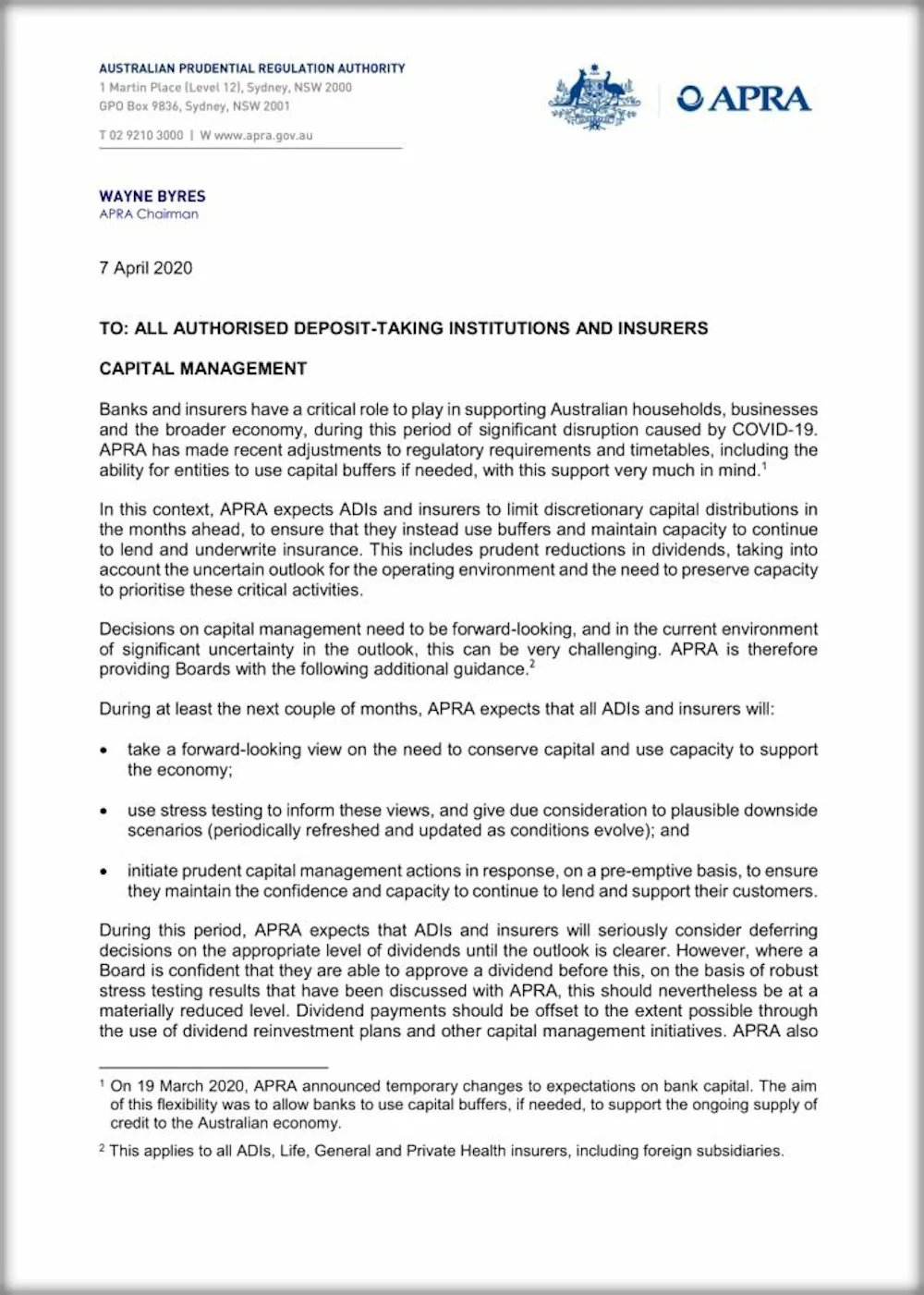 APRA letter to financial institutions, April 7, 2020
In times of crisis where the solvency of corporations is a live question, preferencing shareholders over creditors and employees by paying dividends or buying back shares or borrowing to pay dividends is likely to be a breach of duties because it sucks even more liquidity out of the business and increases leverage.
Both the Bank of England and New Zealand’s Reserve Bank have stopped their banks paying dividends.
On Tuesday Australia’s Prudential Regulation Authority took the unusual step of writing to banks asking them to be extremely cautious about paying dividends.
The Australian Shareholders’ Association has urged the government not to go further and issue a formal direction to banks to suspend dividend payments, saying shareholders rely on dividends to “cover their living expenses”.
Things can’t return to how they were before
When the pandemic is over and the economy recovers it will become clear that the pre-crisis rates of shareholder returns were not sustainable.
Until then, the public might be being asked to pick up the tab to save needlessly febrile companies, just as it has picked up a different sort of tab as a result of systemic misconduct in banking justified by need to keep shareholder returns high.
Post-crisis, companies should be made to wind back returns to shareholders in order to build adequate buffers, invest in their businesses and pay their workers more.
APRA letter to financial institutions, April 7, 2020
In times of crisis where the solvency of corporations is a live question, preferencing shareholders over creditors and employees by paying dividends or buying back shares or borrowing to pay dividends is likely to be a breach of duties because it sucks even more liquidity out of the business and increases leverage.
Both the Bank of England and New Zealand’s Reserve Bank have stopped their banks paying dividends.
On Tuesday Australia’s Prudential Regulation Authority took the unusual step of writing to banks asking them to be extremely cautious about paying dividends.
The Australian Shareholders’ Association has urged the government not to go further and issue a formal direction to banks to suspend dividend payments, saying shareholders rely on dividends to “cover their living expenses”.
Things can’t return to how they were before
When the pandemic is over and the economy recovers it will become clear that the pre-crisis rates of shareholder returns were not sustainable.
Until then, the public might be being asked to pick up the tab to save needlessly febrile companies, just as it has picked up a different sort of tab as a result of systemic misconduct in banking justified by need to keep shareholder returns high.
Post-crisis, companies should be made to wind back returns to shareholders in order to build adequate buffers, invest in their businesses and pay their workers more.
Authors: Andrew Linden, Sessional Lecturer, PhD (Management) Candidate, School of Management, RMIT University


 Daily Bulletin


