

From the bushfires to coronavirus, our old 'normal' is gone forever. So what's next?
- Written by: Sarah Milne, Senior Lecturer, Resources, Environment and Development, Australian National University
The world faces profound disruption. For Australians who lived through the most horrific fire season on record, there has been no time to recover. The next crisis is now upon us in the form of COVID-19. As we grapple with uncertainty and upheaval, it’s clear that our old “normal” will never be recovered.
Radical changes like these can be interpreted through the lens of “rupture”. As the social scientist Christian Lund describes, ruptures are “open moments, when opportunities and risks multiply… when new structural scaffolding is erected”.
The concept of rupture therefore explains what happens during periods of profound change – such as colonisation or environmental catastrophe – when relationships between people, governments and the environment get reconfigured.
This can help us to make sense of the bushfire crisis and COVID-19: we are in an open moment, when the status quo is in flux.
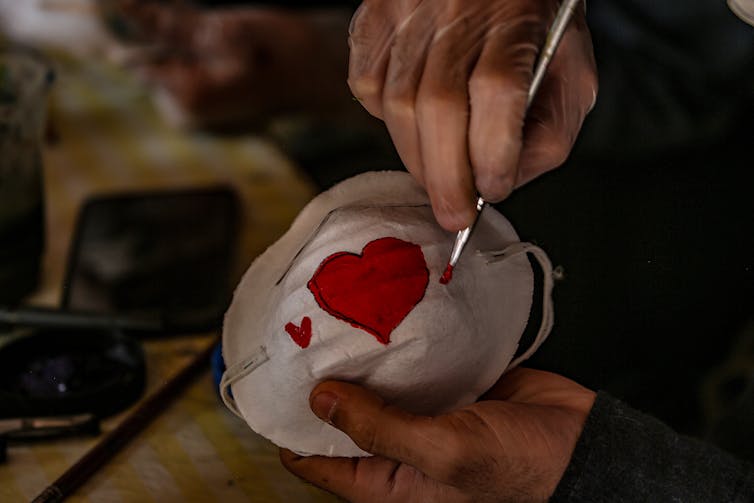 Big crises offer an opportunity to remake society in different ways.
Mohammed Saber/EPA
Big crises offer an opportunity to remake society in different ways.
Mohammed Saber/EPA
History of rupture
Colonisation is perhaps the most dramatic example of rupture in human history. Original ways of life are violently overthrown, while new systems of authority, property and control are imposed.
Novelist Chinua Achebe famously described the effects of colonisation on tribal people in Nigeria, with his 1958 novel Things Fall Apart. But rupture tells us that things do not just fall apart – they also get remade.
We have researched rupture in Southeast Asia, where hydro-electric dam projects have devastated river systems and local livelihoods. New kinds of political power and powerlessness have emerged in affected communities, who’ve had to adjust to flooding, resettlement and an influx of new settlers.
Read more: The community-led movement creating hope in the time of coronavirus
We’ve also found new relationships between people and nature in these contexts. For example, as indigenous people have been displaced from their ancestral lands, they must reestablish access to natural resources and forest-based traditions in new places.
Importantly, the rupture metaphor can be scaled up to help us understand national and global crises. Three insights emerge.
1. Rupture doesn’t come out of nowhere
Both the bushfires and COVID-19 expose how underlying conditions – such as drought, social inequality, and the erosion of public goods and services – contribute to a dramatic event occurring, and in turn shape how it unfolds.
Before the fires hit in late 2019, the drought had already brought many rural communities to their knees. The combination of dry dams, farmers without income, and towns without water meant local capacity to cope was already diminished.
Similarly with COVID-19, pre-existing poverty has translated into higher infection rates, as seen in Spain where vulnerable people in poorly paid jobs have suffered most from the virus.
From this, it is clear that crises are not stand-alone events – and society’s response must address pre-existing problems.
Read more: Here's what the coronavirus pandemic can teach us about tackling climate change
Conversely, favourable underlying conditions – such as social cohesion, public trust and safety nets – can help us adapt and improvise in the face of rupture.
For example during the last bushfire season, a small and nimble community-based firefighting team formed at Mongarlowe in southern New South Wales. The group extinguished spot fires that the under-resourced Rural Fire Service (RFS) could not reach – saving forests, property and potentially, lives.
Such groups emerged from already strong communities. Social cohesion and community responsiveness is also helping societies cope with COVID-19, as seen in the emergence of community-led “mutual aid” groups around the world.
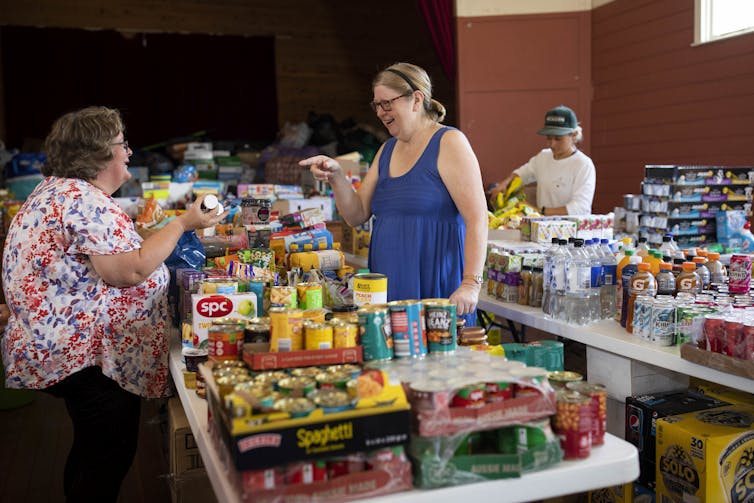 A community supply centre near Bega, NSW, helping residents after the bushfires.
Sean Davey/AAP
A community supply centre near Bega, NSW, helping residents after the bushfires.
Sean Davey/AAP
2. Rupture changes the dynamics of government
Rupture can also expose frictions between citizens and their governments. For example, the Australian government’s initial response to the bushfire crisis was condemned as insensitive and ineffectual. As the crisis evolved, this damaged the government’s credibility and authority – especially in relation to its stance on climate change.
Against this foil, state governments delivered somewhat clearer messaging and steadier management. But tensions soon arose between state and federal leadership, revealing cracks in the system.
The COVID-19 pandemic means that more than ever, we need competent and coherent governance. But fractures have again emerged between state and federal governments, as some states moved ahead of the Commonwealth with faster, stricter measures to combat COVID-19.
Furthermore, as economic stimulus spending reaches A$320 billion - including wage subsidies and free childcare - the government’s neo-liberal ideology appears to have fallen away (at least temporarily).
Critical lessons from other ruptures show that Australians must remain vigilant now, as old systems of authority rewire themselves. To stem COVID-19, governments have announced major societal restrictions in conjunction with the huge spending. These moves demand new kinds of accountability – as demonstrated by calls for bipartisan scrutiny of Australia’s COVID-19 response.
3. Rupture asks us to re-think our relationships with nature
When Australia burned last summer, few could avoid the immediacy of dead wildlife, devastated landscapes and hazardous air. Australians were overwhelmed by grief, and a new awareness of the impacts of climate change. New debates emerged about how our forests should be managed, and the pro-coal stance of the federal Coalition was challenged.
COVID-19 is also a wake-up call to humanity. It is one of many emerging infectious diseases that originated in animals – a product of our “war on nature” which includes deforestation and unregulated wildlife consumption.
Read more: Coronavirus is a wake-up call: our war with the environment is leading to pandemics
As British writer George Monbiot argues, the pandemic means that we can no longer maintain the “illusion of security” on a planet with “multiple morbidities” – looming food shortages, antibiotic resistance and climate breakdown.
Rupture invites us to re-think our relationships to nature. We must recognise her agency – as firestorm or microscopic virus – and our deep dependence upon her.
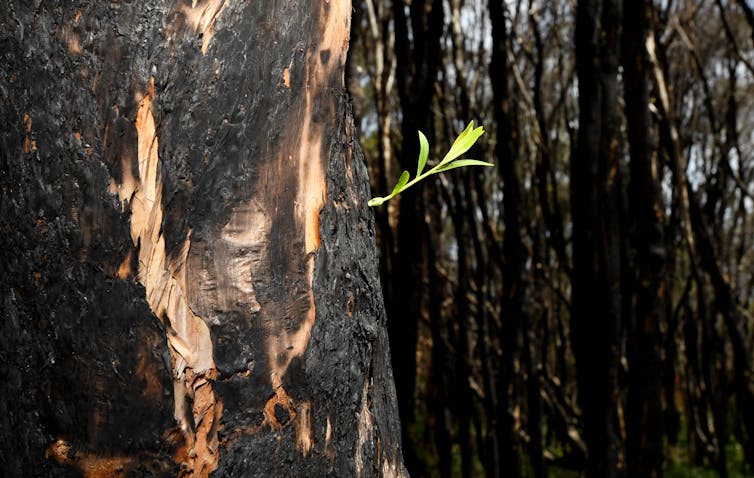 During rupture, things fall apart - and are remade.
Darren England/AAP
During rupture, things fall apart - and are remade.
Darren England/AAP
Looking ahead
Indian author Arundhati Roy recently wrote that, in these troubled times, rupture “offers us a chance to rethink the doomsday machine we have built for ourselves”.
The challenge now is to seize opportunities emerging from this rupture. As our economies hibernate, we’re learning how to transform. Carbon emissions have declined dramatically, and the merits of slowing down are becoming apparent. We must use this moment to re-align our relationships to one another, and to nature.
Authors: Sarah Milne, Senior Lecturer, Resources, Environment and Development, Australian National University


 Daily Bulletin


