

Schools are moving online, but not all children start out digitally equal
- Written by: Amy Graham, Postdoctoral Research Fellow, UNSW
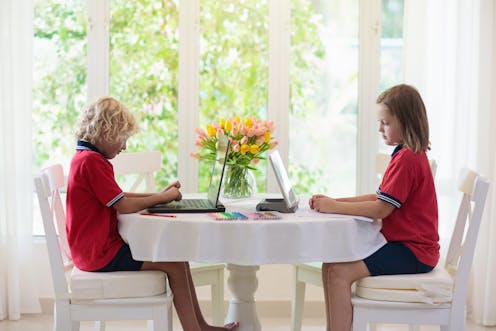
More than one billion young people around the world are now shut out of classrooms due to the COVID-19 pandemic. Even in Australia where many schools remain open, many parents have chosen to keep their kids home.
Some Australian non-government schools have already shut their doors and moved classes online. Victoria, South Australia and Tasmania have ended the term early so teachers can prepare for online learning in the second term. Queensland has closed schools and moved to online classes.
For some children, learning online will be little more than an inconvenience. For others however, this will further magnify their learning disadvantage.
The digital divide
About 87% of Australians can access the internet at home. But only 68% of Australian children aged 5 to 14 living in disadvantaged communities have internet access at home, compared to 91% of students living in advantaged communities.
Students who have unlimited broadband internet at home might do just fine in this new situation. But students living remotely whose internet is intermittent and not fast or reliable enough to cope with online learning, and those in large families sharing limited digital devices, may get left behind.
Read more: Australia's digital divide is not going away
When you add in additional family stress like parents facing sudden unemployment, extra anxiety and little experience supporting their children’s learning, the educational outcomes for vulnerable children will almost certainly go backwards.
A number of experts are worried about this worsening inequality. Education Professor Vaille Dawson of the University of Western Australia told us:
even when they are at school, for some students the only wi-fi connection is in the principal’s office. For those children who may be off the grid, already disengaged from their schooling or from vulnerable families, the outcome may be irreparable.
We have been conducting an ongoing research project, Growing Up Digital Australia, to understand how the widespread use of media and digital technologies is impacting the well-being, health and learning of Australian children.
The first findings from our as yet unpublished 2019 data confirm teachers and principals see family poverty as a key factor in accessing technology that students need for learning. More than 80% of teachers thought students’ socio-economic circumstances impact on their access to technology needed for learning. And one-third of teachers directly observed that children living in poverty had less access to technology than their more well-resourced peers.
This situation is likely to get far worse as the digital learning environment becomes the main option for schooling. Ideally, we would have addressed the existing digital divide before thrusting all students into it.
So, here is what we can do
Inequality in Australian education is increasing. School education, according to the OECD and UNICEF, is not treating Australian children fairly.
Political rhetoric to date has failed to recognise the existing educational inequities, especially in disadvantaged communities and many remote parts of the country. Assuming all children can benefit from learning digitally at home inherently privileges the wealthy and further entrenches a multi-tiered educational model.
We are witnessing a massive global social experiment with children and how they deal with this new way of learning.
Governments should act swiftly to lessen the inconvenient impact caused by this unplanned experiment in mass online learning. Assuming children will not go back to school anytime soon, there should be particular interventions to benefit the most needy families.
Some departments have pledged to address this by mailing out learning materials and offer skeletal staff to support the most vulnerable learners. Other ideas might include a rostered system of computers and digital devices children need to enable their study at home.
Read more: Universities need to train lecturers in online delivery, or they risk students dropping out
Authorities could also relax curriculum requirements and give parents autonomy to spend time with children on alternative educational activities. Music, physical activity and free play outdoors whenever possible can be equally educational for children’s learning and well-being as study with a computer indoors.
We are slowly learning the best way to cope with the threat of COVID-19 is through the lens of “we” rather than “I”. Some schools are much further along the journey in preparing for children learning online without coming to school every day.
Our schools have an opportunity to openly share resources, learning solutions and materials to support the learning of all students, regardless of education sector, social or economic background or location.
One thing governments should not do is to make this situation harder than it already is. They should not tell parents and teachers that missing three or four months of invaluable learning time and tests in schools means they must compress all that lost time into a month and catch up.
Instead, this could be an opportunity to level the playing field; for governments to learn some lessons about how education could be designed more equitably.
Authors: Amy Graham, Postdoctoral Research Fellow, UNSW


 Daily Bulletin


