

climate-linked financial crises loom, but the fix isn't up to central banks
- Written by: Richard Holden, Professor of Economics, UNSW
The Bank for International Settlements – the “central bank” for central banks – made headlines this week with a report outlining how the next major financial crisis may come from unexpected climate risks.
The book calls these risks “green swans” – a play on the term “black swan”, coined by author Nassim Nicholas Taleb. Black swans, Taleb writes in in his 2007 book, are events that are highly improbable, wide-ranging or extreme in their impact and can typically only be explained after they occur.
Read more: Some say we've seen bushfires worse than this before. But they're ignoring a few key facts
An example in the financial markets is how the supposedly risk-free investment strategy of the hedge fund Long Term Capital Management in the late 1990s spiralled out of control and nearly took down the global financial system.
Green swans are the climate-related equivalent of black swans.
This is more than just a cute analogy. One of the defining features of black swans is they cannot be modelled using standard mathematical techniques. As the BIS report puts it:
Black swan events can take many shapes, from a terrorist attack to a disruptive technology or a natural catastrophe. These events typically fit fat-tailed probability distributions, i.e. they exhibit a large skewness relative to that of normal distribution (but also relative to exponential distribution). As such, they cannot be predicted by relying on backward-looking probabilistic approaches assuming normal distributions (e.g. value-at-risk models).
Climate risks have the same features:
Climate-related risks typically fit fat-tailed distributions: both physical and transition risks are characterised by deep uncertainty and nonlinearity, their chances of occurrence are not reflected in past data, and the possibility of extreme values cannot be ruled out.
Where green swans differ from black swans is that, given what we know about climate science, it is highly likely there will be extreme, financially devastating effects.
Australia’s recent bushfires are a notable example of the more frequent extreme events expected. In the United States, there have been more than a dozen “billion dollar” climate and weather disasters every year in recent years.
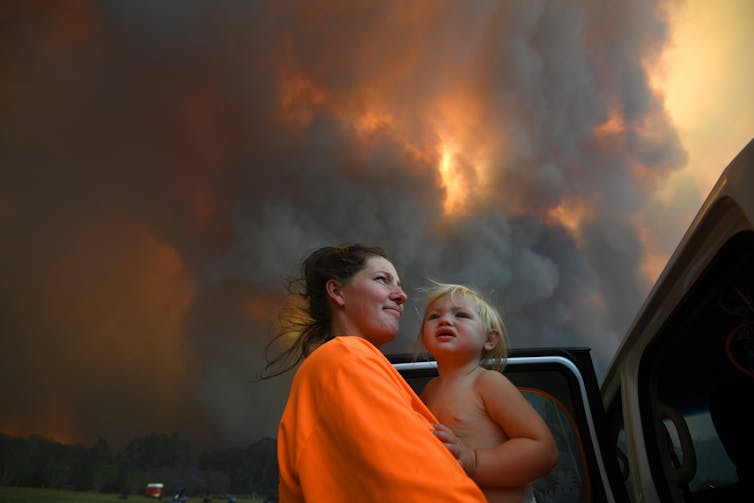 Sharnie Moran and her daughter Charlotte prepare to flee bushfires near Nana Glen, in northeastern New South Wales, on November 12 2019.
Dan Peled/AAP
Sharnie Moran and her daughter Charlotte prepare to flee bushfires near Nana Glen, in northeastern New South Wales, on November 12 2019.
Dan Peled/AAP
Read more: Weather bureau says hottest, driest year on record led to extreme bushfire season
Uncertain certainty
The problem is that we don’t know which extreme climate events will occur. This makes them hard to plan for. It also makes them hard for financial markets to deal with.
If these events could be statistically modelled, at least there would be well-functioning insurance markets for them.
But green swans, by their very nature, defy such predictability.
More than this, green swans can set off cascading additional risks. The BIS book notes:
Climate-related risks are not simply black swans, i.e. tail-risk events. With the complex chain reactions between degraded ecological conditions and unpredictable social, economic and political responses, with the risk of triggering tipping points, climate change represents a colossal and potentially irreversible risk of staggering complexity.
This characterisation of green-swan events seems pretty on point. The big question, of course, is how policy should respond to the presence of these risks.
The BIS report emphasises the role central banks can play.
[…] central banks must also be more proactive in calling for broader and coordinated change, in order to continue fulfilling their own mandates of financial and price stability over longer time horizons than those traditionally considered. We believe that they can best contribute to this task in a role that we dub the five Cs: contribute to coordination to combat climate change.“
The report suggests some things central banks might do. They could keep interest rates lower than they would otherwise be to make "green stimulus” cheaper for governments. They could take account of environmental sustainability goals in determining what securities they hold and the financial stability policies they pursue.
Some of these suggestions I’m not keen on.
I’m for meaningful action on climate change. With co-author Rosalind Dixon, I’ve proposed the Australian Carbon Dividend Plan. I’m also for central bankers highlighting the risks of climate change, as the Reserve Bank of Australia deputy governor, Guy Debelle, has done.
Confusing ends and means
But central banks shifting their mandates to take account of climate risks confuses ends and means.
Yes, climate change is an existential threat. Yes, more needs to be done. And yes, central banks are powerful institutions. But it simply doesn’t follow that they should take on responsibility for policy action on climate change.
One problem is they don’t have the right tools. Central banks can’t impose a price on carbon, for example. The tools they would have to rely on – as the BIS report makes clear – is tinkering with their bond portfolios and keeping interest rates low.
But interest rates are already at historical lows and this hasn’t led to large-scale green stimulus. That is a political problem, not one for central bankers.
A second problem is the potential damage to central banks themselves as institutions. The more central banks are seen as political, the more pressure there will be to make them “accountable” and “democratic”. Such a movement, though well-meaning, could politicise bank boards and damage the virtue of their autonomy.
Read more: Stiglitz is wrong to dismiss central bank independence
Climate change hasn’t been addressed by the political process, and that is a tragedy. But asking other powerful institutions to step into the breach might make matters worse, not better. Ultimately, we need to face up to the pressing political problem of climate change.
Authors: Richard Holden, Professor of Economics, UNSW


 Daily Bulletin


