

With costs approaching $100 billion, the fires are Australia's costliest natural disaster
- Written by: Paul Read, Climate Criminologist & Senior Instructor/Lecturer, Faculty of Medicine, Monash University
It’s hard to estimate the eventual economic cost of Australia’s 2019-20 megafires, partly because they are still underway, and partly because it is hard to know the cost to attribute to deaths and the decimation of species and habitats, but it is easy to get an idea of its significance – the cost will be unprecedented.
The deadliest bushfires in the past 200 years took place in 1851, then 1939, then 1983, 2009, now 2019-20. The years between them are shrinking rapidly. Only a remote grassfire in central Australia in 1974-75 rivalled them in terms of size, although not in terms of material burnt or loss of life.
The term “megafire” is a new one, defined in the early 2000s to help describe disturbing new wildfires emerging in the United States – massive blazes, usually above 400,000 hectares, often joining up, that create more than usual destruction to life and property.
Read more: Firestorms and flaming tornadoes: how bushfires create their own ferocious weather systems
Australia’s current fires dwarf the US fires that inspired the term.
They are 25 times the size of Australia’s deadliest bushfires, the 2009 Black Saturday fires in Victoria that directly killed 173 people, and are so large and intense that they create their own weather in which winds throw embers 30 kilometres or more ahead of the front and pyro-cumulus clouds produce dry lightning that ignites new fires.
The Black Saturday fires burnt 430,000 hectares. The current fires have killed fewer people but have so far burnt 10.7 million hectares – an area the size of South Korea, or Scotland and Wales combined.
There are easy-to-measure costs…
The federal government has promised to put at least A$2 billion into a National Bushfire Recovery Fund, which is roughly the size of the first estimate of the cost of the fires calculated by Terry Rawnsley of SGS Economics and Planning.
He put the cost at somewhere between A$1.5 and $2.5 billion, using his firm’s modelling of the cost of the NSW Tathra fires in March 2018 as a base.
It’s the total of the lost income from farm production, tourism and the like.
It is possible to get an idea of wider costs using the findings of the 2009 Victorian Bushfires Royal Commission.
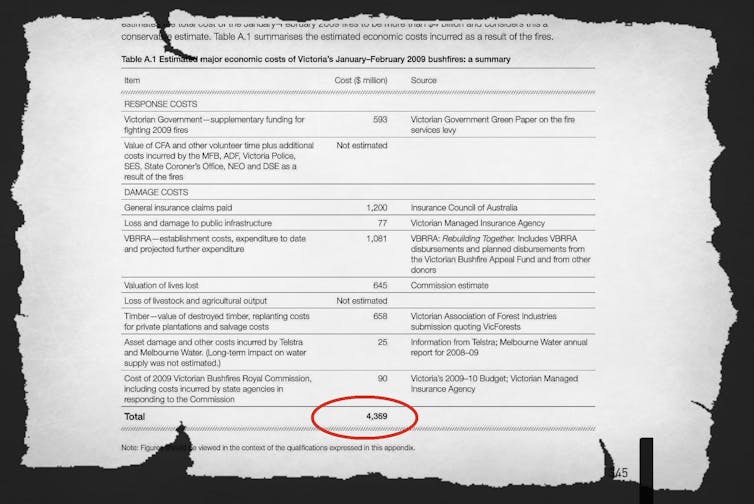 Final Report, 2019 Victorian Bushfires Royal Commission
It came up with an estimate for tangible costs of A$4.369 billion, which after inflation would be about $5 billion in today’s dollars.
… and harder-to-measure costs
Tangible costs are those easily measured including the cost of replacing things such as destroyed homes, contents and vehicles.
They also include the human lives lost, which were valued at A$3.7 million per life (2009 dollars) in accordance with a Commonwealth standard.
The measure didn’t include the effect of injuries and shortened lives due to smoke-related stroke and cardiovascular and lung diseases, or damage to species and habitats, the loss of livestock, grain and feed, crops, orchards and national and local parks.
Also excluded were “intangibles”, among them the social costs of mental health problems and unemployment and increases in suicide, substance abuse, relationship breakdowns and domestic violence.
Read more:
Disaster recovery from Australia's fires will be a marathon, not a sprint
The cost of intangibles can peak years after a disaster and continue to take tolls for decades, if not generations.
One attempt to estimate the cost of intangibles was made by Deloitte Access Economics, in work for the Australian Business Roundtable for Disaster Resilience & Safer Communities.
Deloitte put the tangible costs of the Black Saturday fires at A$3.1 billion in 2015 dollars and the intangible costs at more than that again: A$3.9 billion, producing a total of A$7 billion, which would be A$7.6 billion in today’s dollars.
Black Saturday is a staring point
Final Report, 2019 Victorian Bushfires Royal Commission
It came up with an estimate for tangible costs of A$4.369 billion, which after inflation would be about $5 billion in today’s dollars.
… and harder-to-measure costs
Tangible costs are those easily measured including the cost of replacing things such as destroyed homes, contents and vehicles.
They also include the human lives lost, which were valued at A$3.7 million per life (2009 dollars) in accordance with a Commonwealth standard.
The measure didn’t include the effect of injuries and shortened lives due to smoke-related stroke and cardiovascular and lung diseases, or damage to species and habitats, the loss of livestock, grain and feed, crops, orchards and national and local parks.
Also excluded were “intangibles”, among them the social costs of mental health problems and unemployment and increases in suicide, substance abuse, relationship breakdowns and domestic violence.
Read more:
Disaster recovery from Australia's fires will be a marathon, not a sprint
The cost of intangibles can peak years after a disaster and continue to take tolls for decades, if not generations.
One attempt to estimate the cost of intangibles was made by Deloitte Access Economics, in work for the Australian Business Roundtable for Disaster Resilience & Safer Communities.
Deloitte put the tangible costs of the Black Saturday fires at A$3.1 billion in 2015 dollars and the intangible costs at more than that again: A$3.9 billion, producing a total of A$7 billion, which would be A$7.6 billion in today’s dollars.
Black Saturday is a staring point
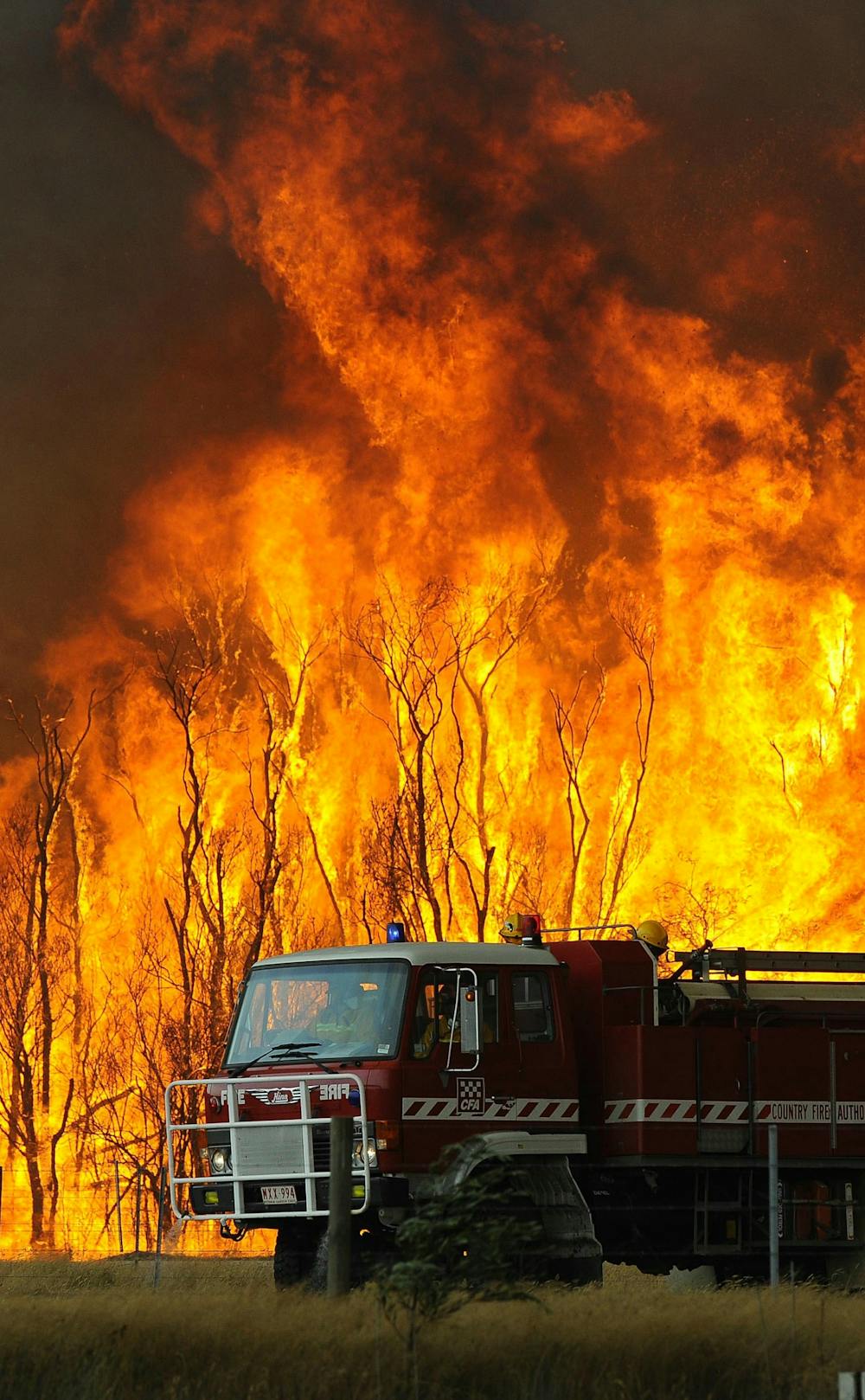 2009 Victoria Black Saturday bushfires.
ANDREW BROWNBILL/AAP
This season’s megafires are, so far, less costly than the 2009 Victorian fires in terms of human life, roughly on par in terms of lost homes, and less costly for other structures.
But given that considerably more land has been burnt we can expect other costs to eclipse those of Black Saturday.
As of today, 25 times as much land has been burnt.
Scaling up the royal commission’s Black Saturday figures for the size of the fire and scaling them down for the fewer deaths and other things that shouldn’t be scaled up produces an estimate of tangible costs of A$103 billion in today’s dollars.
The Deloitte Access Economics ratio of intangible to tangible costs suggests a total for both types of costs of A$230 billion.
As it happens, the tangible costs estimate is close to an estimate of A$100 billion prepared using different methods by University of Queensland economist John Quiggin.
Read more:
We know bushfire smoke affects our health, but the long-term consequences are hazy
The reality won’t be clear for some time.
There are several weeks of fire season remaining, and we are yet to reach the usual peak season for Victoria, which is the first week of February.
What we can safely say, with weeks left to go, is that these fires are by far Australia’s costliest natural disaster.
2009 Victoria Black Saturday bushfires.
ANDREW BROWNBILL/AAP
This season’s megafires are, so far, less costly than the 2009 Victorian fires in terms of human life, roughly on par in terms of lost homes, and less costly for other structures.
But given that considerably more land has been burnt we can expect other costs to eclipse those of Black Saturday.
As of today, 25 times as much land has been burnt.
Scaling up the royal commission’s Black Saturday figures for the size of the fire and scaling them down for the fewer deaths and other things that shouldn’t be scaled up produces an estimate of tangible costs of A$103 billion in today’s dollars.
The Deloitte Access Economics ratio of intangible to tangible costs suggests a total for both types of costs of A$230 billion.
As it happens, the tangible costs estimate is close to an estimate of A$100 billion prepared using different methods by University of Queensland economist John Quiggin.
Read more:
We know bushfire smoke affects our health, but the long-term consequences are hazy
The reality won’t be clear for some time.
There are several weeks of fire season remaining, and we are yet to reach the usual peak season for Victoria, which is the first week of February.
What we can safely say, with weeks left to go, is that these fires are by far Australia’s costliest natural disaster.
Authors: Paul Read, Climate Criminologist & Senior Instructor/Lecturer, Faculty of Medicine, Monash University


 Daily Bulletin


