

Moving the A-League to the winter would improve the play, but will it attract the fans?
- Written by: Jessica Richards, Lecturer Sport Business Management, Western Sydney University
In the past week, the Australian football players union has been pressuring the A-League to make a major change in the sport – shifting to a winter competition, instead of its current spot in the brutal summer.
Both the A-League and W-League seasons currently run from October-April. One of the main reasons for the summer schedule was to avoid head-to-head competition with the much bigger Australian Football League (AFL) and National Rugby League (NRL), which both play in the winter.
But there’s a growing feeling in the sport that a move to the winter months would be beneficial for football, particularly as our summers grow hotter and bushfires worsen.
Last weekend, A-League officials considered cancelling the match between Sydney FC and Newcastle Jets due to the air quality in NSW before shifting course at the last minute. However, the W-League match scheduled before it was postponed.
Schedule not aligned with other leagues
The A-League is believed to be the only professional football league in the world in which the top-level competition plays at a different time of year from its lower-tier league. The semi-pro National Premier League currently plays in the winter, from March to October.
Read more: Why soccer is falling behind footy and rugby in Australia
According to former Socceroo John Aloisi, the way the schedule is currently set up widens the gap between amateur and professional football. This separation limits the development pathways for players, coaches and administrators.
It also situates the Australian national competition outside the Asian football schedule, which is also in the Southern Hemisphere winter.
If we want to move forward as a code we need to go, ‘Alright, Asia is played this time of the year, we have to play with them.’
Moving to the winter could have a huge impact on the women’s game, too. It would give the W-League a major opportunity to grow its fan base since no other Australian women’s sport is played at that time of year, other than netball.
As former Matilda Shelley Youman says,
Crowds are not coming now anyway, so why not try something new. We need to find our place in the busy Australian sporting landscape.
Hotter temperatures lead to patchier play
Other players have also thrown their support behind the idea, arguing the Australian summer heat and constant need for water breaks impacts the quality of football. The FFA heat policy mandates a 90-second drink break in each half when the wet bulb globe temperature (WBGT) is between 26 and 27.9 degrees Celsius, or the ambient temperature is over 31 degrees.
A match can be delayed or postponed when the WBGT reaches 28 degrees.
Former Socceroos star Jason Culina said he loses up to four kilograms after games played in the heat and it can take days to recover. He says the fields in the summer months are also “rock hard”, leading to increased injuries.
My career was almost ended by a serious knee injury in 2011 that was caused by wear and tear. … the hard conditions in Australia might have accelerated the deterioration.
The heat may also be a contributing factor to fans staying away from A-League matches. Statistics show that since 2015, crowd attendance at A-League matches has continually declined.
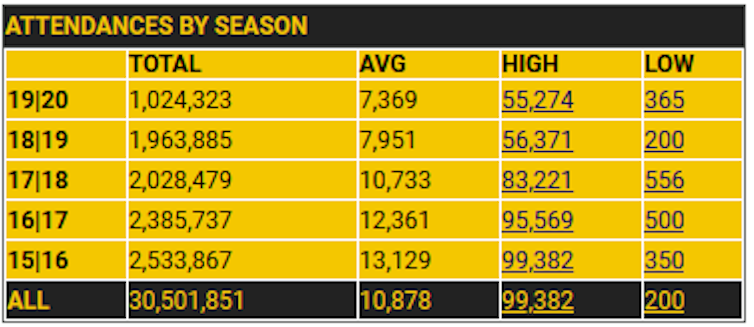 A-League attendance figures (2015-2019)
Austadiums
A-League attendance figures (2015-2019)
Austadiums
Where will they play in winter?
So, how feasible would a switch actually be? Could this be the “shake-up” many have called for in the A-League?
One of the biggest problems is where A-League games would be played if the main stadiums are busy hosting AFL, NRL and Super Rugby matches.
Part of the A-League season currently overlaps with those leagues in March and April. This already poses problems for footballers, due to the damage caused to fields by scrums and studs.
Sydney FC, for example, has scheduled games at several suburban grounds while the Sydney Football Stadium is being rebuilt. However, last February the team had to move a match from Brookvale Oval after the playing surface was considered not up to “A-League standard”.
Add to that Melbourne Victory player Terry Antonis’ knee injury that was largely attributed to the poor condition of the Sydney Cricket Ground after a Super Rugby match.
In NSW, the Berejiklian government has controversially committed A$2 billion to stadium redevelopment, but most of the money is going toward its main stadiums in Olympic Park and Moore Park.
This has resulted in ongoing criticism from those who believe the money could have been dispersed more evenly to upgrade smaller stadiums. The benefits of investing in smaller stadiums include enhancing the match atmosphere and creating a more family-friendly environment. They are overwhelmingly favoured by fans and football clubs alike
Read more: Australians love their sport, but investing in new venues is another matter
Growing the fan base amid so much competition
The A-league’s current position in the sporting calendar is already not drawing huge television audiences. The season opener between the Wanderers and Mariners in October attracted just 47,000 viewers on the ABC in the five major capital cities – down from 93,000 a year earlier.
Read more: Why soccer is falling behind footy and rugby in Australia
While research shows Australians have multiple loyalties when it comes to sport, the A-League has long struggled to build a strong emotional connection with its fans – hence the poor television viewership and match attendance figures.
A recent study by True North Research highlighted how important the emotional connection is between fans and clubs.
Read more: The beautiful social media game: A-League winners and losers on Twitter
The Matildas have long been considered among the “most loved Australian sport teams” but A-League clubs have been ranked the worst of any summer sports teams for emotional connection with fans.
In light of this, a move to winter could pose a serious risk to football’s future. Multiple online fan surveys have shown that if it was a choice between the NRL, AFL or A-League, A-League would not be the winner.
Perhaps instead of a shift to a different season, the A-League should focus on better developing and marketing its summer matches. As it stands now, the league decided not to do any marketing for the 2019-20 season until after the NRL and AFL Finals were over.
If the A-League’s administrators won’t promote the league before the season even starting, what hope does football have against a field of giants?
Authors: Jessica Richards, Lecturer Sport Business Management, Western Sydney University


 Daily Bulletin


