

Australian building codes don't expect houses to be fire-proof
- Written by: Raymond William Loveridge, Adjunct Professor - School of Built Environment, University of Technology Sydney
More than 2,000 homes have been destroyed in Australia since the start of the bushfire season. More will certainly be destroyed before the season ends in March.
Could these houses have been built to better withstand fire?
Quite probably. But that doesn’t necessarily mean Australia’s building regulations need reforming to ensure homes are made more fireproof.
Appropriate building codes are about weighing costs and benefits. Only analysing the reasons buildings were destroyed will tell us if more needs to be done.
Performances standards
Not all buildings are created equal. Newer buildings will generally be more fire-proof than older ones, due to building regulations having been improved over time.
In particular, national building requirements for residences in bushfire-prone areas were improved after the 2009 “Black Saturday” bushfires in Victoria, in which 173 people died and more 2,000 homes were destroyed.
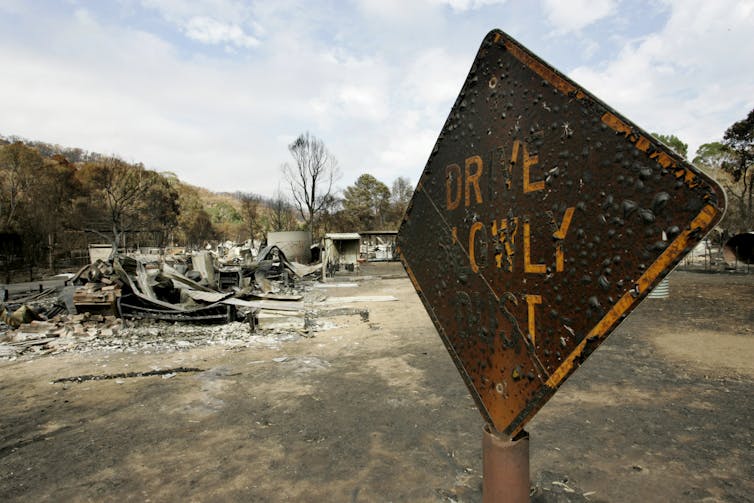 A house in Flowerdale, Victoria, destroyed in the 2009 bushfires. About 80% of houses in the small town were lost, along with 10 lives.
Raoul Wegat/AAP
A house in Flowerdale, Victoria, destroyed in the 2009 bushfires. About 80% of houses in the small town were lost, along with 10 lives.
Raoul Wegat/AAP
Buildings are regulated by states and territories but governments have recognised the value of nationally consistent building codes through the National Construction Code. This code, among other things, sets minimum standards for the design and construction of new buildings on bushfire-prone land. (What land is deemed “bushfire prone” is defined by state and territory legislation.)
The National Construction Code is “performance-based”. It doesn’t specify how a building must be built, but how a building must perform. This means innovative designs, materials and construction methods can be readily approved.
A residential building on bushfire-prone land, the code states, must be designed and constructed to “reduce the risk” of ignition from a bushfire, appropriate to the risk from bushfire flames, burning embers, radiant heat and intensity of the bushfire attack.
The risk to which a building is expected to be exposed depends on the individual site and conditions such as vegetation type and density, and slope of land. Properties are assessed and given a “Bushfire Attack Level” (BAL) rating by inspectors.
There are six BAL levels that classify the severity of potential exposure to bushfire. The highest – BAL FZ – is for buildings exposed to an extreme risk, such as a house surrounded by trees that could produce direct contact from flames.
Lower BAL levels take into account risks from burning debris, ember attack and radiant heat. The lowest deems the risk insufficient to warrant any specific construction requirements.
Construction details for each BAL cover building elements such as floors, walls, roofs, doors, windows, vents, roof drainage systems, verandahs, and water and gas supply pipes. For example, fire-resistant timber may be required for floor framing, or windows may be required to use toughened glass.
Balancing competing interests
Are the requirements of the National Construction Code good enough?
If the aim is to minimise the number of buildings damaged or destroyed in extreme fire events, the answer is no.
But that’s not the aim. Like most government regulation, the code requirements are about balancing competing interests.
All building regulations are subject to cost-benefit analysis. They must demonstrate a “net cost benefit” to the community – that the cost of compliance will be less than the benefit delivered to the general community.
It’s a cold calculation about the risk and potential cost of homes being destroyed in bushfires versus the more certain costs involved in requiring all homes to be built to more stringent building codes.
Government policy treats potential property loss as a matter for owners to address through property insurance. There’s no reason to expect this to change any time soon.
Learning from experience
If the cost of building destruction in bushfires turned out to be greater than the cost of more stringent building requirements, there would be a strong rationale to improve the regulations. This is why post-fire analysis is so important.
A prime example is the royal commission into the causes and costs of the Black Saturday fires.
The commission’s final report made a number of recommendations for changes to the National Construction Code. These included new provisions to:
- make protection from ember attack a performance requirement
- address the design and construction of private (underground) bushfire emergency shelters
- include design and construction requirements for non-residential buildings, such as schools and aged-care centres, in bushfire-prone areas.
All governments agreed to the first two recommendations, which were promptly implemented in the National Construction Code (in 2010).
The recommendation about non-residential building was not implemented at the time because governments considered that planning laws would not allow these types of buildings to be built in a bushfire-prone area.
However, the 2019-2020 business plan of the Australian Building Codes Board (which administers the National Construction Code, includes a “bushfire provisions for non-residential buildings” project, so it is reasonable to expect changes to the code in future.
This season’s fires may also provide impetus for other changes to the construction code. One key factor that will be worthy of research is the age of the buildings destroyed.
Depending on how many homes lost were built after 2010, it might be argued that changes made after the 2009 Victorian fire have been insufficient to keep up with evolving conditions.
Authors: Raymond William Loveridge, Adjunct Professor - School of Built Environment, University of Technology Sydney


 Daily Bulletin


