

Islamophobic attacks mostly happen in public. Here's what you can do if you see it or experience it
- Written by: Derya Iner, Senior Lecturer, Charles Sturt University
The second Islamophobia in Australia Report launched last month, in the same week a graphic video showing a pregnant Muslim woman being punched and stomped on circulated widely on social media.
Earlier in October another video went viral, showing two New South Wales police officers verbally abusing two Muslim women, threatening to falsely charge them as an accessory to murder.
Read more: These young Muslim Australians want to meet Islamophobes and change their minds. And it's working
In both cases, the victims were women and visibly Muslim, wearing a head covering (hijab), and the perpetrators were white men. These examples correlate with the report’s findings, where 71% of perpetrators were male and 72% of victims were female.
Alarmingly, most Islamophobic attacks occurred in public, and yet only 14% of bystanders got involved or intervened. And of those, only one in three defended the victim. The majority of witnesses simply passed by without paying attention.
Islamophobic incidents recorded nationwide
The second biennial Islamophobia in Australia report analysed 349 Islamophobic incidents reported to the Islamophobia Register of Australia, from 2016-2017. Combined with the previous report, 592 online and offline cases were recorded in the last four years. But this represents only the tip of the iceberg.
Both reports conclusively show Islamophobia in Australia does exist and is a persistent social issue, one that overwhelmingly targets women, a vulnerability that stems from being identifiably Muslim when wearing a hijab.
It is also alarming that the incidents in public spaces not only continued to occur regularly, but their prevalence increased since the previous report.
Guarded places, such as shopping centres, train stations and other crowded areas saw 60% more harassment than unguarded places – an increase of 30% since the previous report. Islamophobia in shopping centres was most common, accounting for 25% of reported incidents.
Read more: Islamophobia is still raising its ugly head in Australia
This could be because public spaces give more opportunity for Islamophobic people to cross paths with Muslims. Yet, the presence of a crowd, CCTV cameras and guards didn’t appear to deter them.
What you can do if you see an attack
Hate crimes are rarely prosecuted in Australia, and together with the lack of bystander intervention and pervasive negative stereotypes of Muslims, perpetrators seem more emboldened.
But public opinion is where the most important opportunity to prevent Islamophobia lies. If witnesses to Islamophobic hate incidents intervene, it would strongly discourage perpetrators and others with similar sentiments.
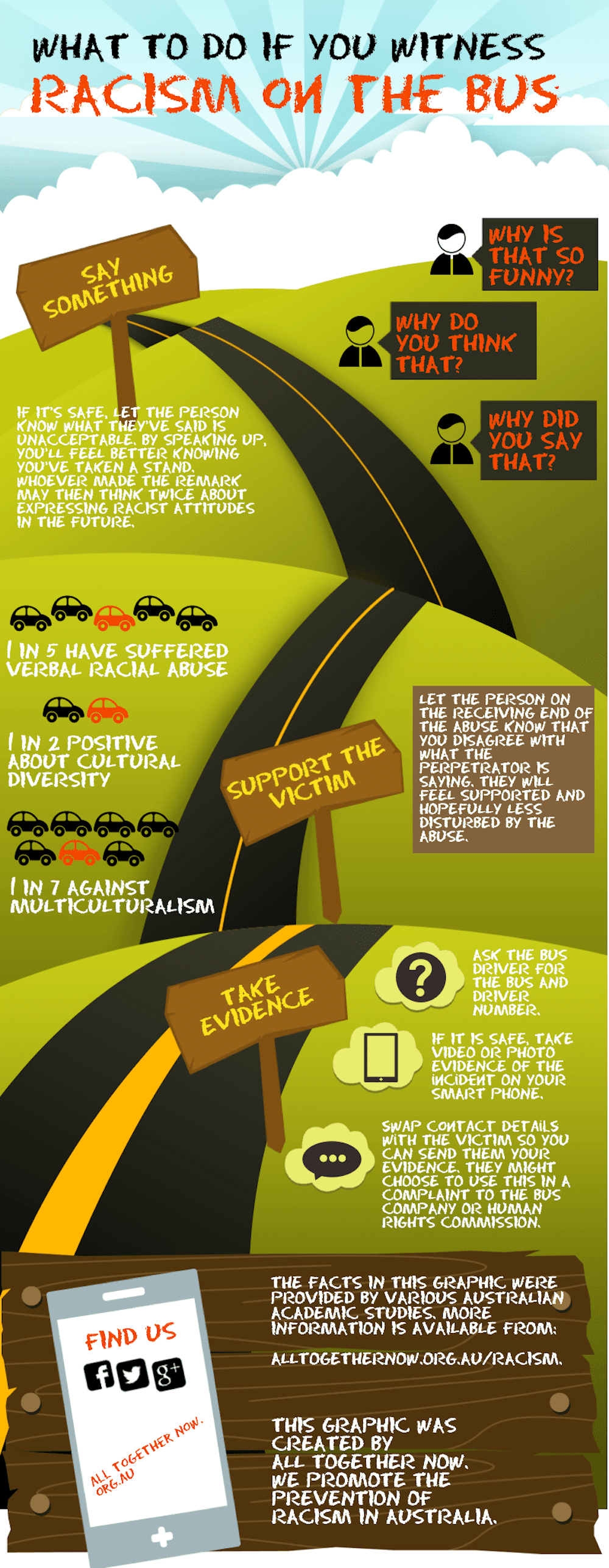 Infographic courtesy of All Together Now
So, if you see an Islamophobic incident in a public, guarded place like a shopping centre, the first thing you can do is directly report to the security guards, who can take the perpetrator away.
Witnesses should also consider reporting the incidents to the Islamophobia Register and the police. In fact, witnesses reported 41% of all physical cases recorded in the report.
The second thing you can do is comfort the victims. Victims, who were often left in tears, say they felt traumatised, deeply disappointed, publicly ridiculed and, as a result, extremely distressed.
A smile or simply saying, “don’t worry, this is your country just like all other Australians”, would go a long way to alleviate the intense feeling of not being accepted.
Read more:
How to tackle Islamophobia – the best strategies from around Europe
And third, witnesses should get involved. In one reported case, when a Muslim mother with her three children was severely abused, the support from surrounding people discouraged the perpetrator, who quickly left.
Here, the mother describes the support she received afterwards.
I was really upset and crying and my kids were in shock […] Everyone was looking at us and the woman from Donut King came over and offered a seat, a cup of tea and some drinks for my kids.
Security moved us to the management office soon after that but not before a sister who I happened to sit next to said she had removed her hijab and abaya because she was tired of being harassed.
Another beautiful lady gave me a much-needed hug and some kind words only someone who knows discrimination could share and another wanted to buy my kids donuts. The staff in the management were very kind and gave my children colouring in.
In another case, high school students defended their Muslim friend, whose name was scribbled on a toilet door, calling her a terrorist.
Her friends scribbled over it and wrote if u knew her u wouldn’t say that about her.
The presence and behaviour of the police is another key factor. Victims reported immense relief and trust in Australia and its institutions when they felt police showed understanding, even if the case couldn’t lead to a criminal charge.
But police attended only half of the 22% of the incidents reported to them. And in some cases, police explained to victims how there’s freedom of speech in Australia and they can’t do much.
In 11% of the cases where police became involved, they were constructive and comforted the victim.
What you can do if you experience Islamophobia
First – stay strong and know you’ve done nothing wrong just for being a Muslim. Remembering this can give you the courage to call for help from bystanders.
In the earlier case of the Muslim mother with three children, it was her firm and loud response to the abuser that attracted attention and led to people offering help.
Victims should also report the cases to the police and to the third-party reporting platforms, such as Islamophobia Register Australia.
Even if the incident doesn’t fall into a crime category, it can still be helpful for police to monitor the perpetrator, while the register can provide advocacy and use the reported incidents to raise public awareness in its reports.
And victims should seek counselling from organisations in every state and territory designed to help victims, such as Victim Services in NSW. The Australian Human Rights Commission also receives complaints and provides advocacy services across Australia.
Read more:
Why Muslim women wear a hijab: 3 essential reads
The Islamophobia Register Australia page provides detailed information about where to report and All Together Now gives instructive advice on tackling racism.
Mosques and Muslim organisations can also provide a safe space for victims to talk about their experiences. Even if you don’t feel the need for counselling, discussing the experience can help make sense of it all in a meaningful way.
Islamophobia in Australia is a social problem that affects a significant portion of society. Recognition of Islamophobia does not diminish the achievements of Australian society and the success of its multiculturalism.
It will merely highlight a social problem that cannot be ignored or downplayed any longer.
Infographic courtesy of All Together Now
So, if you see an Islamophobic incident in a public, guarded place like a shopping centre, the first thing you can do is directly report to the security guards, who can take the perpetrator away.
Witnesses should also consider reporting the incidents to the Islamophobia Register and the police. In fact, witnesses reported 41% of all physical cases recorded in the report.
The second thing you can do is comfort the victims. Victims, who were often left in tears, say they felt traumatised, deeply disappointed, publicly ridiculed and, as a result, extremely distressed.
A smile or simply saying, “don’t worry, this is your country just like all other Australians”, would go a long way to alleviate the intense feeling of not being accepted.
Read more:
How to tackle Islamophobia – the best strategies from around Europe
And third, witnesses should get involved. In one reported case, when a Muslim mother with her three children was severely abused, the support from surrounding people discouraged the perpetrator, who quickly left.
Here, the mother describes the support she received afterwards.
I was really upset and crying and my kids were in shock […] Everyone was looking at us and the woman from Donut King came over and offered a seat, a cup of tea and some drinks for my kids.
Security moved us to the management office soon after that but not before a sister who I happened to sit next to said she had removed her hijab and abaya because she was tired of being harassed.
Another beautiful lady gave me a much-needed hug and some kind words only someone who knows discrimination could share and another wanted to buy my kids donuts. The staff in the management were very kind and gave my children colouring in.
In another case, high school students defended their Muslim friend, whose name was scribbled on a toilet door, calling her a terrorist.
Her friends scribbled over it and wrote if u knew her u wouldn’t say that about her.
The presence and behaviour of the police is another key factor. Victims reported immense relief and trust in Australia and its institutions when they felt police showed understanding, even if the case couldn’t lead to a criminal charge.
But police attended only half of the 22% of the incidents reported to them. And in some cases, police explained to victims how there’s freedom of speech in Australia and they can’t do much.
In 11% of the cases where police became involved, they were constructive and comforted the victim.
What you can do if you experience Islamophobia
First – stay strong and know you’ve done nothing wrong just for being a Muslim. Remembering this can give you the courage to call for help from bystanders.
In the earlier case of the Muslim mother with three children, it was her firm and loud response to the abuser that attracted attention and led to people offering help.
Victims should also report the cases to the police and to the third-party reporting platforms, such as Islamophobia Register Australia.
Even if the incident doesn’t fall into a crime category, it can still be helpful for police to monitor the perpetrator, while the register can provide advocacy and use the reported incidents to raise public awareness in its reports.
And victims should seek counselling from organisations in every state and territory designed to help victims, such as Victim Services in NSW. The Australian Human Rights Commission also receives complaints and provides advocacy services across Australia.
Read more:
Why Muslim women wear a hijab: 3 essential reads
The Islamophobia Register Australia page provides detailed information about where to report and All Together Now gives instructive advice on tackling racism.
Mosques and Muslim organisations can also provide a safe space for victims to talk about their experiences. Even if you don’t feel the need for counselling, discussing the experience can help make sense of it all in a meaningful way.
Islamophobia in Australia is a social problem that affects a significant portion of society. Recognition of Islamophobia does not diminish the achievements of Australian society and the success of its multiculturalism.
It will merely highlight a social problem that cannot be ignored or downplayed any longer.
Authors: Derya Iner, Senior Lecturer, Charles Sturt University


 Daily Bulletin


