

If Australian police officers are allowed to shoot to kill, they should be better trained
- Written by: Rick Sarre, Professor of Law and Criminal Justice, University of South Australia
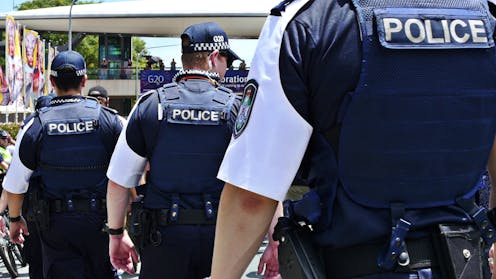
Australians woke to the news last weekend that a 19-year-old Warlpiri man had been shot and killed by a police officer in Yuendumu, 300km north-west of Alice Springs.
A confrontation had occurred after two officers went to a property to arrest the man for breach of a condition of his suspended sentence. One report said the man lunged at the police officer as the pair approached him. Acting deputy commissioner Michael White said:
During that time a struggle ensued and two shots were fired and [the young man] sadly passed away later.
The community outrage has been swift, with a crowd of Yuendumu residents rallying outside the police station, demanding justice. The matter has now been classified as a death in custody.
Why is this still happening in modern Australia? Surely police have learned lessons from past tragedies, and they’re trained today to use their guns as a last resort. After all, they have tasers and other non-lethal weapons, don’t they?
In attempting to answer these questions, it’s useful to make some observations about current police practice and the available research.
Most Australian police officers carry guns
The first observation about last weekend’s tragedy is a simple one. Firearm deaths occur in heated situations because police carry guns as standard issue.
In 1970, only the New South Wales Police Force was habitually armed. Over time, policies were introduced in each Australian jurisdiction that allowed police officers to gauge their own level of vulnerability and request a firearm in circumstances they perceived as dangerous. As the years passed, this became a very subjective assessment.
The consequence of this policy of accretion is that firearms are now carried by most patrol officers in all Australian states and territories most of the time.
Read more: Victorian police have 'shoot to kill' powers when cars are used as weapons: here's why this matters
Police direction on “shoot to kill” is clear. An officer can use lethal force against another person when there’s a reasonable threat of death or serious injury to the officer, another officer or a member of the public. The difficulty is in determining the reasonableness of the threat. In the heat of the moment this, too, involves a highly subjective assessment.
So does the routine arming of police make the public safer? Yes and no.
A civilian is 14 times more likely to be shot and killed by a police firearm in the US than by a police firearm in Australia, and 42 times more likely to be shot and killed by a police firearm in the US than by a police firearm in Germany.
But police in all three nations routinely carry firearms. So, the mere arming of police doesn’t appear to be the key factor in civilian deaths. There must be something more at play.
Best practice for firearms training
There is. The research tells us the number of civilian deaths caused by police firearms varies according to four important factors: the extent of police militarisation; the rules that pertain to the use of lethal force; the standards of firearms training; and the gun culture in the society in which officers operate.
The most important one for Australian policymakers is the third of these: the standards of firearms training.
To that end, five key imperatives for firearm training emerge from the research:
- Australian police policies must have clear and precise rules regarding the carriage and drawing of firearms, and there must be high standards of accountability for those who carry and draw them
- uniform firearms training must be across all jurisdictions
- this training must include best practice communication techniques such as negotiation skills and deescalation strategies, and clear instructions regarding non-lethal alternatives
- strong collaborations must be in place between police and health professionals and other social services
- body cameras should be compulsory on all operational officers.
If these initiatives and practices are in place, and entrenched, one can safely assert that fewer deaths at the hands of police will occur.
Read more: Shoot to kill: the use of lethal force by police in Australia
Police are employed to protect us. If that does not happen, such as in Yuendumu, then there’s something going wrong in our police training centres.
Firearms make police officers feel safer
There will be a coroner’s inquest into the young man’s death. It’s too early to say what evidence will be offered and what the consequences might be. But the coroner will not rule that deadly force can never be used.
As you might recall, the Lindt cafe siege coroner was told the sharp-shooter who had the murderer in his sights in December 2014 was directed not to use lethal force, a decision that may have had fatal consequences.
Yes, police today are trained to use their guns as a last resort. And yes, they have tasers and other non-lethal weapons at their disposal. But in the heat of the moment, with the lives of serving officers potentially on the line, judgements are made quickly. Hindsight is a wonderful thing, but it is never available when it is needed most.
So what does the evidence tell us about firearms and the safety of police officers themselves? Available research suggests there is no clear evidence guns make police safer, but officers feel safer with firearms at their disposal.
And what of the future? There is no going back to the days when police did not carry guns. So the training associated with their use needs to be unremitting. Australian lives are relying on it.
Authors: Rick Sarre, Professor of Law and Criminal Justice, University of South Australia


 Daily Bulletin


