

Afghanistan’s suffering has reached unprecedented levels. Can a presidential election make things better?
- Written by: Safiullah Taye, Phd. Candidate and Research Assistan, Deakin University
After months of delays and uncertainty, Afghanistan is set to hold its presidential election on Saturday. This election, the third since the overthrow of the Taliban regime in 2001, has critical implications for the political stability and security of the country.
Most importantly, it will test the resilience of the country’s fragile democratic process and shape the conditions under which the now-defunct negotiations between the United States and the Taliban can be resumed with more meaningful participation from Kabul.
And if the vote produces a broadly acceptable and functioning government – which is not a guarantee after the last presidential election in 2014 and parliamentary elections in 2018 – it will have profound repercussions for the Afghan people.
Read more: How to end Afghanistan war as longest conflict moves towards fragile peace
Nearly two decades after the US-led coalition invaded the country and ousted the Taliban, Afghanistan is still in a downward spiral. In June, the country replaced Syria as the world’s least peaceful country in the Institute for Economics and Peace’s Global Peace Index report. The BBC tracked the violence in the country in August and found that on average, 74 Afghan men, women and children died each day across the country.
Further, the number of Afghans below the poverty line increased from 33.5% in 2011 to nearly 55% in 2017.
And in another bleak assessment of where things are at the moment, Afghan respondents in a recent Gallup survey rated their lives worse than anyone else on the planet. A record-high 85% of respondents categorised their lives as “suffering”, while the number of people who said they were “thriving” was zero.
Tests of democracy in Afghanistan
Despite the major challenges posed by insecurity and risks of electoral fraud, Afghanistan’s recent elections have been serious contests between the country’s various political elites.
Ordinary voters take extraordinary risks to participate in the polls. Thanks to a dynamic media sector, these contests involve spirited debates about policy-making and the visions of the candidates. This is particularly true when it comes to presidential elections, as the country’s 2004 Constitution concentrated much of the political and executive power in the office of the president.
There have been serious tests of Afghanistan’s nascent democracy before, however. The 2014 election was tainted by allegations of widespread fraud, pushing the country to the brink of a civil war.
The political crisis was averted by the formation of the national unity government, in which Ashraf Ghani became president and his main challenger in the election, Abdullah Abdullah, took the position of chief executive officer, with powers similar to a prime minister.
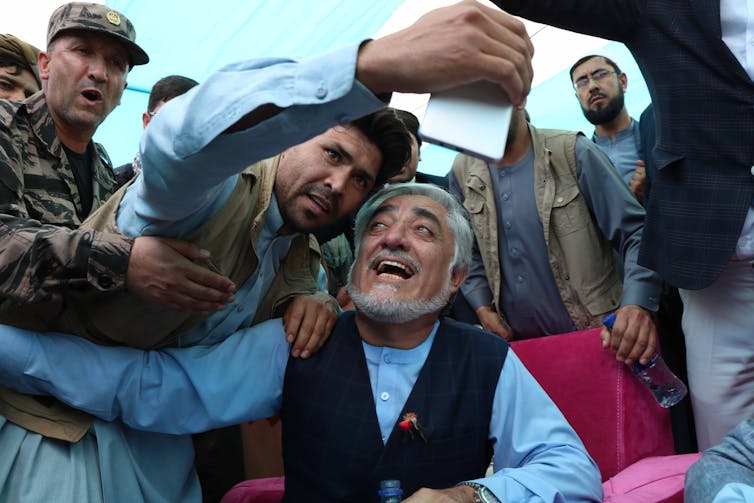 Abdullah Abdullah is again the main challenger for President Ashraf Ghani, similar to the 2014 vote.
Jalil Rezayee/EPA
Abdullah Abdullah is again the main challenger for President Ashraf Ghani, similar to the 2014 vote.
Jalil Rezayee/EPA
Negotiations with the Taliban
Since the withdrawal of most of the US and NATO forces from Afghanistan in 2014, the Taliban has considerably expanded the areas under its influence. Nonetheless, the insurgent group has been unable to score any strategic military victories by gaining control of provincial or population centres.
In 2016, President Donald Trump came to the White House with the promise of ending the war in Afghanistan. However, after a meticulous assessment of the risks associated with a complete troop withdrawal, he backed away from that pledge.
Trump instead called the 2014 departure of most US troops a “hasty withdrawal” and declared a new strategy that included an increase in the number of US forces in Afghanistan.
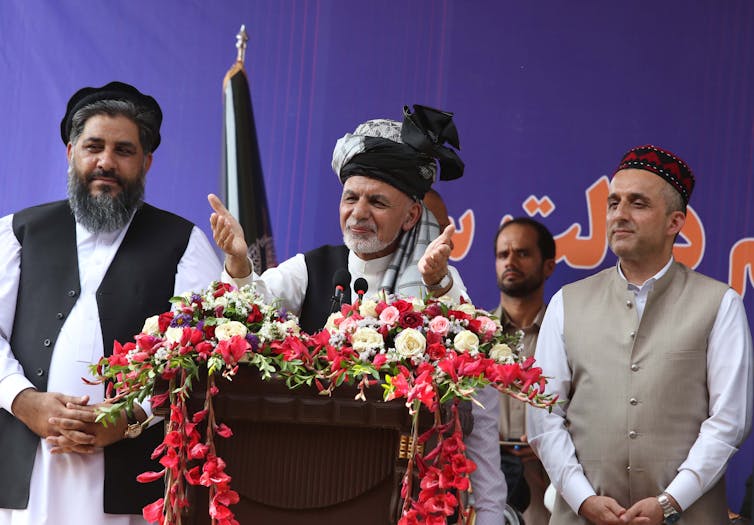 Afghan President Ashraf Ghani (centre) has adopted a populist style in his re-election campaign to connect better with voters.
Ghulamullah Habibi/EPA
Afghan President Ashraf Ghani (centre) has adopted a populist style in his re-election campaign to connect better with voters.
Ghulamullah Habibi/EPA
The deployment of additional troops significantly escalated the military campaign against the Taliban but failed to decisively change the security dynamics in the country.
Then, in 2018, the Trump administration formally began engaging the Taliban in a series of direct negotiations in Qatar. The process was called off by Trump earlier this month when it was reportedly at the threshold of an agreement.
Read more: A peace agreement in Afghanistan won't last if there are no women at the table
Critics noted, however, the many flaws of this approach and the haste with which the negotiations were conducted by Zalmay Khalilzad, the US special representative for Afghan reconciliation.
Ironically, at the insistence of the Taliban, the process excluded the government of Afghanistan, which the Taliban refuses to recognise as the legitimate authority in the country. This led to phased negotiations, whereby a deal between the US and the Taliban was expected to be followed by an intra-Afghan dialogue and eventually a ceasefire.
A successful presidential election that produces a broadly acceptable outcome can significantly strengthen the position of the new government in negotiating and implementing a peace process with the Taliban. This is one reason why Ghani does not want to be sidelined from the negotiations.
Challenges for the upcoming vote
The election involves a significant number of political players and coalitions, but is essentially a replay of the 2014 poll between Ghani and Abdullah. While none of the other 13 candidates have a realistic chance of winning, they can split the votes to prevent one of the leaders from claiming victory in the first round. A run-off was required in the last two presidential elections in 2009 and 2014.
Another factor is the threat of violence from the Taliban. The group has already vowed to violently disrupt the election. In recent weeks, it has claimed responsibility for deadly attacks on election rallies, including a devastating attack on the campaign office of Amrullah Saleh, the first vice-president on Ghani’s ticket.
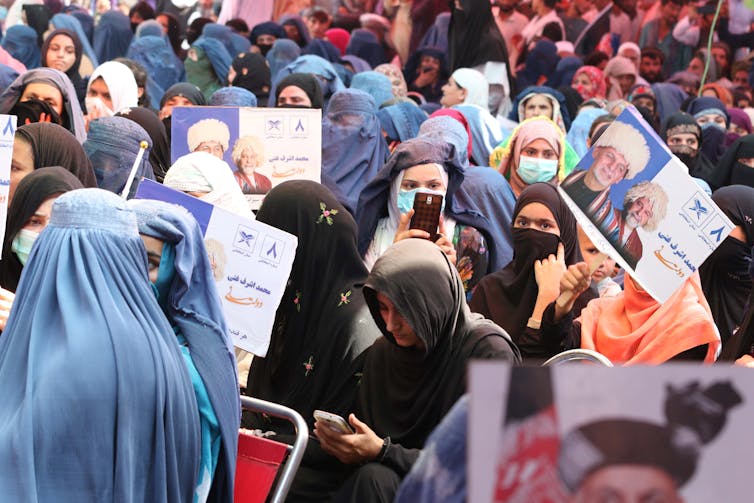 Supporters of incumbent President Ashraf Ghani at a rally in Jalalabad this month.
Ghulamullah Habibi/EPA
Supporters of incumbent President Ashraf Ghani at a rally in Jalalabad this month.
Ghulamullah Habibi/EPA
Insecurity will also likely prevent significant numbers of people from participating in the process. The number of polling stations has significantly dropped to less than 5,000 this year compared to 7,000 in 2014, highlighting the deteriorating security conditions.
There are also fears that more polling stations will be closed on election day, both for security reasons and political reasons (the latter in areas that are likely to vote for opposition candidates).
Read more: Afghanistan election: with Kabul in lockdown, we watch and wait
This election is unlikely to be a game changer in the face of the magnitude and complexity of the challenges facing Afghanistan and its people.
Nonetheless, the election presents a rare opportunity for the country’s people to exercise their rights to choose who governs the country.
And if the supporters of the leading candidates stay committed to a transparent process, even a reasonably credible outcome can go a long way in restoring confidence in the country’s shaky institutions and strengthening the position of the government in any future peace negotiations with the Taliban.
Authors: Safiullah Taye, Phd. Candidate and Research Assistan, Deakin University


 Daily Bulletin


