

Yang Hengjun case a pivotal moment in increasingly tense Australia-China relationship
- Written by: Tony Walker, Adjunct Professor, School of Communications, La Trobe University
In diplomacy, there are moments that help to define the trajectory of a relationship between countries, and these can be either good and bad.
Australia and China appear to be living through one of those bad moments following the arrest of an Australian citizen of Chinese origin for espionage.
This is a serious situation by any standards. In China, spying is a capital offence that can lead to the death penalty.
What makes the formal arrest of writer Yang Hengjun on suspicion of “committing espionage crimes” a potentially defining moment is that it coincides with a persistent downturn in the relationship between Canberra and Beijing.
Read more: Australian-Chinese author's detention raises important questions about China's motivations
In its spying allegations, China has not specified on whose behalf Yang may have been “spying”. Given his record as a critic of the Chinese state, one should be sceptical about these allegations.
Australia has denied emphatically any suggestion of an espionage relationship with the Australian-Chinese writer. Foreign Minister Marise Payne said:
There is no basis for any allegation Dr Yang was spying for the Australian government.
Payne used unusually blunt language in her initial response to news of Yang’s arrest.
The government is very concerned and disappointed to learn that Australian citizen and academic Dr Yang Hengjun was formally arrested in China on suspicion of espionage on 23 August and will continue to be criminally detained.
Whether intended, or not, the words “criminally detained” could be read two ways. Payne could simply have meant that Yang continued to be detained. On the other hand, her words could suggest she believes he was unlawfully detained.
Either way, this is an uncharacteristically strong intervention by a foreign minister who has a reputation for being super cautious.
Canberra might seek to pretend it is business as usual with China given the continued strength of the trading relationship, but that aside it is now clear relations are heading further into troubled waters.
This may have been inevitable given China’s growing assertiveness in the Indo-Pacific.
But the Yang episode has brought into sharp relief the tensions that have resided not far below the surface in the Australia-China relationship.
Read more: Why 'Democracy peddler' Yang Hengjun has been detained in China and why he must be released
These have been festering since then-Prime Minister Malcolm Turnbull adopted a harder-edged approach to dealing with perceived Chinese interference in Australia’s internal affairs.
This involved the passage of foreign interference laws aimed at limiting China’s ability to influence Australia’s internal political debate. The new laws restricted donations to political parties and a installed a registration system for entities that might seek domestic political leverage.
At the same time, Turnbull ramped up Australia’s rhetoric about alleged Chinese interference. Australia, he said, would “stand up” against such interference.
This statement infuriated Beijing, since it recalled Mao Zedong’s words in proclaiming the People’s Republic on October 1 1949, the 70th anniversary of which will be celebrated the length and breadth of China in a month’s time.
There is some dispute among China historians whether Mao actually said these words from the Gate of Heavenly Peace overlooking Tiananmen Square. In any case, they are embedded in Chinese mythology.
Turnbull exhibited poor political judgment in throwing a sacred Chinese text back in Beijing’s face. He compounded the mistake by repeating the words in Mandarin.
Since then no Australian prime minister has visited Beijing. Ministers who find their way to China are treated coolly.
On a recent visit to Beijing for talks on the Regional Comprehensive Partnership (RCEP), Trade Minister Simon Birmingham was not granted a formal meeting with his Chinese counterpart. He had to make do with an encounter on the sidelines.
In such ways does China makes its displeasure known.
That unhappiness will not have dissipated following Australian-US ministerial consultations (AUSMIN) in Sydney earlier this month. The Americans, led by hawkish Secretary of State Mike Pompeo, pushed Australia towards a harder-edged position on China.
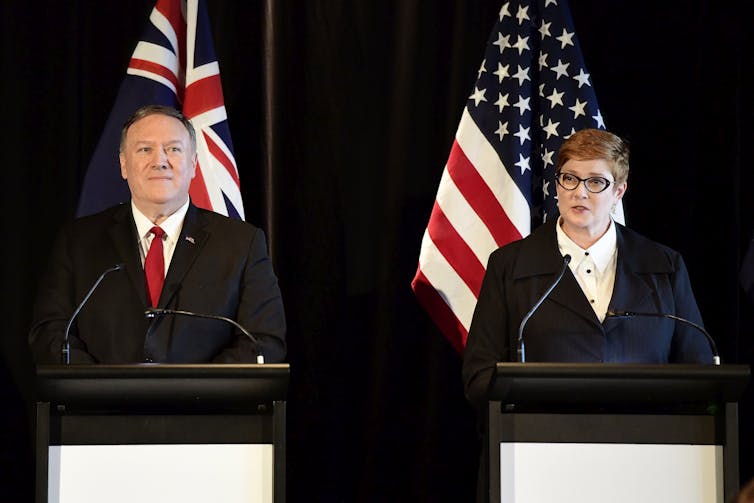 At the recent AUSMIN talks, US Secretary of State Mike Pompeo pushed for a harder-edged position on China.
AAP/Bianca de Marchi
At the recent AUSMIN talks, US Secretary of State Mike Pompeo pushed for a harder-edged position on China.
AAP/Bianca de Marchi
This was reflected in a ministerial communique that singled out Beijing for a range of provocative actions in what China regards as its sphere of influence.
The principals expressed serious concerns at continued militarisation of disputed features in the South China Sea. They strongly objected to coercive unilateral actions by any claimant state that could alter the status quo and increase tensions.
The communique went on at greater length about what Canberra and Washington perceive to be the unhelpful activities of China in its neighbourhood.
Historically, the 2019 AUSMIN session may well come to be regarded as an inflection point in Australian and US collaboration in dealing with threats posed to regional peace and stability by a rising China.
In the lead-up to AUSMIN, China had made its disappointment with Australia known in remarks by its foreign minister, Wang Yi, on the sidelines of an Association of South East Asian Nations forum in Bangkok in early August.
Payne had described a meeting with Wang as “productive”. Wang, on the other hand, said that “the process of improving our ties has not been satisfactory”.
In light of this, it’s likely relations have become even less satisfactory since the AUSMIN talks.
Hard on the heels of AUSMIN came the extraordinary intervention in the China debate by Liberal backbencher Andrew Hastie, who likened France’s failure to withstand Nazi Germany to the West’s inadequate responses to China’s rise.
Prime Minister Scott Morrison tried to brush aside Hastie’s provocative remarks by suggesting there was nothing new in what he had to say. This was disingenuous, given the circumstances.
In Beijing for trade talks at the time, Birmingham appealed to his colleagues to consider the “national interest” before indulging in the sort of intemperate observations that Hastie had committed himself to in a newspaper opinion piece.
None of this quietened a debate in Australia about managing relations with China. All sides of the debate are now engaged in what is arguably the most complex foreign policy dilemma in the history of the Federation.
Read more: Australia and China push the 'reset' button on an important relationship
Remarks made by Morrison in Hanoi on his way to the G7 summit in France will have further piqued Beijing’s displeasure. In response to questions at a press conference the prime minister appeared to align himself with Vietnam in its resistance to what is perceived to be China’s bullying of smaller states in the region.
Morrison did not directly identify China as the culprit but his remarks were clear.
It’s not about picking sides. It’s about ensuring each and every nation in this region can have confidence in its independence and sovereignty.
Vietnam and China are at loggerheads over disputed waters in the East China Sea. Sharpening these differences is the potential for oil and gas riches in waters off Vietnam.
Read more: Despite strong words, the US has few options left to reverse China's gains in the South China Sea
This brings us back to the case of Yang Hengjun.
If relations were in better working order, would Yang be in the same situation? This is a reasonable question without an immediate answer.
However, what would seem to be relevant are the cases of two Canadians detained last December and accused by Beijing of stealing state secrets. These are serious matters and, like Yang’s case, could involve the death penalty.
Michael Kovrig and Michael Spavor were detained following the arrest in Vancouver of Meng Wenzhou, the daughter of the founder of technology giant Huawei.
The US has been seeking Meng’s extradition to face charges of breaching sanctions against Iran.
US attempts to extradite Meng are making their way through the Canadian court system. Meanwhile, Kovrig and Spavor are hostages to a ruthless Chinese geopolitical power play.
In Yang’s case, Australia’s options are limited beyond pushing as hard as it can for his release. Now he has arrested for a serious crime, this will become more difficult.
The Yang episode may well prove a watershed moment in Australia-China relations against the background of gathering geopolitical tensions over trade and security.
Authors: Tony Walker, Adjunct Professor, School of Communications, La Trobe University


 Daily Bulletin


