

Athlete development must better support Indigenous and Pasifika players
- Written by: Sierra Keung, Kaiako - Sport & Recreation, Auckland University of Technology
For the past seven years, 70 of the 75 players who have been selected for New Zealand’s senior men’s rugby league team were of Māori or Pasifika heritage. About 42% of the National Rugby League’s player base is Pasifika.
The start of the inaugural Rugby League International Federation (RLIF) Oceania Cup last month further highlights the contribution Indigenous and Pasifika communities make to the game. The Oceania Cup allowed Māori and Pasifika players to showcase their footy skills and represent their cultural heritage on a global stage, outside of the world cup competition.
Given the continued contribution Indigenous and Pasifika communities make to the growth of rugby league in particular, we need to use processes and practices that resonate with the diverse player base.
Read more: It's time we moved the goalposts on Indigenous policies, so they reflect Indigenous values
Player development ignores culture
The Oceania Cup is a long overdue move. It reflects the impact of the decision several prominent Pasifika rugby league players made at the 2017 Rugby League World Cup to turn down the opportunity to represent a top-tier nation like New Zealand and Australia. Instead they chose to represent the country of their heritage. Since then, more Pasifika players have followed suit.
The pathway towards a professional sporting career is typically shaped by four key aspects: physical, technical, tactical and psychosocial. Despite the significant contribution of our Indigenous communities, existing talent development research fails to acknowledge cultural nuances that are critical to the preparation and performance of Māori or Pasifika athletes.
Research highlights the critical role the psychosocial aspect plays in facilitating longevity and success for a professional sportsperson. For many teenage Māori and Pasifika athletes, this can be more arduous than the physical aspect.
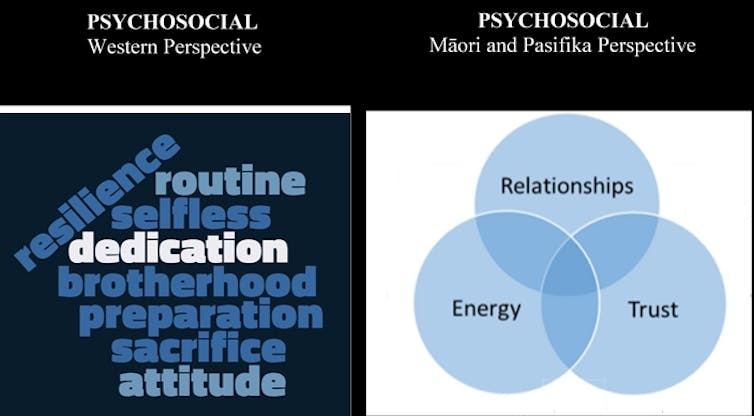
So far, the psychosocial aspect of talent development has been discussed from a Western perspective, which focuses on the achievements of the individual. In my research, I challenge this with an approach that more appropriately reflects the Māori and Pasifika talent of rugby league.
A significant finding was the importance and value of relationships with other people, including family and mentors. My research suggests that key relationships are those that are anchored by trust and create an energy that helps junior players to process mentally trying times they may experience during training. When viewed through a Māori and Pasifika lens, psychosocial training is (re)defined as the inter-connectedness of relationships, trust and energy.
 CC BY-ND
This relational foundation is missing when psychosocial development is viewed from a Western perspective. Elite athletes are aware of the fact failure is part of the process for success and growth. How one learns to cope with setbacks is dependent on an athlete’s psychosocial foundation, which they build as they move to a senior elite level.
A more appropriate approach would integrate practices throughout the talent development process to facilitate reciprocal relationships, based on trust. Relationships also include those of a spiritual nature. Faith or spirituality play a significant role in strengthening the overall health and well-being for Māori and Pasifika.
CC BY-ND
This relational foundation is missing when psychosocial development is viewed from a Western perspective. Elite athletes are aware of the fact failure is part of the process for success and growth. How one learns to cope with setbacks is dependent on an athlete’s psychosocial foundation, which they build as they move to a senior elite level.
A more appropriate approach would integrate practices throughout the talent development process to facilitate reciprocal relationships, based on trust. Relationships also include those of a spiritual nature. Faith or spirituality play a significant role in strengthening the overall health and well-being for Māori and Pasifika.
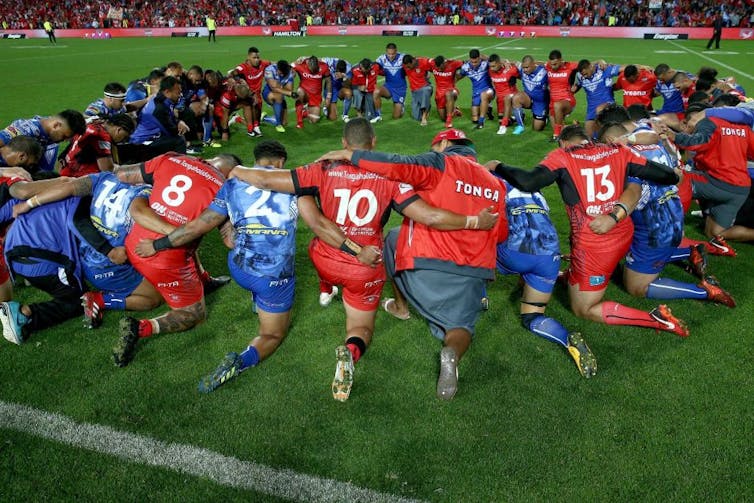 A prayer circle before a game between Toa Samoa and Mate Ma a Tonga.
Supplied, CC BY-ND
Faith and a belief in God were found to give athletes strength and perspective in dealing with adversity. As such, organisations may do well to offer time or space for athletes to meditate, read or listen to scripture, or simply express gratitude. This is a critical element of talent development that tends to be overlooked when supporting the performance of Māori and Pasifika athletes.
Read more:
Federal budget undermines Indigenous self-determination in sport programs
Value of relationships and trust
Professional sports, like other mainstream industries, are heavily dominated by a Eurocentric power structure and culture. Māori and Pasifika are expected to integrate into a system that does not typically reflect their cultural structure, values and beliefs.
Specialist support people and resources are typically made available in the professional sporting world to help athletes manage the demands of becoming a professional sportsperson. But we need to consider the value of relationships, trust and energy for Māori and Pasifika athletes to succeed in the high performance sport environment.
From a collective cultural perspective, success is measured by how well one takes care of those around them. Athletes are likely to progress better through the development process when they feel their support team (coaches, trainers, managers) takes care of them. For Māori and Pasifika athletes, this includes their family and the wider collective they represent.
The athlete may be the individual training and playing the game, but for Māori and Pasifika, their success is not their success alone.
A prayer circle before a game between Toa Samoa and Mate Ma a Tonga.
Supplied, CC BY-ND
Faith and a belief in God were found to give athletes strength and perspective in dealing with adversity. As such, organisations may do well to offer time or space for athletes to meditate, read or listen to scripture, or simply express gratitude. This is a critical element of talent development that tends to be overlooked when supporting the performance of Māori and Pasifika athletes.
Read more:
Federal budget undermines Indigenous self-determination in sport programs
Value of relationships and trust
Professional sports, like other mainstream industries, are heavily dominated by a Eurocentric power structure and culture. Māori and Pasifika are expected to integrate into a system that does not typically reflect their cultural structure, values and beliefs.
Specialist support people and resources are typically made available in the professional sporting world to help athletes manage the demands of becoming a professional sportsperson. But we need to consider the value of relationships, trust and energy for Māori and Pasifika athletes to succeed in the high performance sport environment.
From a collective cultural perspective, success is measured by how well one takes care of those around them. Athletes are likely to progress better through the development process when they feel their support team (coaches, trainers, managers) takes care of them. For Māori and Pasifika athletes, this includes their family and the wider collective they represent.
The athlete may be the individual training and playing the game, but for Māori and Pasifika, their success is not their success alone.
Authors: Sierra Keung, Kaiako - Sport & Recreation, Auckland University of Technology


 Daily Bulletin


