The pope, climate change and the cultural dimensions of the Anthropocene
- Written by: The Conversation
 Laudato Si': for some, a guide to personal values and morals in the Anthropocene. Max Rossi/Reuters
The ink is still drying on the Pope’s Encyclical Letter “Laudato Si’” or “On Care for Our Common Home,” and scholars, critics and pundits will analyze and assess it for years to come.
But one aspect of the letter becomes clear to anyone who reads it: it is impressively expansive, covering environmental science, economics, international politics, carbon credits, social equity, technology, consumerism, social media, theology, and much more. Getting to the root of our “ecological crisis,” Pope Francis calls for us to “promote a new way of thinking about human beings, life, society and our relationship with nature.” It’s a bold appeal to reevaluate our worldviews, values and spiritual beliefs.
But why now? The modern environmental movement has been with us for more than 50 years, leading to social movements, myriad legislation and lifestyle changes that reflect environmentalists’ modern focus on sustainability. Why does the pope’s encyclical on ecology resonate so much today?
I’d like to offer one thought on why this message is important at this point in human history. We are at a unique moment in our time on Earth as a species, one never faced before and one requiring a new system of ethics, values, beliefs, worldviews and above all, spirituality.
Geophysicists have given this moment a name; it is called the Anthropocene. The pope’s landmark encyclical provides a moral compass to help navigate this emerging era.
Changing view of humanity
The Anthropocene is a proposed new geologic epoch, one which leaves the Holocene behind and acknowledges that humans are now a primary operating element in the Earth’s ecosystems.
Though the concept has not yet received full, formal recognition by geophysical societies, it points out that we can no longer describe the environment without including the role that humans play in how it operates. This era is argued to have started around the industrial revolution of the early 1800s, and has become more acute since “the Great Acceleration” around 1950 onwards. It is marked by the reality that, according to Nobel-prize winning, atmospheric chemist Paul Crutzen who first proposed the term:
Human activity has transformed between a third and a half of the land surface of the planet; Many of the world’s major rivers have been dammed or diverted; Fertilizer plants produce more nitrogen than is fixed naturally by all terrestrial ecosystems; Humans use more than half of the world’s readily accessible freshwater runoff.
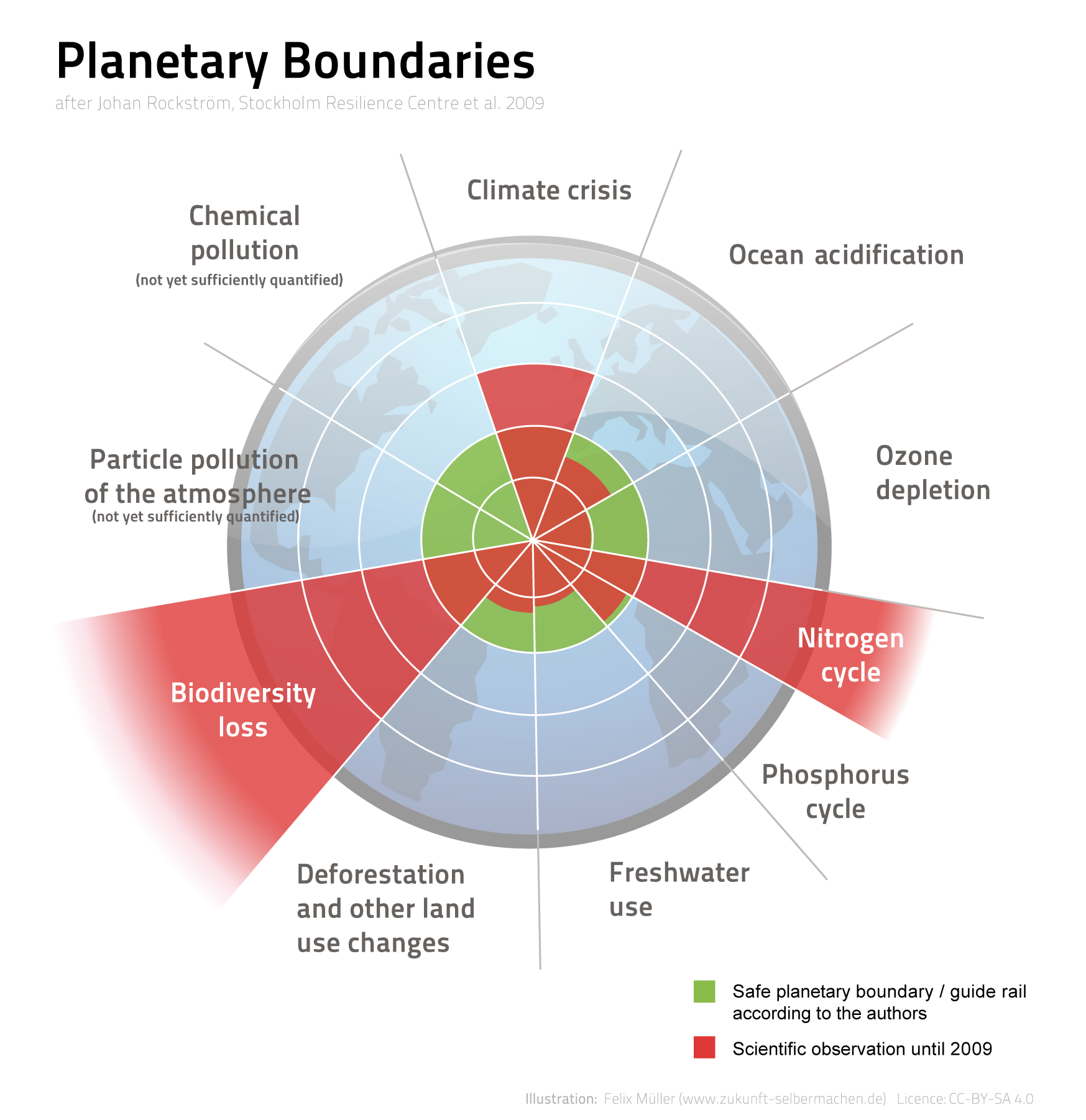
Though the pope singles out climate change in his encyclical letter, this is just one of a number of “planetary boundaries” that scientists say represent “thresholds below which humanity can safely operate and beyond which the stability of planetary-scale systems cannot be relied upon.”
 Climate change is one of nine planetary boundaries.Felix Mueller, CC BY
In terms of science, acknowledging an unprecedented shift in our geophysical reality would be a significant and unprecedented moment in history. But, the social and cultural shift is even more profound.
Consider the central cultural question of climate change: Do you believe that we, as a species, have grown to such numbers and our technology to such power that we can alter the global climate?
If you answer this question in the affirmative, then a series of related cultural challenges emerge. Climate change represents a deep shift in the way we view ourselves, each other, the environment and our place within it. Addressing this problem will require the most complicated and intrusive global agreement ever negotiated. It will also require a shift in our sense of global ethics around collective responsibility and social equity.
The fossil fuels burned in Ann Arbor, Shanghai, or Moscow have an equal impact on the global environment we all share. The kind of cooperation necessary to solve this problem is far beyond anything that we, as a species, have ever accomplished before. International treaties to ban land mines or eliminate ozone-depleting substances pale in comparison.
Climate as proxy for Anthropocene
Recognition of the Anthropocene signals an urgency and complexity that the general idea of sustainable development lacks, compelling change deep within the structures of our collective understanding of the world around us.
According to geographer and political philosopher Rory Rowan,
The Anthropocene is not a problem for which there can be a solution. Rather, it names an emergent set of geo-social conditions that already fundamentally structure the horizon of human existence. It is thus not a new factor that can be accommodated within existing conceptual frameworks, including those within which policy is developed, but signals a profound shift in the human relation to the planet that questions the very foundations of these frameworks themselves.
Droughts, wildfires, food insecurity, water scarcity, and the social unrest that results are all emergent markers of the Anthropocene Era that point to a fundamental system failure created by our social structures. We now have control over the biosphere and therefore, the human systems which depend on it, in ways that are monumental.
A response to the Anthropocene Era calls for a new set of values and beliefs about our relationship with the environment, with each other and for many, with God. And this is what the pope’s encyclical letter is trying to articulate.
This will not go down easily. The accompanying tensions that such a shift will create can be vividly observed in the currently polarized debate over climate change. The cultural and ideological elements of religion, government, ideology and worldviews that animate the climate change debate offer a glimpse into the cultural dimensions of recognition of the Anthropocene.
New ethics and values required
In the end, the Anthropocene challenges our ways of understanding the environment and how they change on both regional and global scales. It leads to a transformative cultural shift that is akin to the Enlightenment of the 17th and 18th centuries.
The Enlightenment was built on a cultural shift from perceiving nature as subsuming the human endeavor, to one in which humankind embarked on the “conquest of nature” and a metaphor of the planet as an enemy to be subdued.
In similar ways, the Anthropocene is an acknowledgment that the scientific method essential to the Enlightenment is no longer fully adequate to understand the natural world and our impact upon it. As the pope points out:
“Given the complexity of the ecological crisis and its multiple causes, we need to realize that the solutions will not emerge from just one way of interpreting and transforming reality…If we are truly concerned to develop an ecology capable of remedying the damage we have done, no branch of the sciences and no form of wisdom can be left out, and that includes religion and the language particular to it.
In responding to the “urgent challenge to protect our common home,” he asks us “to bring the whole human family together to seek a sustainable and integral development.”
Indeed, this kind of global common cause is a challenge we have not yet faced as a species. It will require a level of cooperation that we are not prepared for, and that requires a global set of ethics and values we do not yet know.
Many have compared Pope Francis’ letter to the 1891 Encyclical Letter “Rerum Novarum” or “Rights and Duties of Capital and Labor,” in which Pope Leo XIII addressed the condition of the working classes. In offering a way to understand the unprecedented confusion of clashing capitalist and communist notions of labor in the midst of the industrial revolution, Rerum Novarum has become a foundational document for Catholic social teaching.
Will Laudito Si’ offer a similarly transformative way to understand the unprecedented confusion over global scale environmental and social changes that we are creating?
The answer to that question is not solely a testament to the Encyclical Letter’s importance; it will be a testament to our ability to hear a message that is hard to hear, and harder still to act upon. As paleontologist and science writer Stephen Jay Gould wrote in 1985:
We have become, by the power of a glorious evolutionary accident called intelligence, the stewards of life’s continuity on earth. We did not ask for this role, but we cannot abjure it. We may not be suited to it, but here we are.
Pope Francis is asking us to face this new reality with respect for the natural world around us and a humility to recognize our limitations in understanding how it works and what we are doing to it. He is asking it at a key moment in time when we are taking a new place in the natural world; what he is careful to call “creation” a term that connotes far more spiritual importance.
To read more on the papal encyclical, see:
-Pope encyclical on ‘ecological crisis’ asks us to examine our deepest values and beliefs
Authors: The Conversation


 Daily Bulletin