

Report finds every $1 Australia spends on preschool will return $2, but this won't just magically happen
- Written by: Jen Jackson, Education Policy Lead, Mitchell Institute, Victoria University
A report released last week showed quality preschool would deliver a two-for-one return on investment for Australia: that is, for every dollar governments invest in preschool, two dollars will be returned to the economy.
Commissioned by early childhood research organisation the Front Project, and conducted by data analysts PwC, the analysis looked at the impact of Australia’s current system, which provides 15 hours a week of early childhood education in the year before school.
The report is the first comprehensive Australian analysis of the economic impact of early childhood education. It adds a uniquely Australian perspective to the international evidence base about the benefits of investing in preschool.
Research on return on investment in early learning became prominent in the mid-2000s, and drove a global reform agenda to invest more in early childhood education and care. US economist James Heckman has since famously found high-quality support for early learning can deliver US$13 for every dollar spent over a lifetime.
But the promised returns on investment in preschool won’t just happen. They depend on a complex chain of events, from preschool through to adulthood, involving the child and their family.
The chain of events
Here’s what needs to happen for an Australian child, and the Australian economy, to reap the two-for-one return.
First, the child must have access to a preschool in their local area, and a family willing and able to enrol them. Their family must also be able to transport them to and from the preschool each day.
The economic benefits increase if the adults in the family decide to increase their hours of paid work while the child attends preschool. This depends on meaningful work being available for parents, which would fit with the availability of the preschool program.
Second, the preschool must be of high-enough quality to make a difference to the child’s learning and development. International studies emphasise benefits are most likely to be delivered by quality preschools – low-quality preschools will not have the same impact.
Read more: Both major parties are finally talking about the importance of preschool – here's why it matters
Quality preschools run play-based learning programs in which children are encouraged to discover and explore. These play experiences provide opportunities for children to develop essential skills such as co-operation, concentration, problem-solving and self-control.
Quality standards for Australian preschools are set out in the National Quality Standard.
Third, if the preschool gets the child off to a good start, then the school system must also be of sufficient quality to sustain the gains in their learning. This is easiest if the child lives in a family where there is strong support for learning, but harder to sustain when home support is limited.
Fourth, if the child can sustain their learning advantage, the next set of economic benefits are delivered through their participation in tertiary education. To realise this benefit, there needs to be a place for them in university, or in quality vocational education and training.
And finally, the full set of economic benefits are delivered when that child (now a young adult) takes their tertiary qualification into the labour market. For these benefits to be realised, there needs to be a healthy supply of jobs for tertiary graduates for which the young adult is well-prepared.
Read more: Jobs are changing, and fast. Here's what the VET sector (and employers) need to do to keep up
Strengthening the chain in Australia
Every weak link in this chain reduces the overall economic gains. A quick scan of the Australian policy environment shows some clear opportunities for the chain to be strengthened.
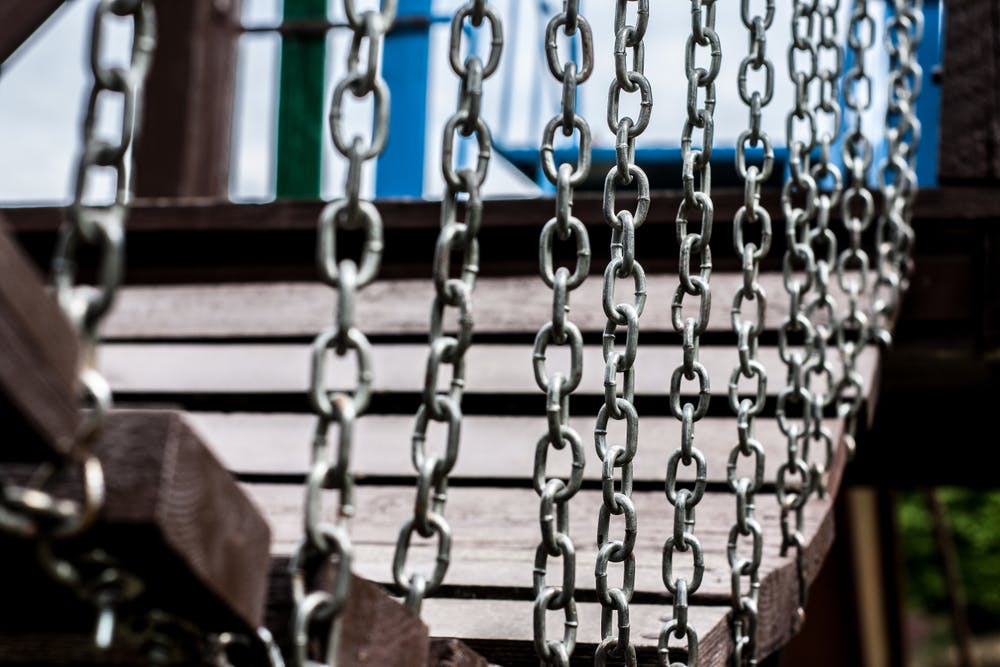 Any weak link in the chain threatens the opportunity for a full return on investment.
from shutterstock.com
Any weak link in the chain threatens the opportunity for a full return on investment.
from shutterstock.com
National funding for access to preschool in the year before school continues to be agreed year-by-year, rather than as a sustained commitment. So the very first link in the chain is loose. Despite major gains in participation, around 10% of Australian children still don’t attend preschool.
Of the early childhood services that provide preschool, 7% of stand-alone preschools and 21% of long day care services don’t yet meet the National Quality Standard.
Lower-quality early childhood services are disproportionately located in poorer communities, where they are needed the most.
Australia’s schools deliver unequal benefits for learners from different backgrounds. The widening gap between wealthier and poorer children suggests schools aren’t sufficiently equipped to support children who need extra support to sustain their learning.
Overall participation rates in tertiary education are projected to decline under current policy settings. If we produce more great learners at earlier stages of learning, there need to be tertiary places for them.
Lastly, Australia’s labour market is facing significant challenges in providing meaningful full-time work for young people, even those with a tertiary qualification. The costs of youth unemployment are significant, and mean the potential economic benefits of their education are squandered.
It’s about more than dollars
Even with weak links in the chain, investment in preschool can still deliver returns. The Front Project report tests a number of versions of its economic modelling and finds preschool is still a worthwhile investment, even under less optimistic scenarios about its long-term effects.
Investment in early learning is not just about economic returns. At the centre of each scenario is a child who has a right to receive support from the government to help them learn and thrive.
Read more: Three things Australia's next education minister must prioritise to improve schools
The UN Convention on the Rights of the Child, which Australia ratified in 1990, recognises children’s right to education, and the UN Sustainable Development Goals recognise the importance of quality early childhood education and care in delivering that right to all children.
Governments willingly invest in school education, recognising the right to education means they have an obligation to their youngest citizens. Yet government investment in early childhood education in Australia still seems to depend heavily on economic arguments.
While these arguments may be important for engaging policy-makers with their eye on the budget, there are other compelling reasons to provide Australian children with quality early learning.
Authors: Jen Jackson, Education Policy Lead, Mitchell Institute, Victoria University


 Daily Bulletin


