

We create 20m tons of construction industry waste each year. Here's how to stop it going to landfill
- Written by: Salman Shooshtarian, Research Fellow, RMIT University
The Australian construction industry has grown significantly in the past two decades. Population growth has led to the need for extensive property development, better public transport and improved infrastructure. This means there has been a substantial increase in waste produced by construction and demolition.
In 2017, the industry generated 20.4 million tons (or megatonnes, MT) of waste from construction and demolition, such as for road and rail maintenance and land excavation. Typically, the waste from these activities include bricks, concrete, metal, timber, plasterboard, asphalt, rock and soil.
Between 2016 and 2017, more than 6.7MT of this waste went into landfills across Australia. The rest is either recycled, illegally dumped, reused, reprocessed or stockpiled.
But with high social, economic and environmental costs, sending waste to landfill is the worst strategy to manage this waste.
Read more: With the right tools, we can mine cities
What’s more, China introduced its “National Sword Policy” and restricted waste imports, banning certain foreign waste materials and setting stricter limits on contamination. So Australia’s need for solutions to landfill waste has become urgent.
China has long been the main end-market for recycling materials from Australia and other countries. In 2016 alone, China imported US$18 billion worth of recyclables.
Their new policy has mixed meanings for Australia’s waste and resource recovery industry. While it has closed China’s market to some of our waste, it encourages the development of an Australian domestic market for salvaged and recycled waste.
But there are several issues standing in the way of effective management of Australia’s construction and demolition waste.
Read more: A crisis too big to waste: China's recycling ban calls for a long-term rethink in Australia
The producers should take more responsibility
In Australia, the main strategy to reduce the waste sent to landfill is the use of levies. But the effectiveness of levies has been questioned in recent years by experts who argue for smarter strategies to manage waste from construction and demolition. They say that imposing a landfill levy has not achieved the intended goals, such as a reduction in waste disposal or an increase in waste recovery activities.
One effective strategy Australia should expand is extended producer responsibility (EPR).
The idea originated in Germany in 1991 as a result of a landfill shortage. At the time, packaging made up 30% by weight and 50% by volume of Germany’s total municipal waste stream.
To slow down the filling of landfills, Germany introduced “the German Packaging Ordinance”. This law made manufacturers responsible for their own packaging waste. They either had to take back their packaging from consumers and distributors or pay the national packaging waste management organisation to collect it.
Australia has no specific EPR-driven legal instrument for the construction and demolition waste stream, nor any nationally adopted EPR regulations.
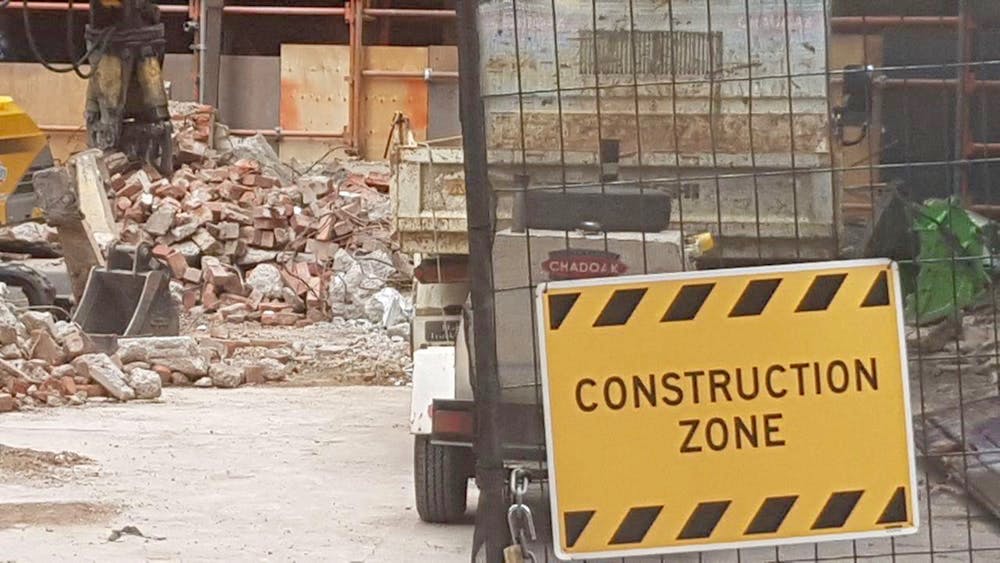 Waste piled at a demolition site at Little A'Beckett Street in Melbourne in April 2019.
Salman Shooshtarian, Author provided
Waste piled at a demolition site at Little A'Beckett Street in Melbourne in April 2019.
Salman Shooshtarian, Author provided
But some largely voluntary approaches have had an impact. These include the national Product Stewardship Act 2011, New South Wales’ Extended Producer Responsibility Priority Statement 2010 and Western Australia’s 2008 Policy Statement on Extended Producer Responsibility.
These schemes have provided an impetus for industry engagement in national integrated management of some types of waste, such as e-waste, oil, batteries and fluorescent lights. Voluntary industry programs also cover materials such as PVC, gypsum, waffle pod and carpet.
Read more: Indonesia has sent Australia's recycling home – it's time to clean up our act
For instance, since 2002, the Vinyl Council of Australia has voluntarily agreed to apply EPR principles. Armstrong Australia, the world’s largest manufacturer of resilient PVC flooring products, collects the offcuts and end-of-life flooring materials for recycling and processing into a new product. These materials would otherwise have been sent to landfill.
In another example, CSR Gyprock uses a take-back scheme to collect offcuts and demolition materials. After installation, the fixing contractor arranges collection with CSR Gyprock’s recycling contractor who charges the builder a reasonable fee.
Connecting industries
But extending producer responsibility in a sustainable way comes with a few challenges.
Everyone in the supply chain should be included: those who produce and supply materials, those involved in construction and demolition, and those who recover, recycle and dispose of waste.
The goal of our work is to connect organisations and industries across the country so waste can be traded instead of sent to landfill.
Read more: The 20th century saw a 23-fold increase in natural resources used for building
But the lack of an efficient supply chain system can discourage stakeholders from taking part in such schemes. An inefficient supply chain increases the costs associated with labour and admin staff at construction sites, transport, storage, separation of waste and insurance premiums.
All of these are not only seen as a financial burden but also add complexities to an already complicated system.
Australia needs a system with a balanced involvement of producers, consumers and delivery services to extend producer responsibility.
How can research and development help?
In our research, we’re seeking to develop a national economic approach to deal with the barriers preventing the effective management of construction and demolition waste in Australia, such as implementing an extended producer responsibility.
And a project aimed to find ways to integrate supply chain systems in the construction and demolition waste and resource recovery industry is supporting our efforts.
The goal is to ensure well-established connections between all parts in the construction supply chain. A more seamless system will boost markets for these materials, making waste recovery more economically viable. And that in turn will benefit society, economy and the environment.
Authors: Salman Shooshtarian, Research Fellow, RMIT University


 Daily Bulletin


